
Published: July 29, 2026. Last updated: July 29, 2026.
Quick answer
Aluminium composite panel (ACP) is the default substrate for shopfront boards, building fascias, and outdoor signage in India, and a UV flatbed printer lets you print full colour directly onto that panel in one pass instead of printing vinyl and laminating it. Direct UV printing on ACP removes the print, laminate, and mounting steps, cuts labour and material waste, and produces a scratch and weather resistant board because the ink is cured hard onto the surface by ultraviolet light. For a sign shop, the practical decision is not whether ACP signage will sell (retail and construction demand is rising every year), but whether you own the printer that lets you keep that work in house at a healthy margin instead of buying finished boards from a competitor.
Why signage demand in India keeps climbing
Signage demand is rising because retail, real estate, and infrastructure are all expanding at once, and every new store, office, clinic, and site needs boards. India’s retail market reached about ₹94 lakh crore (roughly USD 1,124.2 billion) in 2025 and is projected to grow at a compound annual rate of 12.8 percent through 2034, according to IMARC Group’s India retail market report. More stores means more storefronts to brand.
The signage layer of that growth is expanding even faster. The India digital signage market, per IMARC Group, was valued at USD 940.5 million in 2024 and is forecast to reach USD 3,415.0 million by 2033, a compound annual growth rate of 14.25 percent. Printed signage on rigid boards rides the same wave of new commercial space.
The board itself is a growing market too. Grand View Research reports that India’s aluminium composite panel market generated USD 221.5 million in 2024 and is expected to reach USD 394.4 million by 2030, a compound annual rate of 10.1 percent, driven by construction and urbanisation. ACP is the material that demand flows through.
What this means for sign shops and small print businesses
The pressure point for most small sign shops is that the demand is there, but the margin leaks out to whoever owns the printing. If you print your design onto vinyl, laminate it, and paste it onto a bought panel, you carry three consumables, extra labour hours, and the risk of bubbles and peeling that force a reprint.
The buyers of that work are the founders and owners of India’s small and medium businesses, the segment that the Ministry of Micro, Small and Medium Enterprises reports contributes about 30.1 percent of national GDP and 35.4 percent of manufacturing output (see the Ministry of MSME release via PIB). These owners want fast turnaround, a durable board, and one supplier who can do it all. A shop that outsources printing cannot promise any of those reliably.
Every job you send out to a larger printer is margin and control handed to a competitor. When same day and next day signage is the expectation, the shop that cannot produce a finished ACP board in house loses both the price and the relationship.
How UV printing on ACP actually works
UV printing lays liquid ink directly onto the panel and then flashes it solid with ultraviolet light in the same pass. The process uses inkjet printing heads to jet the colour, and UV curing to harden it instantly, so the ink bonds to the surface rather than soaking or smearing.
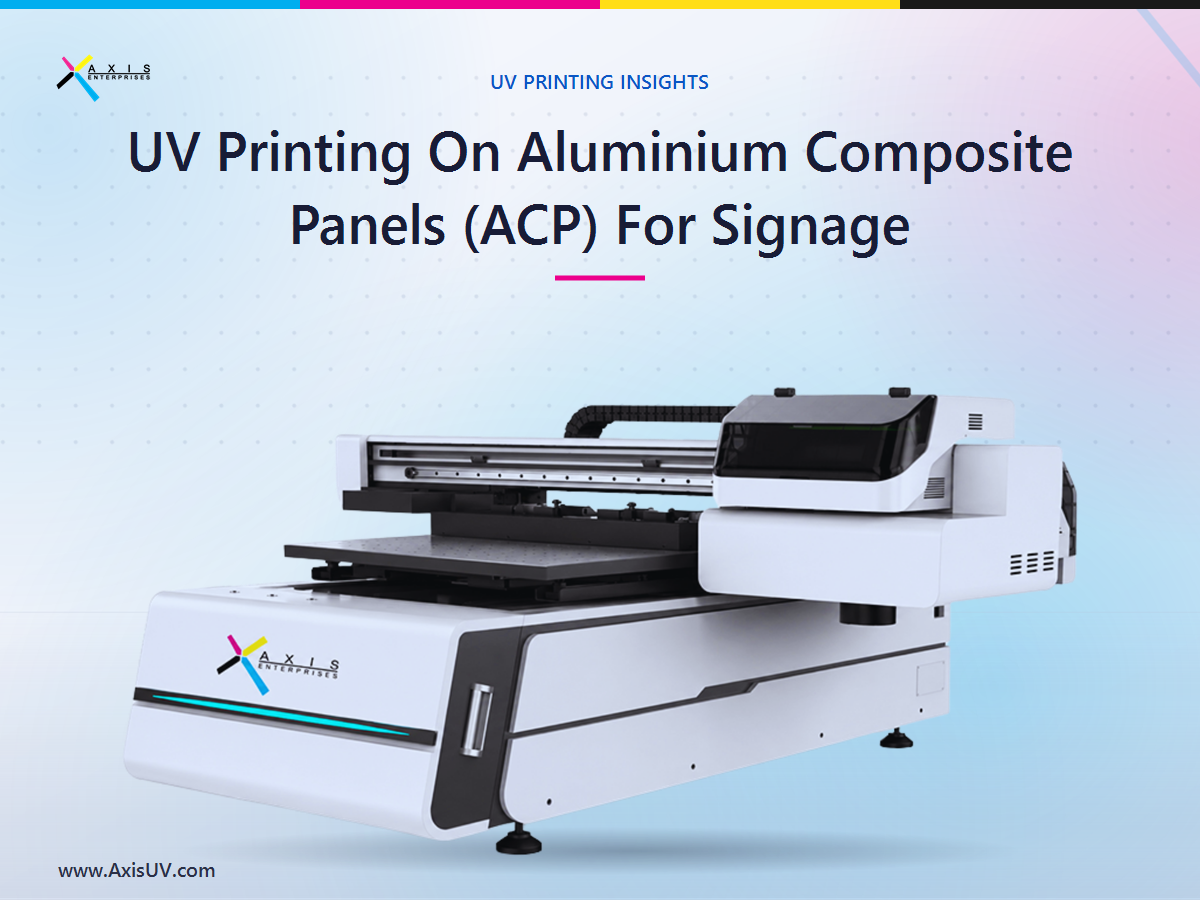
An aluminium composite panel is two thin aluminium skins bonded to a plastic core, and it is widely used across the signage industry as a lighter, cheaper alternative to solid metal. A UV flatbed printer holds that rigid sheet flat and prints straight onto it, which is why ACP and UV printing pair so naturally.
The difference from the old method is the number of steps. Direct UV printing collapses print, laminate, and mount into a single production run, and it can lay down white ink and clear varnish for opaque colour and gloss or matte finish. The table below shows the contrast.
The real economics: where ACP signage margin is won or lost
Margin on ACP signage is decided by total cost of ownership, not by the sticker price of the machine. The honest way to compare printers is on total cost of ownership, which folds in ink consumption, print head life, maintenance, downtime, and power, not just the purchase figure.
Tax is part of that maths. Printing machinery in India sits under HSN code 8443 and attracts 18 percent Goods and Services Tax, as summarised in Aditya Birla Capital’s HSN and GST guide. A registered business can usually claim that GST as input tax credit, so the real cost of the machine is often the price before tax, a point many first time buyers miss.
Running cost favours modern curing. UV LED curing lowers press power consumption by roughly 60 to 65 percent versus older mercury lamps while removing lamp replacement and mercury handling, notes the Mordor Intelligence UV cured printing inks report, which also values the global UV ink market at USD 1.75 billion in 2025 with Asia Pacific holding the largest share. Lower power and fewer consumables per board is where a signage shop protects its margin.
What smart buyers should look for in a UV printer for ACP
The right printer for ACP signage is a flatbed with the bed size, ink set, and support to run rigid panels all day. Judge any machine against a short, objective checklist rather than headline price.
- Flatbed bed size that fits standard panels. ACP sheets come in large formats, so a bed that accepts your common sheet sizes avoids wasted material and tiling.
- White ink and varnish channels. White ink gives opaque, vivid colour on coloured or brushed panels, and varnish adds gloss, matte, or a raised texture that commands premium pricing.
- Strong adhesion and primer support. ACP surfaces vary, so the ability to prepare or prime the panel is what prevents scratch off and reprints.
- UV LED curing. Lower power draw, no mercury lamp swaps, and instant cure, which together cut running cost and downtime.
- Reliable colour management. Good RIP software and calibration keep brand colours consistent across repeat orders for the same client.
- Local service, spares, and training. A printer is a production asset, so nearby support and fast spare parts decide how much money downtime costs you.
A better way forward
Once those criteria are clear, the buying decision becomes about matching a proven flatbed to your panel sizes and your service expectations, which is exactly the conversation Axis Enterprises at uvprinterindia.com is set up to have. The focus is on helping sign and print shops bring ACP and rigid board printing in house at a cost that the numbers actually support.
Rather than sell you the largest machine, the aim is to fit the right UV flatbed to the work you already turn away, so you can quote the whole job. You can compare UV flatbed printers for signage, ask about white ink and varnish options, and get an honest total cost of ownership estimate before you commit. If you are weighing an upgrade, it helps to talk through your panel sizes and monthly volumes first.
Frequently asked questions
Can a UV printer print directly on aluminium composite panel? Yes. A UV flatbed printer holds the rigid ACP sheet flat and jets ink straight onto the surface, curing it instantly with ultraviolet light, so no vinyl or lamination is needed for most signage work.
Is direct UV printing on ACP more durable than printed vinyl? Generally yes. The ink is cured hard onto the panel rather than sitting under a laminate film, which reduces peeling and edge lift, though surface preparation and primer still matter for long term adhesion outdoors.
What GST applies when I buy a UV printing machine in India? UV printing machines fall under HSN code 8443 and attract 18 percent GST. A GST registered business can typically claim this as input tax credit, which lowers the effective cost of the machine.
Do I need white ink for ACP signage? For coloured, brushed, or dark panels, yes, because white ink lays down an opaque base so the colours stay bright. On plain white ACP you can often print without it, but white ink widens the range of jobs you can accept.
Why is UV LED curing worth paying for? UV LED curing uses far less power than older mercury lamps, removes lamp replacement and mercury handling, and cures instantly, which lowers your running cost per board and reduces downtime.
Next step
If ACP signage is work you keep sending out, the fastest way to change that is to price the machine against the jobs you already lose. Book a free UV Printing Machine Buying Consultation at uvprinterindia.com, share your typical panel sizes and monthly volume, and get a clear, GST aware total cost of ownership picture so you can decide with numbers rather than guesswork.
Sources
- IMARC Group, India Retail Market Size, Share and Industry Report
- IMARC Group, India Digital Signage Market Size and Forecast
- Grand View Research, India Aluminum Composite Panels Market Size and Outlook
- Press Information Bureau, Ministry of MSME, MSME contribution to GDP, manufacturing and exports
- Mordor Intelligence, UV Cured Printing Inks Market Size and Share Analysis
- Aditya Birla Capital, GST Rates and HSN Code for Printing Machinery