

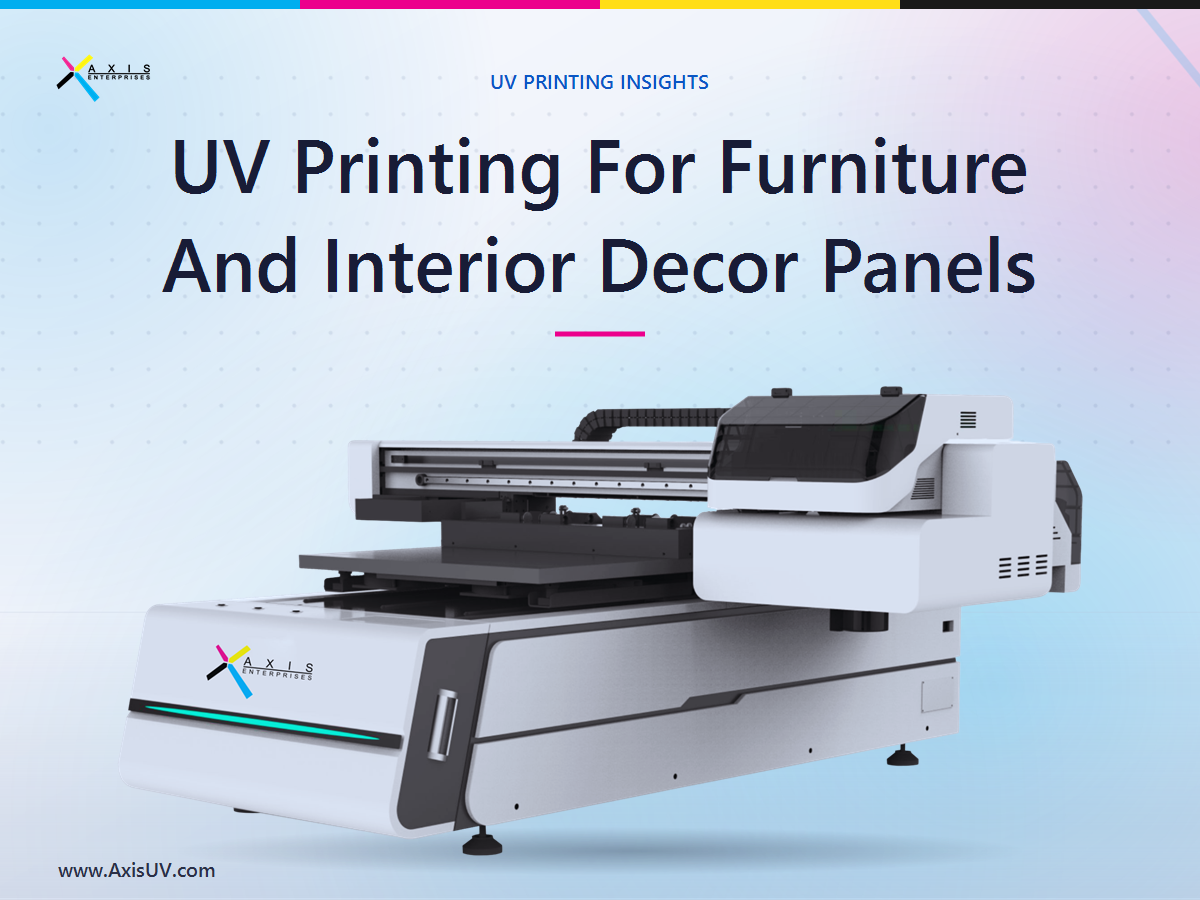
Published: August 9, 2026. Last updated: August 9, 2026.
Quick answer: can you really print custom designs directly on furniture and decor panels?
Yes. A flatbed UV printer prints full-color images, wood-grain patterns, textures, and branding directly onto rigid panels such as MDF, plywood, acrylic, glass, laminate, and metal, then cures the ink instantly with UV light so it is dry and handle-ready in seconds. This lets furniture makers, modular kitchen firms, and interior fit-out contractors produce customized panels in-house instead of outsourcing decorative surfaces. The finish resists scratching and moisture, needs no lamination for most indoor uses, and can carry raised textures and gloss effects. For Indian workshops, it turns decor personalization into an owned, repeatable, profit-generating process.
Why furniture and interior firms are quietly losing margin
Demand for decorated interiors has never been higher, yet most of the value is leaking out the back door to outside vendors. That is the real problem.
The India furniture market was worth USD 27.23 billion in 2024 and is on track to reach USD 44.30 billion by 2034, according to IMARC Group. The higher-margin slice, modular furniture, grew to USD 3.71 billion in 2024 and is forecast to more than double by 2033, IMARC Group reports.
Buyers increasingly want these surfaces personalized. Deloitte Digital found that one in five consumers will pay up to a 20% premium for a product they can personalize, and that shoppers who value personalization tend to spend more with brands that offer it.
When a workshop sends its decorative panels out to a job printer, it gives away that premium, waits on someone else’s schedule, and loses control of quality. Over a year, that is lakhs of rupees in margin handed to a vendor.
What UV printing on panels actually is
UV printing is a digital process that jets ink onto a surface and hardens it immediately using ultraviolet light, a reaction called UV curing. Because the ink cures on contact instead of soaking in or air-drying, it sits crisply on top of hard, non-absorbent materials that older methods struggle with.
The print engine itself is a form of inkjet printing, but on a flatbed the material stays still while the printhead moves across it. That is why a single machine can print on a sheet of medium-density fibreboard (MDF) in the morning and a glass shutter in the afternoon.
For anyone working in interior design and fit-outs, this matters: wardrobe shutters, headboards, wall panels, table tops, cabinet fronts, and partition glass can all carry custom art, marble and wood-grain effects, or a client’s branding, produced on demand.
What this means for furniture makers, panel manufacturers, and fit-out firms
If you build or install interiors, the pain is specific, not abstract. You are competing on price for undifferentiated panels while the customized work that commands better rates sits with a third party.
This is a small-business story as much as an industry one. India’s MSME sector now accounts for 30.1% of GDP and 35.4% of manufacturing output, the Press Information Bureau reported in 2025, citing the Union Minister for MSME. Thousands of these enterprises are exactly the furniture units, signage shops, and interior contractors who currently outsource decoration.
The tooling is getting cheaper to justify, too. India’s broader digital printing market reached USD 1.4 billion in 2024 and is projected to hit USD 2.9 billion by 2033, per IMARC Group, a sign that in-house digital decoration is moving from novelty to norm.
Common buyer-specific pains that in-house UV printing removes:
- Outsourcing dependency: no more waiting on a vendor’s queue for a single client’s wardrobe shutter.
- Minimum order quantities: print one custom panel as profitably as one hundred.
- Sampling delays: produce a design proof for a client in minutes, not days.
- Thin, look-alike catalogues: offer bespoke finishes competitors cannot match locally.
What smart buyers should look for in a UV printer for furniture work
Not every UV printer suits panel and decor production. Reset your buying criteria around what furniture and interior work actually demands, rather than headline price alone.
Use this checklist when you evaluate any machine:
- Bed size for real panels: a flatbed that accepts shutter and cabinet-front dimensions, not just A3 novelty items.
- White ink and varnish: essential for printing on dark or transparent surfaces and for raised, textured, and gloss decor effects.
- Adhesion and primer support: guidance and primers for glass, metal, and coated laminates so prints do not peel.
- Scratch and moisture resistance: a cured film tough enough for furniture that gets touched, cleaned, and moved.
- Throughput that matches your orders: a print speed aligned to your daily panel volume so the machine pays for itself.
- Local service, spares, and training: fast on-site support and operator training, because downtime on a production floor is lost revenue.
- Honest total cost of ownership: ink, maintenance, and Goods and Services Tax (India) and landed cost included, not just the sticker figure.
How UV printing compares to the usual ways of decorating panels
Here is a plain comparison of the main options a furniture or interior business weighs.
A better way forward
Once the criteria are clear, the logical move is to bring decorative panel printing in-house on a UV flatbed sized for furniture work. That is exactly what we help Indian businesses do at Axis Enterprises. We supply UV printing machines for furniture, modular interiors, signage, and product decoration, matched to your material mix and production volume, and backed by service and training.
If you are weighing the switch, the honest first step is to see the output on your own materials. You can request a sample print on your own panel material, or explore UV flatbed printers built for furniture and panel work to understand bed sizes, white ink, and finishing options. If volume is your main question, our team can help you match a UV printer to your production volume before you commit a rupee.
Next step
If your workshop still sends decorative panels to an outside printer, you are funding someone else’s margin on work you could own. The lowest-risk way to test the numbers for your own shop is a short, no-pressure conversation about your materials, order sizes, and goals. You can book a free UV printing machine buying consultation with the team at Axis Enterprises and get a clear, GST-aware view of costs and payback before you decide anything.
Frequently asked questions
Can a UV printer print directly on wood and MDF?
Yes. A flatbed UV printer prints full-color designs, including wood-grain and marble effects, directly onto wood, MDF, and plywood. The ink cures instantly on the surface, so panels are ready to handle right away, usually without lamination for indoor furniture.
Is UV printing on furniture durable and scratch resistant?
UV-cured prints form a hard film that resists everyday scratching, cleaning, and moisture, which suits furniture and interior surfaces. For high-wear areas such as flooring or heavily handled tops, a protective varnish or clear coat adds extra durability.
Can you print on laminate, glass, and acrylic panels for interiors?
Yes. UV printing works on laminate, glass, acrylic, and metal when the right primer and white-ink settings are used. White ink lays down an opaque base so colors stay vivid on dark or transparent surfaces like glass shutters and partitions.
Does in-house UV printing make sense for a small furniture business?
It often does. Printing one custom panel is as economical as printing many, so even small workshops can offer bespoke finishes and capture the personalization premium instead of outsourcing it. The right machine size depends on your panel dimensions and monthly volume.
Do UV-printed panels need lamination?
For most indoor furniture and decor, no. The cured ink is already tough and bonded to the surface. Lamination or varnish is optional and mainly used for extreme-wear applications or a specific matte or gloss look.
Sources
- IMARC Group, India Furniture Market Size, Growth and Analysis
- IMARC Group, India Modular Furniture Market Size and Industry Report
- IMARC Group, India Digital Printing Market Size and Industry Growth
- Press Information Bureau, Government of India, MSME contribution to GDP, manufacturing and exports
- Deloitte Digital, Personalizing Brand Experiences research
- India Brand Equity Foundation (IBEF), Growth and Opportunities in India’s Home Decor Industry