
Published: October 6, 2026
Quick answer: UV flatbed or flexographic printing?
Choose flexographic printing when you run the same label or flexible-packaging design in very high volumes (tens of thousands of impressions per job) on roll-fed material, because the cost per print keeps falling the longer the run goes. Choose UV flatbed printing when your work is short-run, personalized, multi-substrate, or made of rigid items (signage, gift products, panels, cases, boxes, promotional goods), because there are no printing plates, almost no setup, and you can print one piece profitably.
Most Indian SMBs are not choosing between two ways to do the same job. They are choosing which jobs they can take at all. Flexo wins long runs of a fixed design. UV flatbed wins variety, speed-to-first-print, and the ability to say yes to small and custom orders.
Why the printing market is moving toward digital and UV
The direction of spend is clear: digital is the fastest-growing part of package printing, even though it is still a small slice of total volume. According to Smithers, a packaging-print research firm, digital packaging output is growing at a 12.8% CAGR and reached 3.9% of market value in 2024 while sitting at just 1.1% of volume. That gap between value and volume is where the margin lives: digital work is low-volume, high-value, personalized work.
The flexo market itself is healthy but slower. Market analysis firm Mordor Intelligence values the global flexographic printing market at USD 19.80 billion in 2025, growing at 5.76% to USD 27.71 billion by 2031. Inside that same flexo market, UV-curable inks are expanding faster than the whole, at 8.28% a year.
UV printing as a category is compounding faster still. Mordor Intelligence puts the UV printer market at USD 1.02 billion in 2025, reaching USD 1.58 billion by 2031 at a 7.59% CAGR, with packaging and labels the fastest-growing application segment at 8.12%. The takeaway is not that flexo is dying. It is that the growth, and the premium work, is shifting toward short-run, variable, multi-material printing.
What is flexographic printing, and what is UV flatbed printing?
Flexography is a high-speed relief process: a flexible rubber or polymer plate carries the raised image, an anilox roll meters ink onto it, and the plate presses ink onto a moving web of film, foil, or paper. Every design needs its own set of plates, and the press needs setup and registration before good copies start coming off the roll.
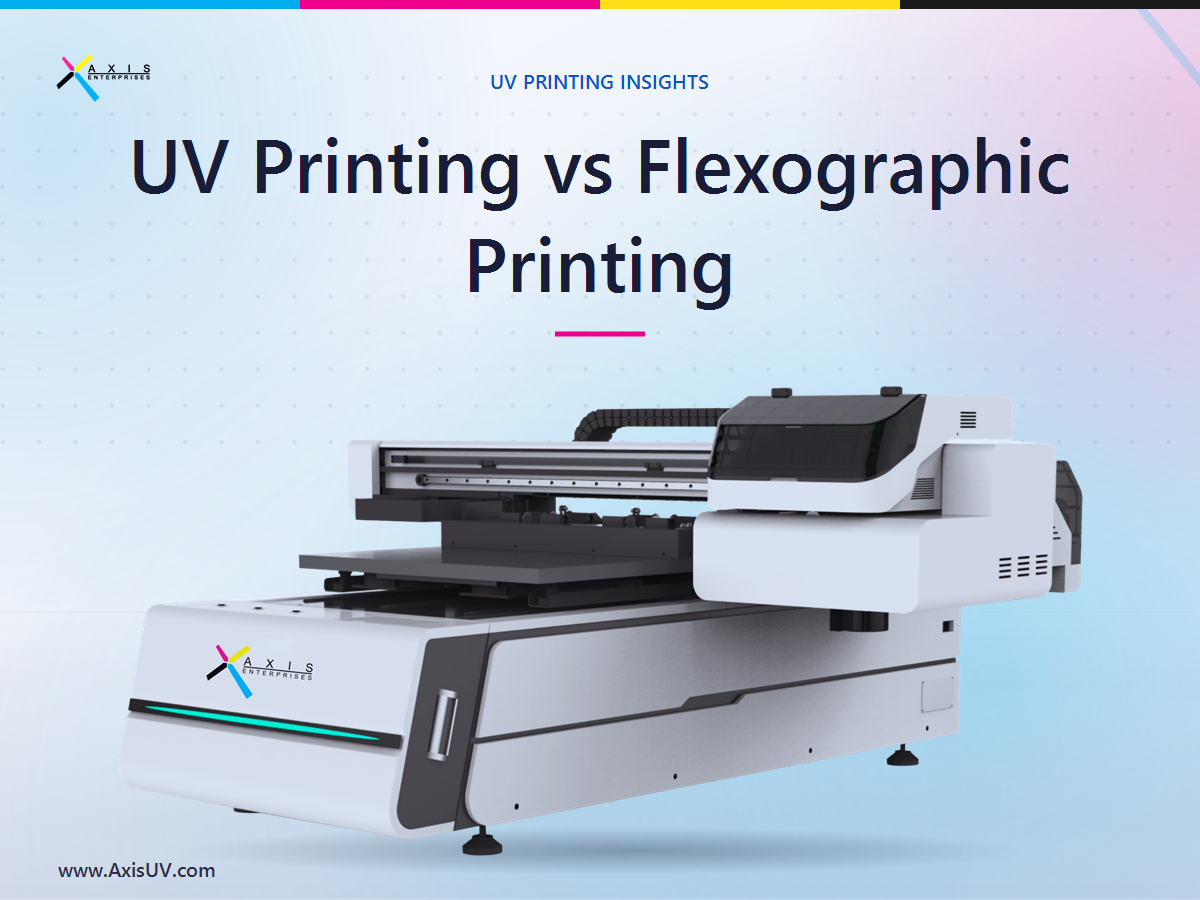
A UV flatbed printer is an inkjet device with no plates at all. The design goes straight from the computer to the printheads, and a UV curing lamp instantly hardens the ink the moment it lands, so prints are dry and scratch-resistant on contact. Because there is no plate and no drying time, you can change the design on every single piece and print directly onto rigid objects.
That single difference, plates versus no plates, drives almost every cost and capability comparison that follows.
Where does flexo win, and where does UV flatbed win?
Flexo wins on the cost per print at very high volumes of one fixed design on roll material. Once the plates are made and the press is dialled in, flexo runs fast and cheap for long stretches, which is why it dominates mass-produced flexible packaging and label rolls.
UV flatbed wins on everything that involves variety or rigidity. It prints on acrylic, wood, glass, metal, leather, MDF, PVC, boards, boxes, and finished products without plates, so short runs, one-off personalization, and prototypes are profitable instead of painful. There is effectively no minimum order quantity, which is a decisive advantage in a market full of custom and made-to-order demand.
The break-even logic in plain terms
The honest way to decide is run length and job variety, not brand loyalty. If you repeat the same artwork across huge volumes, flexo’s plate cost spreads thin and wins. If your orders are small, varied, personalized, or printed on solid objects, the plate cost and setup never pay off, and UV flatbed wins clearly.
UV flatbed printing vs flexographic printing: a side-by-side comparison
What smart buyers should look at before deciding
The right question is not “which technology is better,” it is “which technology matches the jobs I actually get paid for.” Smart buyers in India weigh a few criteria that most sales pitches skip.
Total cost of ownership, not sticker price. Compare on total cost of ownership: plates, setup, ink, power, maintenance, and waste over three years, not the machine price alone. UV LED systems are efficient here; Mordor Intelligence notes UV LED curing can cut operational energy use by over 70% versus older lamp technology, and UV units in flexo lines consume around 65% less power than mercury arc curing.
Run length and MOQ reality. Map your last 100 orders by quantity. If most are small, varied, or custom, plate-based economics work against you.
Substrate demand. List every material and object customers ask for. The more rigid and varied the list, the stronger the case for UV flatbed.
Personalization and variable data. Demand for made-to-order and personalized goods is rising, and it is exactly what plates cannot serve efficiently.
GST and landed cost. Factor Goods and Services Tax, freight, and installation into your comparison so EMI and payback are calculated on the real landed cost, not the quoted figure.
Why this matters for Indian SMBs right now
India’s packaging sector is expanding faster than almost anywhere, which raises demand for both long-run and short-run print. The India Brand Equity Foundation (IBEF) reports the Indian packaging industry at about USD 84 billion in 2024, projected to reach USD 143 billion by 2029 at an 11% CAGR. Asia-Pacific already commands the largest share of UV printer revenue globally, per Mordor Intelligence, at 38.43%.
For a 30 to 5,000 person SMB, that growth shows up as more enquiries for custom, small-batch, and personalized work: branded gifts, signage, panels, cases, boxes, and short label runs. Those are the jobs flexo handles poorly and UV flatbed handles profitably. Buying a flatbed does not mean abandoning flexo; many converters run both, and hybrid presses are the fastest-growing flexo format at a 9.09% CAGR, per Mordor Intelligence, precisely because long runs and short runs now coexist in the same shop.
A better way to decide, and where to start
If your work is dominated by huge, repeating roll runs, flexo remains the backbone. If your growth is coming from variety, personalization, rigid materials, and small orders, a UV flatbed printer lets you say yes to work you currently turn away or outsource. Axis Enterprises builds its guidance around that exact decision, helping Indian business owners match the machine to the jobs they actually win.
At uvprinterindia.com, you can compare flatbed UV printing machine options by material, format, and budget before you commit. The team can walk you through a transparent cost-per-print and payback estimate for your real order mix, and help you run a sample on your own products so you see the finish before you buy. If flexo covers your long runs and you only need UV for short-run and custom work, that is a conversation worth having too, and you can talk to a UV printing specialist about where a flatbed fits alongside what you already own.
Next step
If you are weighing UV flatbed printing against flexo for your next machine, start by mapping your real order mix and the materials your customers keep asking for, then put the two technologies side by side on total cost of ownership. When you want a second opinion grounded in your actual jobs rather than a sales target, you can book a free UV printing machine buying consultation and get a clear, pressure-free view of whether a flatbed, flexo, or a combination fits your business best.
Frequently asked questions
Is flexographic printing better than UV flatbed printing?
Neither is universally better; they fit different jobs. Flexo is better for very long runs of a fixed design on roll material, where its low cost per print at scale wins. UV flatbed is better for short runs, personalization, rigid materials, and mixed substrates, where it avoids plates and setup entirely.
What is the break-even point between flexo and UV flatbed?
The break-even is driven by run length and job variety rather than a single fixed number. Flexo’s plate and setup cost spreads thin only across very large quantities of the same artwork. For small, varied, or personalized orders, that cost never pays off, so UV flatbed is the cheaper route.
Can a UV flatbed printer print on packaging and labels?
Yes, UV flatbed printers print on boxes, rigid packaging, cards, and many label materials, and packaging and labels are the fastest-growing UV printer application at 8.12% a year, per Mordor Intelligence. For very high-volume roll-fed label runs, flexo or hybrid digital-flexo presses may still be more economical.
Is UV printing cheaper than flexo for short runs?
For short runs, UV flatbed is almost always cheaper because there are no plates to make and little to no setup. Flexo carries fixed plate and press-setup costs on every design, which short runs cannot absorb.
Do I still need flexo if I buy a UV flatbed printer?
Only if you have genuinely high-volume, repeating roll runs. Many Indian converters keep flexo for mass production and add a UV flatbed for short-run, custom, rigid, and personalized work, which is why hybrid and multi-technology shops are growing fastest.
Sources
- Mordor Intelligence: UV Printers Market Size, Share and Growth Trends
- Mordor Intelligence: Flexographic Printing Market Size, Growth and Share Report
- Packaging Europe: Smithers forecasts packaging print market to reach USD 604.0 billion in 2029
- India Brand Equity Foundation (IBEF): Paper and Packaging Industry in India
- Wikipedia: Flexography
- Wikipedia: UV curing
- Wikipedia: Inkjet printing
- Wikipedia: Total cost of ownership