
Published: 20 October 2026
Quick answer
UV printing lets Ayurveda and wellness brands decorate bottles, jars, caps, wooden lids, boxes, and labels in small batches, without screen-printing setup charges or large minimum orders. It uses ultraviolet light to cure ink instantly, so one flatbed or UV DTF machine can print on glass, plastic, metal, wood, and paper on the same day. For a growing Indian wellness brand, that means premium packaging on demand, faster product launches, and a lower per-unit cost than repeat outsourcing. The real decision is not whether UV printing works for wellness products. It is which machine, material range, and finishing options match your products and your monthly volumes.
Why is Ayurveda packaging suddenly a printing challenge?
Demand is growing far faster than most small brands can package it. According to IMARC Group, the India Ayurvedic products market was valued at INR 1,017.51 Billion in 2025 and is projected to reach INR 3,728.75 Billion by 2034, a compound annual growth rate of 15.52 percent for 2026 to 2034. That is one of the fastest growth rates of any consumer category in the country.
The wider wellness economy is scaling alongside it. Mordor Intelligence estimates the India AYUSH and alternative medicine market at USD 24.87 Billion in 2025, rising to USD 36.62 Billion by 2031. Every one of those products needs a container, a label, and a brand identity that looks the part on a shelf or a quick-commerce thumbnail.
Packaging is where the bottleneck shows up. The India packaging market was valued at USD 102.40 Billion in 2024 and is forecast to reach USD 149.82 Billion by 2032, per Fortune Business Insights. Rising demand pushes up minimum order quantities and lead times at outside printers, exactly when a small wellness brand needs flexibility most.
What does this mean for a small Ayurveda or wellness brand?
It means the packaging that sells your product is often the hardest part to control. Most Ayurveda, herbal, and wellness founders in India run lean. The Ministry of Micro, Small and Medium Enterprises reported 4,77,92,809 MSMEs registered on the Udyam portal and Udyam Assist Platform as of 31 July 2024 (Ministry of MSME, Press Information Bureau), and wellness brands are a fast-growing slice of that base.
For these owners, outsourcing printed bottles, jars, and cartons creates four recurring pains. Minimum order quantities force you to buy thousands of units of one design before you have proven it sells. Lead times of one to three weeks delay launches and restocks. Every design change, batch code, or new SKU restarts the clock and the setup cost. And margin leaks out the door to a vendor on work you could do in-house.
The result is familiar: a strong product trapped behind slow, expensive, inflexible packaging. In a category growing at double digits, that is not a cosmetic issue. It is a growth ceiling.
What is UV printing, and why does it fit wellness products?
UV printing is digital printing in which ultraviolet light instantly cures (hardens) the ink the moment it is laid down. Because the ink dries on contact rather than soaking in, it bonds to surfaces that ordinary printing cannot handle, and it is ready to pack immediately. The underlying process is called UV curing, and the print heads work on the same drop-on-demand principle as inkjet printing.
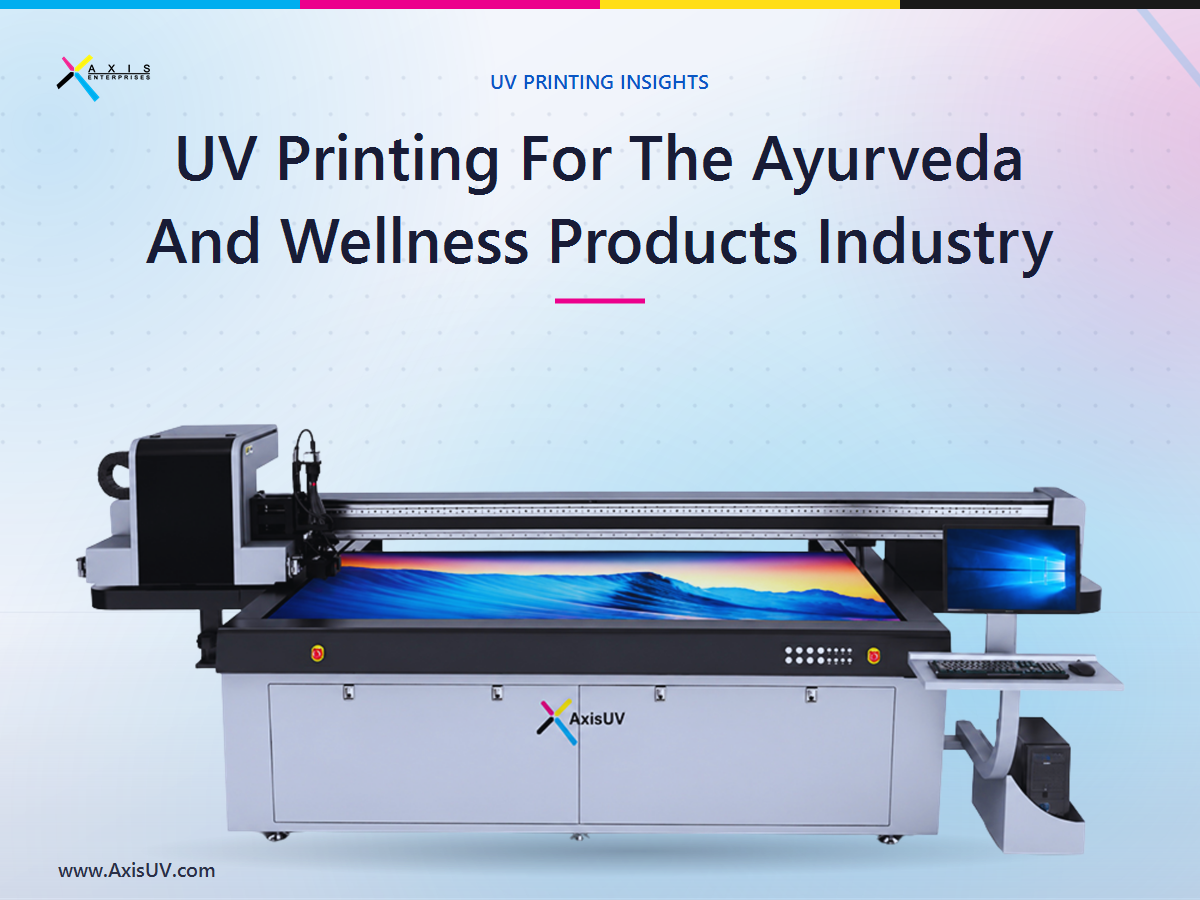
Two machine types matter for wellness brands. A UV flatbed printer prints directly onto flat or thick rigid items placed on a bed: boxes, wooden lids, signage, rigid jars, and panels. A UV DTF (direct-to-film) printer prints a transfer sticker that wraps onto curved and irregular items such as bottles, tubes, and tins.
Two finishing terms are worth knowing. A white ink underbase is a layer of white printed first so colours stay vivid on amber glass, kraft board, or dark jars. A varnish or spot gloss is a clear raised layer that adds a premium tactile finish, useful for a logo or a botanical pattern. Both are standard on capable UV machines.
This fits Ayurveda and wellness products almost exactly, because the category lives on natural materials (amber glass, kraft cartons, wooden caps, aluminium tins) and on premium, small-batch, story-led branding. UV printing decorates all of those surfaces directly, in the quantity you actually need.
What can a wellness brand actually print with one machine?
More than most owners expect. A single UV setup covers the main surfaces an Ayurveda or wellness line uses every day. The table below maps common wellness items to the UV method that suits them.
How should a wellness brand think about bringing printing in-house?
Treat it as a profit-and-control decision, not a machine purchase. The question is not “can I afford a printer,” but “how much am I paying outside printers each month, and what would it cost to do that work myself.” Audit three months of outsourced printing spend first. For many growing brands, the saved outsourcing cost alone covers a machine EMI.
Adoption is clearly moving this way. IMARC Group values the India digital printing market at USD 1.50 Billion in 2025, growing to USD 2.94 Billion by 2034, and lists UV-cured ink as a core segment. Label demand is rising even faster: Mordor Intelligence puts the India print label market at USD 2.46 Billion in 2025, reaching USD 4.59 Billion by 2030 at a 13.29 percent growth rate. Brands that print their own labels and packaging capture that value instead of paying it away.
There is also a tax point worth checking with your accountant. A UV printer is a business asset, and the Goods and Services Tax (India) paid on it is typically available as input tax credit to a GST-registered business, which lowers the real landed cost below the sticker price. Plan the purchase on landed cost after input tax credit, not on the quoted price alone.
What should you look for in a UV printer for wellness packaging?
Look for the features that match wellness materials and small-batch runs, not the biggest spec sheet. A machine built for high-volume signage is not automatically right for amber bottles and kraft boxes. Use this checklist when you compare options.
- Material range that covers your real products: glass, PET, acrylic, wood, aluminium, and board, verified with a sample print on your own packaging, not a generic demo.
- White ink and varnish support: essential for vivid colour on amber glass and kraft, and for premium raised-logo finishes.
- A rotary or UV DTF option for round items: most wellness packaging is cylindrical, so confirm how the machine handles bottles and jars.
- Genuine small-batch economics: fast setup and low changeover time so a run of 50 units is still profitable.
- Local service, spare parts, and operator training: response time and parts availability matter more than a slightly lower price, because downtime stops your packaging line.
- Honest print samples on your materials: ask for adhesion and scratch results on the exact surfaces you sell.
A smarter way to print Ayurveda and wellness packaging
Given everything above, the practical path for most Indian wellness brands is a single UV printing machine sized to their materials and volumes, so packaging becomes something they control rather than wait for. This is exactly what Axis Enterprises helps owners set up, with UV flatbed and UV DTF machines selected around the surfaces and batch sizes a specific brand actually runs.
Rather than guess, you can compare flatbed and UV DTF options against your own product list, and request a sample print on your materials before any decision. Seeing your own amber bottle or kraft box printed, cured, and scratch-tested answers more questions than any brochure. If financing is the concern, the team can also walk through landed cost after input tax credit and typical payback from saved outsourcing.
Frequently asked questions
Can one UV printer handle bottles, jars, boxes, and labels?
Yes, in most cases one setup covers all four. A UV flatbed prints flat and rigid items such as boxes and wooden lids directly, while a UV DTF unit handles curved items such as bottles and tubes with a transfer. Many wellness brands run a flatbed as the main machine and add UV DTF for round packaging.
Is UV printing durable enough for oils, balms, and handling?
UV-cured prints are hard, water-resistant, and scratch-resistant once cured, which suits products that are handled, shipped, and exposed to oils. Durability depends on correct surface preparation and the right primer for each material, so always confirm adhesion with a scratch and tape test on your actual packaging before committing to a machine.
What minimum order quantity do I need to justify printing in-house?
There is no fixed minimum, which is the point. UV printing is digital and needs no plates or screens, so a run of 50 or 100 units is viable. The real trigger is your monthly outsourced printing spend: when that spend would cover a machine EMI, in-house printing usually pays back.
Will printed Ayurveda packaging meet labelling and shelf expectations?
UV printing can reproduce fine text, botanical artwork, batch codes, and multi-language information clearly, which supports the ingredient and usage details wellness products carry. Printing in-house also lets you update batch and manufacturing details per run without reordering from a vendor. Always keep your label content compliant with the rules that apply to your product category.
Flatbed or UV DTF: which should a wellness brand buy first?
Start with whichever matches your highest-volume packaging. If most of your line is boxes, wooden caps, and flat jars, a flatbed is the first machine. If most of your revenue rides on round bottles and tubes, UV DTF comes first. Many brands end up with both, added in that order.
Sources
- IMARC Group, India Ayurvedic Products Market
- Mordor Intelligence, India AYUSH and Alternative Medicine Market
- Fortune Business Insights, India Packaging Market
- IMARC Group, India Digital Printing Market
- Mordor Intelligence, India Print Label Market
- Ministry of MSME, Press Information Bureau, Udyam Registration Data (2024)