
Published: October 23, 2026. Last updated: October 23, 2026.
Quick answer
UV printing and latex printing are not the same decision, and treating them as interchangeable is where most buyers lose money. UV printing cures ink instantly with ultraviolet light and prints on almost any flat surface, including rigid materials such as acrylic, wood, metal, glass, and PVC. Latex printing uses water-based ink that is dried with heat and is built mainly for flexible roll media such as vinyl, banners, and wallpaper. If your work is signage boards, personalized products, packaging samples, industrial parts, or anything on a hard substrate, UV is almost always the right fit. If you only print flexible banners and vehicle wraps, latex can serve. The real question is not which technology is better, it is which one matches the jobs you actually sell.
What is the real difference between UV printing and latex printing?
The core difference is how the ink dries and what it can stick to. Both are forms of inkjet printing, so both spray fine ink droplets, but the curing method changes everything downstream.
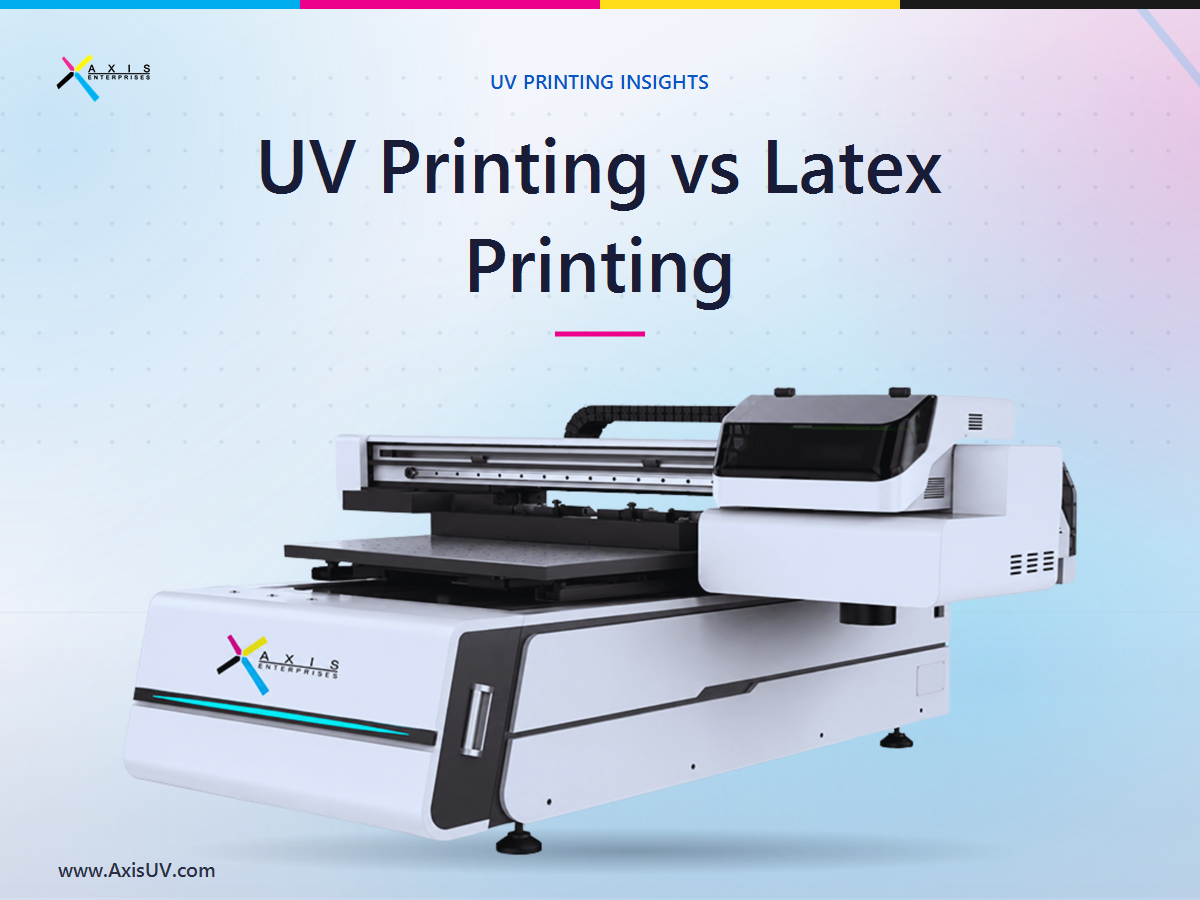
UV printing uses UV curing, where ultraviolet light hardens the ink the instant it lands, with very little heat. Because the ink sets immediately, it sits on top of rigid and non-absorbent surfaces, which is why a UV flatbed can print directly on acrylic, metal, wood, glass, and tiles.
Latex printing is water-based. The printer uses heat to evaporate the water so the latex particles fuse into the media. That heat-and-absorb process is designed for flexible roll materials, so latex lives in the banner, vinyl, and soft-signage world rather than on rigid boards.
Why are so many print shops spending on the wrong machine?
Because the wide-format market is growing fast, and growth pulls in buyers who pick a technology before they map their own job mix. Demand is real, but a machine bought for the wrong substrates becomes a slow, underused asset.
According to Mordor Intelligence, the global UV printers market was valued at about USD 1.02 billion in 2025 and is projected to reach USD 1.58 billion by 2031, a compound annual growth rate of 7.59 percent. That is a market expanding faster than the broader large-format category.
MarketsandMarkets estimates the India large-format printer market at roughly USD 233 million in 2025, rising toward USD 347 million by 2030 at an 8.3 percent CAGR, ahead of the global large-format rate of about 5.5 percent. Indian demand is outpacing the world average.
Inkjet is the engine behind this. Smithers reports that global inkjet printing sales reached USD 117.7 billion in 2024 and are forecast to hit USD 162.1 billion by 2029, a 6.6 percent annual growth rate. When a category grows this quickly, equipment gets bought in a hurry, and hurried buying is how shops end up with a printer that cannot touch half their order book.
UV printing vs latex printing: a side-by-side comparison
Here is the honest comparison, framed for a shop owner who has to pay for the machine and fill it with billable work. The technical claims below reflect manufacturer documentation, including Mimaki, which publishes a direct comparison of UV and latex printing.
Both technologies keep odor and volatile organic compound exposure lower than old solvent printing, so neither is the dirty option. The dividing line is substrate, not fumes.
What does this mean for a small Indian print or signage shop?
For most Indian SMBs, the money is in rigid substrates and personalization, and that work belongs to UV. A latex printer that can only run flexible rolls locks you out of acrylic sign boards, wooden nameplates, metal panels, phone cases, gift items, and industrial labels, which are exactly the higher-margin jobs customers keep asking for.
The pain is specific. You buy a wide-format machine, then a customer asks for a printed acrylic board or a batch of personalized bottles, and you have to outsource it or refuse it. Every outsourced job is margin handed to a competitor, and every refusal trains that customer to call someone else next time.
A UV flatbed flips that. One machine lets you say yes to signage, gifting, furniture panels, packaging mockups, and industrial marking from the same floor space, which is why versatility, not banner speed, is the metric that pays back an Indian shop.
How should you actually choose between UV and latex?
Choose by your job mix and your true cost of ownership, not by the sticker price of the machine. The right question is which technology lets you bill the widest range of work with the fewest outsourced jobs.
Run these checks before you commit:
- Map your real orders. List the last fifty jobs customers requested, including the ones you turned away. If rigid or personalized items appear often, latex cannot serve them.
- Count the substrates. If you need acrylic, wood, metal, glass, or PVC, UV is the only one of the two that prints them directly.
- Calculate the full cost, not the price tag. Weigh ink, maintenance, power, consumables, and operator time together, because total cost of ownership decides profit, not the day-one invoice.
- Factor in tax and landed cost. A capital machine carries Goods and Services Tax and, for imports, duty and freight, so compare the full landed figure in rupees, not the quoted base price.
- Value the ability to say yes. A machine that captures more of what customers ask for pays back faster than a cheaper machine that forces you to outsource.
What to look for before you buy a UV printer
If your job mix points to UV, buy on substrate range, finish capability, and service, not on headline speed alone. These are the criteria that separate a profitable machine from an expensive paperweight.
- Confirmed printing on the exact materials you sell, tested with the correct primer and ink profile.
- White ink and spot varnish capability, so you can charge premium rates for finishes latex cannot produce.
- A clear print-head specification and a published maintenance routine, because uptime depends on daily care.
- Local spare parts and a defined service response time in India, so a fault does not idle your production for weeks.
- Honest sample prints on your own substrates before purchase, not a generic demo sheet.
- A transparent breakdown of ink and consumable cost per print, in rupees, so you can price jobs for profit.
A better way forward
If that checklist describes what you are after, a flatbed UV printer is the technology that keeps the most work inside your shop. This is the exact ground Axis Enterprises covers: flatbed UV printing machines matched to the substrates and finishes Indian SMBs actually sell, from signage and gifting to industrial and interior work. You can explore the flatbed UV printer range at Axis Enterprises and see how one machine replaces several outsourced vendors.
The goal is not to sell you the biggest machine. It is to match the printer to your job mix so the payback is real. If you are weighing UV against latex for a specific line of work, you can see which UV printer fits your substrates and compare it against the jobs you turn away today.
Next step
Before you spend several lakh rupees on any wide-format machine, get a clear read on which technology matches your orders. Bring your real job list and your target substrates, and get a straight answer on whether UV or latex fits, with the full landed cost in rupees laid out. You can book a free UV printing machine buying consultation with the team, or talk to Axis Enterprises about a sample print on your own materials. The consultation is free, the advice is specific to your shop, and it starts with your work, not a sales pitch.
Frequently asked questions
Can one UV printer really print on acrylic, wood, glass, and metal?
Yes. A UV flatbed cures ink instantly with light, so the ink bonds to rigid, non-absorbent surfaces including acrylic, wood, glass, metal, tiles, and PVC. With the correct primer and ink profile, a single UV machine covers a far wider substrate range than a latex printer, which is limited to flexible roll media.
Is latex printing better than UV printing for a signage business?
It depends on the signage. Latex is strong for flexible soft signage such as banners, vinyl, and vehicle wraps. For rigid sign boards, acrylic displays, backlit panels, and anything mounted on a hard surface, UV is the better fit because it prints directly on the board without a separate print-and-mount step.
Which technology has lower running costs?
Running cost depends on your job mix, ink usage, maintenance discipline, and power, so compare total cost of ownership rather than ink price alone. For a shop doing rigid and personalized work, UV usually lowers total cost because it keeps outsourced jobs in-house, and every job you stop outsourcing adds margin that a cheaper single-purpose machine cannot.
Is UV printing durable enough for outdoor use in India?
UV-cured prints resist water, scratching, and fading, which makes them suitable for outdoor signage and heavy-handling products. For long outdoor exposure, pair the right ink with a suitable substrate and, where needed, a protective finish, and confirm the durability claim with a sample test on your own material before you commit.
Should a small shop in India start with UV or latex?
Most Indian SMBs should start with UV, because the higher-margin demand sits in rigid substrates and personalization that latex cannot print. A UV flatbed lets a small shop accept signage, gifting, packaging, and industrial jobs from one machine, which matters more for payback than the roll speed a latex printer offers.
Sources
- Mordor Intelligence, UV Printers Market Size and Forecast
- MarketsandMarkets, India Large Format Printer Market
- Smithers, Inkjet Printing Market to Lead Growth Post Drupa 2024
- Mimaki, UV vs. Latex Printing
- Wikipedia, UV curing
- Wikipedia, Inkjet printing
- Wikipedia, Volatile organic compound
- Wikipedia, Total cost of ownership
- Wikipedia, Goods and Services Tax (India)