
Published: November 14, 2026 | Last updated: November 14, 2026
Quick answer: can you run a UV printing business from home?
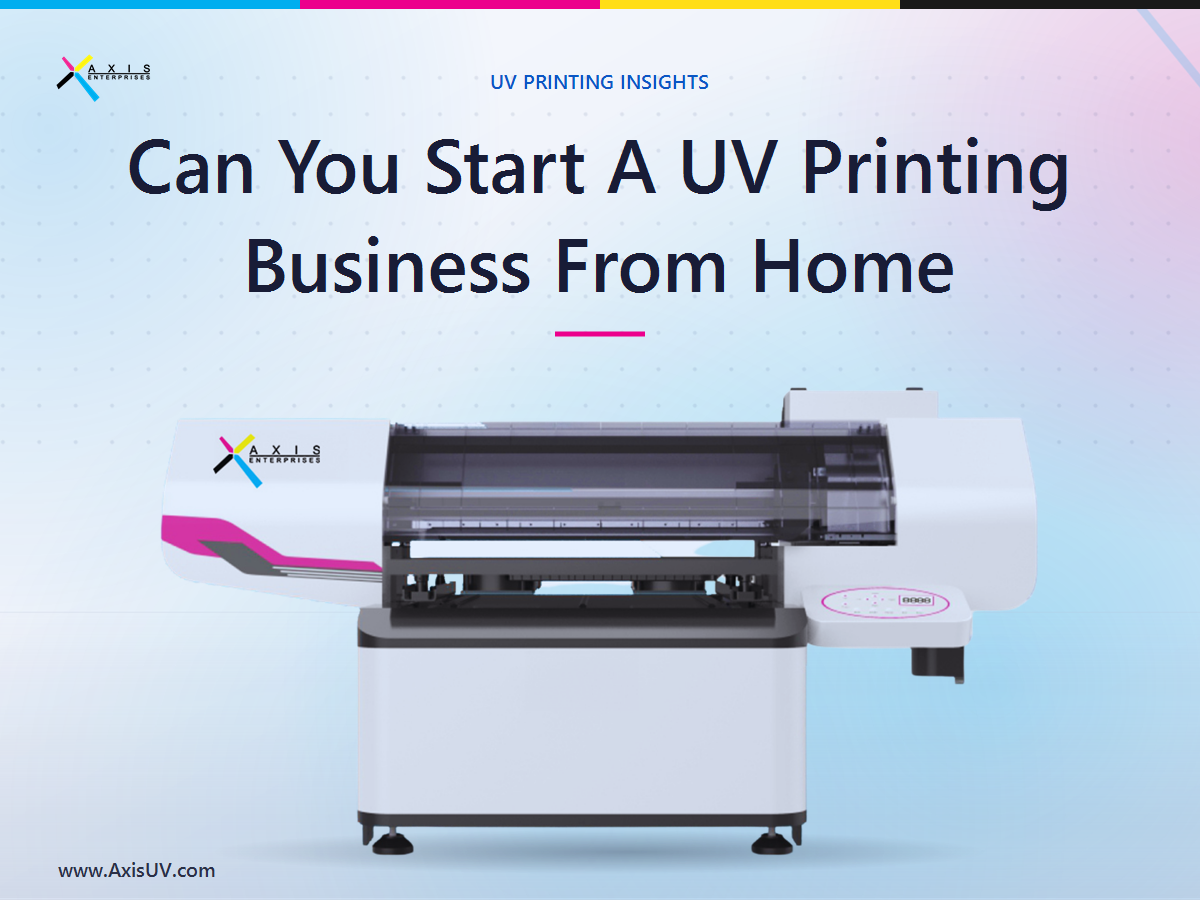
Yes, you can start a small UV printing business from home in India, and many first-time owners do. A compact flatbed UV printer runs on a normal single-phase power point, fits on a strong table in a spare room, and prints on acrylic, wood, glass, metal, and phone cases without outsourcing. The real limits are rarely legal or technical: they are space for curing and finishing, steady ventilation, dust control, and whether the home can support the volume as orders grow. Treat the home setup as stage one, prove demand, then move to a dedicated unit when output outgrows the room.
What is a UV printer, and why does the home question keep coming up?
A UV printer is a digital inkjet machine that jets specially formulated inks onto a surface and hardens them instantly with ultraviolet light, a process called UV curing. Because the ink cures on contact instead of soaking in or air-drying, one machine can decorate acrylic, wood, glass, metal, leather, and plastic in a single pass.
That versatility is exactly why the home question comes up. A machine that prints saleable products on almost any material, with no minimum order, looks like an ideal micro business. The honest view is more nuanced, and worth understanding before you spend.
How big is the opportunity behind this decision?
Demand is growing faster than most small owners realise, which is what makes a home start viable at all. According to MarketsandMarkets, India’s UV curing system market is projected to grow from about USD 150.5 million in 2026 to USD 324.5 million by 2031, a 13.7% compound annual growth rate. The same firm values India’s large format printer market at about USD 233.1 million in 2025, rising to USD 346.7 million by 2030.
The pull comes from where print is heading. As per the IMARC Group, India’s commercial printing market reached roughly USD 36.53 billion in 2025, with packaging alone making up about 43.8% of application demand. Short runs, personalisation, and on-demand decoration are the fast-growing slices, and those are precisely the jobs a single UV printer handles well.
Why do most people assume they need a factory first?
The factory assumption comes from older print technology, not from how UV printing actually works today. Traditional print methods needed large presses, drying racks, solvent handling, and floor space. UV curing changed the footprint.
Modern systems cure with UV LED light rather than hot mercury lamps. UV LED curing emits very little infrared heat, which is why it works on thin and heat-sensitive materials and runs cooler in a small room. The shift away from mercury-vapor lamps toward compact LED curing is a large part of why a desktop or small flatbed machine can sit in a home workspace at all.
So the barrier is rarely the machine. It is everything around the machine: the room, the air, the dust, and the plan.
What does the micro-business reality in India tell us?
Home-based and micro enterprises are the backbone of Indian business, so a UV print studio run from home sits in very normal company. As per the Ministry of Micro, Small and Medium Enterprises, over 7.3 crore enterprises were registered on the Udyam and Udyam Assist platforms by December 2025, and the vast majority are micro units (Drishti IAS Year End Review 2025). Wikipedia’s summary of the MSMED Act, 2006 notes that India has roughly 63 million MSMEs contributing close to 30% of GDP.
The policy environment is turning micro-friendly too. The Government of India raised MSME investment and turnover limits effective April 1, 2025, and introduced a customised credit card offering up to INR 5 lakh to Udyam-registered micro enterprises (Press Information Bureau, 2025). For a home owner, registering as a micro enterprise unlocks credit and scheme access that was once hard to reach.
What should you actually weigh before buying for a home setup?
A smart home buyer stops asking “can the machine fit?” and starts asking “can my home support a repeatable workflow?” The machine is the easy part. The workflow is where home businesses succeed or stall.
Weigh these five factors honestly before you commit:
- Power stability: A compact UV printer runs on single-phase power, but it needs a clean, stable supply. Voltage swings and frequent cuts damage printheads, so a stabiliser or small backup matters more at home than in an industrial area.
- Air and dust: UV ink and open substrates attract dust, and airborne particles ruin prints. A home room needs a dedicated, low-dust corner, not a shared living space.
- Ventilation: Even low-odour UV inks benefit from airflow. A window or exhaust fan is the minimum for a room where you work daily.
- Space for the full cycle: You need room not just for the printer, but for substrate storage, jigs, curing, finishing, and packing. The printer is often the smallest part.
- Noise and household rhythm: A printer running batch jobs has a working sound. Think about whether that fits a shared home, and whether local residential rules allow a home business of this kind in your area.
What should you look for in a machine and a supplier?
For a home start, the right machine is the one small enough to live in your room and backed well enough that you are never stranded. First-time owners often over-index on price and under-index on support, which is the costliest mistake at home, where you have no backup machine.
Look for a setup that offers these things:
- A footprint sized to your room: A small-format or compact flatbed that fits your table and power point, with headroom to grow, not a large-format machine you cannot house.
- Single-phase compatibility: Confirmed home-friendly power requirements, so you are not forced into an expensive three-phase connection.
- Strong material versatility: White ink and varnish capability so you can print premium finishes on dark and transparent materials, which is where home studios earn higher margins.
- Local service and spare parts: Fast response time and locally stocked consumables, because downtime at home means zero production.
- Hands-on training: Real onboarding on material profiles, nozzle care, and print preparation, since you will be the operator, the maintenance team, and the salesperson.
- A demo on your own products: A supplier willing to print your intended items before you buy, so you see results on the materials you plan to sell.
How do the common home paths compare?
Not every home start looks the same, and matching the path to your goal prevents overspending. The table below compares the three routes first-time owners usually consider.
For most first-time buyers, the middle path works best: start compact at home, prove the orders, then scale the space and the machine together.
A better way forward
If a home UV printing business is the goal, the deciding factor is not the room. It is buying a right-sized machine from a partner who will keep you running. At uvprinterindia.com, Axis Enterprises helps first-time owners choose a flatbed UV printer that fits a home setup and a growth plan, with local service and training built in.
You can book a free UV printing machine buying consultation to map your space, power, and product plan before you spend. The team can also arrange a demo print on your own sample products so you see real output on your materials, and walk you through compact, single-phase machine options suited to a home workspace.
Next step
If you are weighing a home UV printing start, the most useful next move is a short, honest conversation about your room, your power, and the products you want to sell. Book a free UV printing machine buying consultation at uvprinterindia.com, bring a few sample items you want to print, and get a clear, no-pressure view of whether a home setup fits your plan or whether a small unit makes more sense from day one.
Frequently asked questions
Can one UV printer really print on acrylic, wood, glass, and metal?
Yes. A flatbed UV printer uses UV-cured inks that bond to the surface, so a single machine can decorate acrylic, wood, glass, metal, leather, and plastic. Each material needs the correct print profile and sometimes a primer, but you do not need a separate machine per material.
Which material is easiest for a beginner to start with at home?
Acrylic and MDF are common starting points because they are flat, predictable, and widely used in gifts, signage, and name plates. Begin with a small set of materials you can master, then add surfaces as your profiles and confidence grow.
Does a home UV printer need three-phase power?
Most compact and small-format UV printers run on standard single-phase power, which suits a home. Larger industrial machines may need three-phase, so confirm the exact power requirement with your supplier before you buy, and plan a stable supply with backup.
Is a UV printing business profitable as a small home operation?
It can be, because personalised and short-run products carry healthy margins and need no minimum order. Profitability depends on steady orders, smart pricing, and low rework, so start with products you can sell locally before scaling volume.
Do I need to register my home UV printing business?
Registering as a micro enterprise on the Udyam portal is free and unlocks credit, schemes, and formal recognition. Check local residential rules and GST requirements for your turnover, and keep your workspace compliant with any zoning rules in your area.
Sources
- MarketsandMarkets: India UV Curing System Market
- MarketsandMarkets: India Large Format Printer Market
- IMARC Group: India Commercial Printing Market
- Drishti IAS: Year End Review 2025, Ministry of MSME
- Press Information Bureau: Budget 2025-26, Fuelling MSME Expansion
- Wikipedia: UV curing
- Wikipedia: MSMED Act, 2006