

Published: July 26, 2026. Last updated: July 26, 2026.
Quick answer: Can Indian businesses export custom-printed products profitably?
Yes. Indian print, signage, gifting, and manufacturing businesses can export custom-printed products profitably, and the window is widening fast. The government has set a target of USD 200 to 300 billion in e-commerce exports by 2030, up from roughly USD 4 to 5 billion today, according to India’s Directorate General of Foreign Trade. Global demand for custom-printed goods reached USD 38.10 billion in 2024 and is forecast to hit USD 68.46 billion by 2030, per Grand View Research. The businesses that win will be the ones that can produce short-run, personalized, no-minimum-order products in-house, on many materials, at export quality. That capability, not marketing spend, is the real bottleneck.
Why are Indian print businesses leaving export money on the table?
Most Indian print and product businesses still sell only within a 50 kilometre radius, while foreign buyers actively search for exactly the customized goods they make. India’s e-commerce exports were only about USD 4 to 5 billion in FY2023, roughly 0.9 to 1.1 percent of total merchandise exports, according to analysis reported by Indian Retailer. That is a tiny slice of a market the government wants to grow 40 to 60 times over.
The gap is not demand. It is production capability. Amazon alone pledged in December 2024 to enable USD 80 billion in cumulative e-commerce exports from India by 2030, a fourfold jump from its earlier commitment, as reported by Amazon India. Sellers who can fulfil small, customized international orders quickly are the ones platforms are racing to onboard.
Meanwhile buyers increasingly expect products made for them, not mass-produced. McKinsey research found that 71 percent of consumers expect companies to deliver personalized interactions, and 76 percent get frustrated when that does not happen. A business that cannot personalize cannot serve the fastest-growing part of global retail.
How big is global demand for custom-printed products?
Global demand for custom-printed goods is large, growing at double digits, and concentrated in Asia. The global custom printing market was valued at USD 38.10 billion in 2024 and is projected to reach USD 68.46 billion by 2030 at a 10.3 percent compound annual growth rate, according to Grand View Research, which also notes that Asia Pacific held about 39.9 percent of that market in 2024.
Individual product categories are growing even faster. The global custom t-shirt printing market alone was USD 5.16 billion in 2024 and is expected to reach USD 9.82 billion by 2030 at an 11.5 percent CAGR, per Grand View Research. Printed gifts, phone cases, drinkware, signage, packaging, and decor follow similar curves.
The technology powering this shift is digital and UV curing based printing. The broader digital printing market is set to reach USD 57.03 billion by 2030 (a 6.2 percent CAGR), and within it the UV-curable ink segment is the fastest growing at 7.4 percent, rising from USD 8.48 billion in 2023 to USD 13.78 billion by 2030, according to Grand View Research. In short, the world is buying more short-run, personalized, printed products every year, and it is buying them from whoever can make them well.
What does this mean for a small Indian print or manufacturing business?
For a small Indian business, exporting is now a realistic growth path rather than a fantasy reserved for large factories. Micro, small, and medium enterprises already carry the country’s trade: the MSME share of India’s exports rose from 45.74 percent in FY2024 to 48.55 percent in FY2025, according to IBEF. If you run a signage shop, a gifting brand, a phone-case business, a packaging unit, or a small manufacturing line, you are exactly the profile that is expanding into exports.
The pain is specific. You get international enquiries you cannot fulfil because you depend on outsourcing, cannot print on the material a buyer wants, or cannot deliver a customized sample fast enough to close the order. Every enquiry you turn away is margin handed to a competitor who kept production in-house.
Export buyers also demand consistency across repeat batches, tight turnaround, and the ability to print small quantities without a minimum order. Those are the exact things a business loses control of the moment it outsources. Owning the production step is what converts an export enquiry into a repeat account.
Why do most export attempts stall before the first order?
Most export attempts stall not at customs, but at the sample stage, because the business cannot produce what the buyer asked for, on the material they specified, at the quality they expect. A foreign buyer asks for a personalized run on acrylic, wood, metal, or a coated surface, and the seller either says no or ships an outsourced sample that looks different from what they promised.
Regulatory friction is real but solvable. India has simplified courier export limits and set up postal export centres under its trade policy, and e-commerce platforms now handle much of the logistics and paperwork. The harder problem is upstream: production flexibility.
This is why the smart question is not “how do I export?” but “can I make, in-house, the range of customized products the world is buying?” A business that can print on almost any substrate, in small runs, at premium quality, has removed the single biggest reason export deals collapse. The buying decision, then, is really a production-capability decision.
What should smart buyers look for before going export-ready?
Before investing to become export-ready, evaluate production capability against the demands of international, customized orders, not just today’s local jobs. Export orders reward flexibility, consistency, and durability, so the machine and the supplier behind it matter more than the sticker price.
Use the checklist below to compare options objectively.
A business that scores well on this list is not just export-ready. It is positioned to serve the fastest-growing, highest-margin corner of the market: customized products made on demand.
A better way to build export-ready printing in-house
Given everything above, the practical move is to bring flexible, high-quality printing in-house on a machine built to handle the material range and small-batch work that export orders demand. This is exactly what Axis Enterprises helps Indian businesses do at uvprinterindia.com, with UV printing machines that print on acrylic, wood, glass, metal, leather, and more, backed by service and support.
If you are weighing your first machine, you can explore UV flatbed printers built for Indian businesses and see which configuration matches the products your buyers are asking for. For owners already fielding export enquiries, it helps to talk to the Axis Enterprises team about export-ready printing before committing budget, so the machine matches the materials and volumes you plan to sell abroad. The goal is simple: never turn away an order because you could not make it in-house.
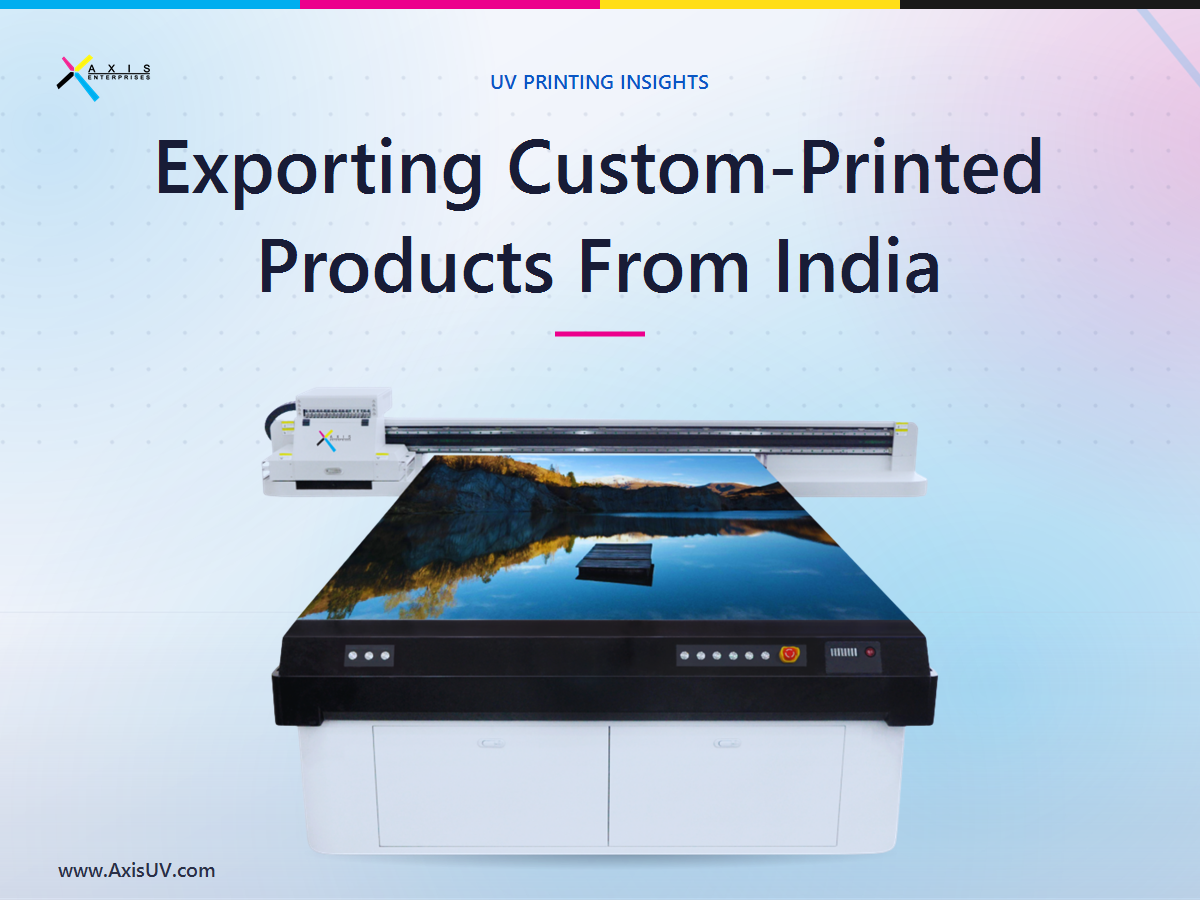
UV printing uses inkjet printing heads with instantly cured ink, which is what makes on-demand, multi-material, small-run production commercially viable for a growing business.
Frequently asked questions
Can I export UV-printed products?
Yes. UV-printed products such as personalized gifts, signage, phone cases, drinkware, decor panels, and branded packaging are all exportable, and India’s simplified courier and postal export routes make small-parcel shipping practical. The main requirement is producing consistent, durable, customized items in-house, since that is what foreign buyers and marketplaces reward.
Which countries import customized products from India?
The United States, United Kingdom, United Arab Emirates, Canada, Australia, and the wider European Union are among the largest buyers of personalized and custom-printed goods. Demand is broad because personalization is a global consumer trend, with 71 percent of consumers expecting personalized products and experiences, according to McKinsey.
Which custom-printed products are easiest to export and highest margin?
Lightweight, low-breakage, personalized items ship most easily and carry the best margins, including printed apparel, phone cases, wooden and acrylic decor, drinkware, stationery, and branded corporate gifts. The custom t-shirt printing segment alone is growing at 11.5 percent a year to reach USD 9.82 billion by 2030, per Grand View Research, which signals strong demand for made-to-order goods.
Can a small business or MSME export customized products?
Yes. MSMEs already generate close to half of India’s exports, with their share rising to 48.55 percent in FY2025 according to IBEF, and cross-border e-commerce platforms have lowered the entry barrier for small sellers. The deciding factor is in-house production flexibility, not company size.
What certifications or approvals help export businesses?
An Importer Exporter Code from the Directorate General of Foreign Trade, GST registration, and product-specific or buyer-specific compliance (for example material safety declarations for toys or food-contact items) are the usual starting points. Marketplace-led export programs often guide small sellers through much of this paperwork, so the practical constraint remains your ability to make the product.
Next step
If your business is already getting enquiries you cannot fully serve, the fastest way to test the export opportunity is to make sure you can produce those products in-house first. Book a free UV Printing Machine Buying Consultation at uvprinterindia.com to map the materials, volumes, and finishes your buyers want to the right machine, so you stop turning away orders and start turning enquiries into repeat international accounts.
Sources
- IBEF: India MSME sector and its share of exports
- Grand View Research: Custom Printing Market Size And Trends Report, 2030
- Grand View Research: Custom T-shirt Printing Market, 2030
- Grand View Research: Digital Printing Market and UV-curable ink segment, 2030
- McKinsey: The value of getting personalization right, or wrong, is multiplying
- Indian Retailer: Unlocking India’s e-commerce export potential, a path to USD 200 to 300 billion by FY30
- Amazon India: Government initiatives and Amazon’s USD 80 billion export pledge