

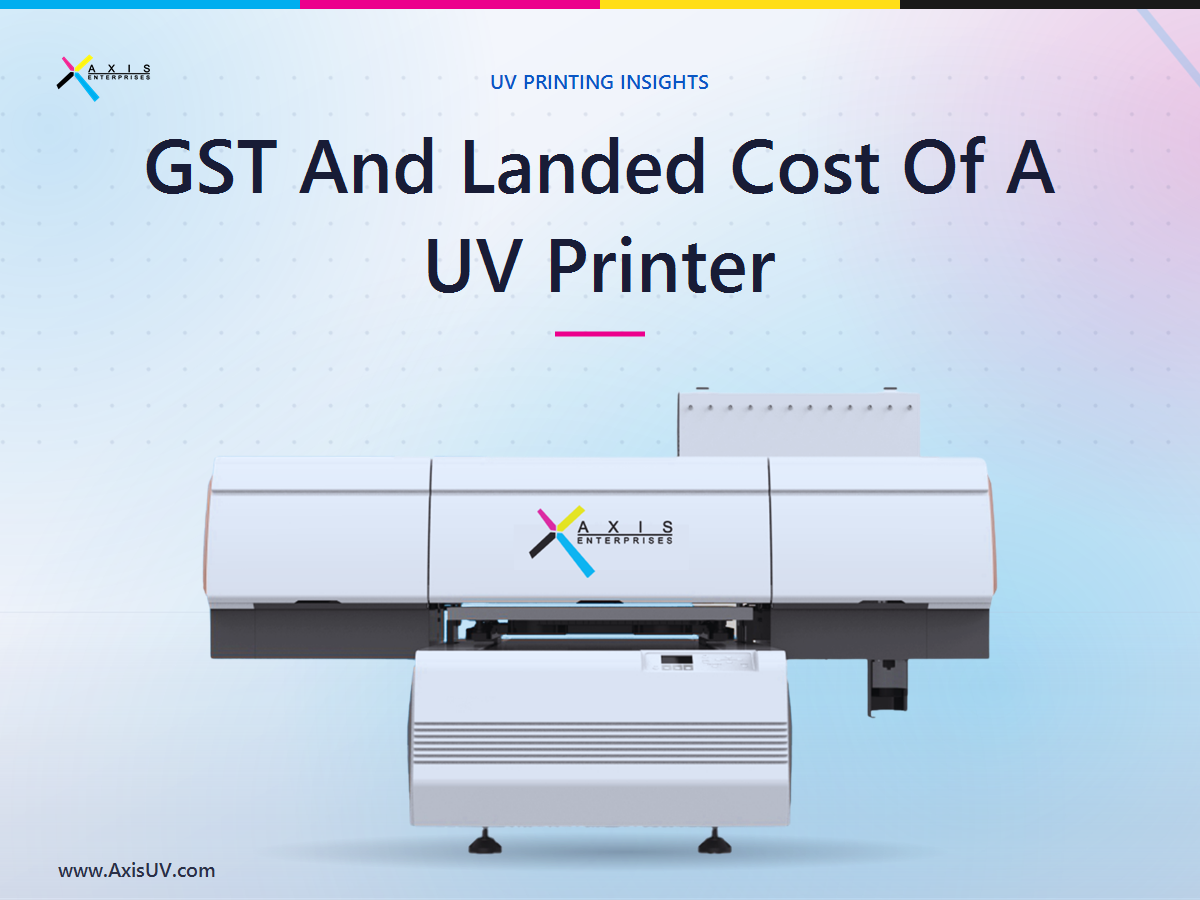
Quick answer: The price on a UV printer quotation is almost never the amount you actually pay to put the machine into production. In India, UV printers fall under HSN 8443, which carries an 18 percent GST (charged as 9 percent CGST plus 9 percent SGST inside your state, or 18 percent IGST on an inter-state sale or import). Basic Customs Duty on this category is currently 0 percent, but an imported machine still attracts 18 percent IGST plus a Social Welfare Surcharge, along with freight, insurance, installation, and training. The good news: if you are a GST-registered business buying the machine for taxable work, the 18 percent GST is usually recoverable as Input Tax Credit, and the machine can be depreciated at 15 percent a year under the Income Tax Act. Your real landed cost is the quoted price, plus taxes and delivery, minus the credits you are legally entitled to claim.
The number on the quotation is rarely the number you pay
Demand for print is not the problem. India’s digital printing market reached about USD 1.4 billion in 2024 and is projected to climb to roughly USD 2.9 billion by 2033, a compound annual growth rate near 7.8 percent, according to the IMARC Group. A separate estimate from Grand View Research puts the growth even higher, at about 9.1 percent a year through 2030. Personalized products, faster turnarounds, and shorter print runs are pulling work toward digital and UV methods.
So the opportunity is real. What quietly erodes it is a poor understanding of what a machine costs to acquire. Two buyers can pay the same sticker price and end up with very different real costs, simply because one of them planned the tax lines and credits and the other did not.
Why acquisition cost trips up so many first-time buyers
Most UV printer buyers in India are small and medium businesses, and that sector is enormous. India has more than 7.47 crore registered enterprises in the micro, small, and medium category, contributing around 31 percent of GDP and about 35.4 percent of manufacturing output, according to the India Brand Equity Foundation, which draws on Ministry of MSME data. The same sector drives close to half of the country’s exports.
That scale hides a common weakness. Many owners of small and medium enterprises buy their first capital machine the way they buy consumables: they look at one headline price and compare. A UV printer is not a consumable. It is a capital asset whose true cost is spread across taxes, logistics, commissioning, and the tax benefits you either capture or leave on the table. Comparing two quotations on sticker price alone can point you at the more expensive machine.
What actually sits inside a UV printer’s landed cost
Landed cost is the total you spend to get the machine installed and running, not just the invoice value. For a UV printer in India, the main components are:
- Base machine price: the figure most buyers fixate on.
- GST at 18 percent: UV printers sit under HSN 8443, which attracts 18 percent GST, as confirmed by EximPe’s HSN 8443 duty reference. Inside your own state this splits into 9 percent CGST and 9 percent SGST; across states or on import it is a single 18 percent IGST.
- Customs duty on imports: Basic Customs Duty for this HSN line is currently 0 percent, but an imported machine still carries 18 percent IGST on the assessable value plus duties, and a Social Welfare Surcharge on the aggregate customs duties.
- Freight and insurance: heavy, sensitive equipment costs real money to move and cover.
- Installation, commissioning, and training: the machine earns nothing until it is set up and your operator can run it.
The tax lines explained simply
If you buy a machine made in India from a domestic supplier, your tax is straightforward: 18 percent GST on the invoice. If you import, the customs side matters. Because import duty (Basic Customs Duty) on HSN 8443 printers is currently nil, the dominant tax on an imported UV printer is the same 18 percent, now collected as IGST at the port, plus the surcharge. The lesson is simple: the tax rate is broadly similar whether the machine is Indian or imported, so the honest comparison is on landed price and support, not on an imagined duty advantage.
The offsets most buyers forget
Here is where careful buyers pull ahead. The taxes above are not all a sunk cost.
Input Tax Credit. If you are GST-registered and the printer is used for taxable supplies, the 18 percent GST you pay on the machine is generally claimable as Input Tax Credit on capital goods, which directly reduces your net GST outflow. The rules, timing, and conditions are set out clearly by ClearTax’s guide to ITC on capital goods. One important caution the same guidance flags: you cannot claim the tax portion as Input Tax Credit and also depreciate that tax portion under income tax. You choose one benefit on that component, not both.
Depreciation. A UV printer is plant and machinery, which is generally depreciated at 15 percent a year on the written down value under the Income Tax Act, as listed in ClearTax’s depreciation rate tables. That is a genuine, recurring reduction in your taxable profit for years after purchase.
When you fold these in, the real economics look very different from the sticker. This is exactly what the discipline of total cost of ownership is built to capture: acquisition, taxes, operating cost, and end-of-life value, all in one view.
What smart buyers should look for in a quotation
Before you sign, judge every UV printer quotation against these criteria:
- Tax shown separately and correctly: the quotation should state the base price and 18 percent GST as distinct lines, with the correct HSN 8443 code, so you can plan your Input Tax Credit.
- Landed cost, not sticker cost: ask for freight, installation, commissioning, and operator training either included or itemized, so nothing surprises you later.
- A clear picture of consumables: ink, cleaning fluid, and print head life shape your ongoing cost, and UV curing systems differ widely in efficiency.
- GST-compliant invoicing and a real GSTIN: without a proper tax invoice, your Input Tax Credit claim is at risk.
- Service, spares, and warranty in writing: a low sticker price with weak support usually costs more over three years.
Score two quotations this way and the cheaper headline often loses. The machine that shows its tax lines, includes installation, and backs itself with service is usually the lower real cost.
A clearer way to price your first UV printer
This is the work we do every day at Axis Enterprises. Rather than hand you a one-line price, we help you build the full landed-cost and after-credit picture for the exact configuration you need, so you compare machines on truth instead of on sticker. You can compare UV printer models and configurations with tax and delivery laid out plainly, or ask us for a transparent landed-cost estimate for your specific job mix.
If you are weighing an Indian machine against an import, we will show both on the same landed-cost basis so the decision is honest. When you are ready, you can plan your first UV printer purchase with a team that treats the numbers the way your accountant would.
Frequently asked questions
What is the GST rate on a UV printer in India?
UV printers are classified under HSN 8443, which attracts 18 percent GST. Within your state this is 9 percent CGST plus 9 percent SGST; on an inter-state purchase or an import it is 18 percent IGST, per the HSN 8443 duty reference.
Can I claim the GST paid on a UV printer back?
Usually yes. If your business is GST-registered and the machine is used for taxable supplies, the GST on this capital good is generally available as Input Tax Credit, reducing your net GST payable. You cannot, however, take Input Tax Credit on the tax component and also depreciate that same component under income tax, as explained by ClearTax.
Is there customs duty on importing a UV printer?
Basic Customs Duty on HSN 8443 printers is currently 0 percent, but imports still carry 18 percent IGST plus a Social Welfare Surcharge on customs duties. Because the tax burden is broadly similar to a domestic purchase, compare on landed cost and support rather than assuming imports are cheaper.
How is a UV printer treated for depreciation?
A UV printer is plant and machinery, generally depreciated at 15 percent a year on the written down value under the Income Tax Act, according to ClearTax’s rate tables. That lowers your taxable profit each year you own the machine.
What does landed cost include?
Landed cost is the base machine price plus GST or IGST, any customs surcharge on imports, freight, insurance, installation, commissioning, and operator training. It is the number that tells you what the machine truly costs to put into production.
Next step
If you are planning your first UV printer, price it the way a finance-literate owner would: on landed cost after credits, not on the sticker. Bring your job mix and your questions, and book a free UV printing machine buying consultation with the Axis Enterprises team. We will lay out the taxes, the credits, and the real cost so you buy the right machine once, with no surprises.
Sources
- IMARC Group, India Digital Printing Market
- Grand View Research, India Digital Printing Market Outlook
- India Brand Equity Foundation (IBEF), MSME Industry in India
- EximPe, Printer HSN Code 8443, GST Rate and Customs Duty
- ClearTax, ITC Rules for Capital Goods under GST
- ClearTax, Depreciation Rates under the Income Tax Act