

Published: August 6, 2026
Quick answer: can you print machine panels and control overlays in-house with a UV printer?
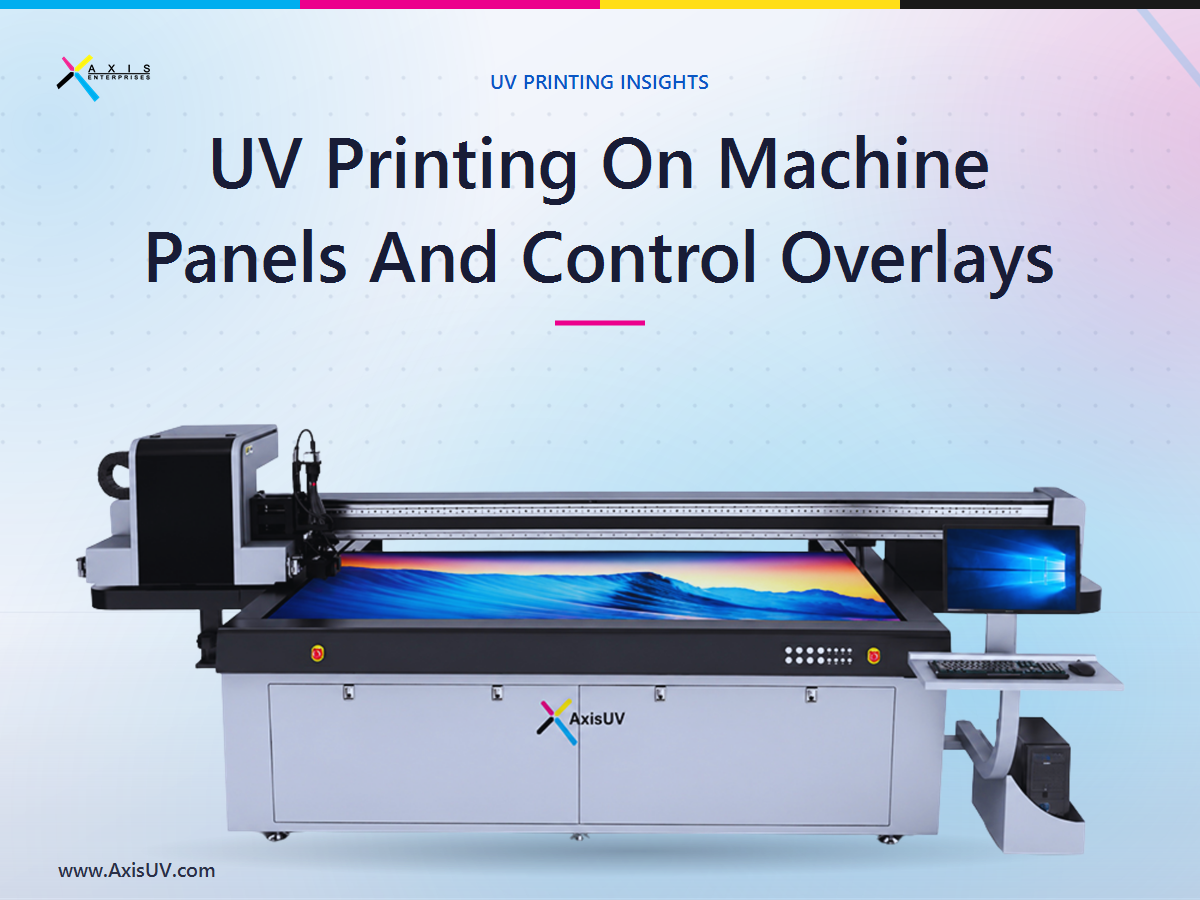
Yes. A flatbed UV printer prints graphics, legends, warning marks, and branding directly onto machine control panels, equipment fascia, and rigid overlay plates in polycarbonate, acrylic, aluminium, and ABS. The ink is cured instantly by ultraviolet light, so the print bonds hard to the surface and resists scratching, solvents, and daily machine-floor handling. For an Indian manufacturer or job-work shop, this replaces slow, batch-minimum outsourcing with same-day, single-piece production. The machine sits with you, the artwork stays with you, and revisions that once took a week take an afternoon. That control is the real prize, not just the printing.
Why machine panels quietly drain margin and time
Every piece of industrial equipment carries printed information: control legends, dial markings, safety symbols, model plates, and brand identity. Most Indian manufacturers still buy these panels from an outside vendor. That single decision shapes cost, lead time, and quality far more than owners expect.
The market for these parts is large and growing. According to Precedence Research, the global membrane switch and control-overlay market was valued at about USD 7.20 billion in 2025 and is forecast to reach USD 15.54 billion by 2035. Expert Market Research places 2025 value higher still, near USD 11.61 billion, and projects growth at a 12.30% CAGR through 2035. The demand is not shrinking. It is accelerating, pulled by electric vehicles, appliances, and factory equipment that all need printed human-machine interfaces.
That growth sits on top of a booming Indian industrial base. India’s capital goods sector production rose from Rs. 2,66,672 crore in FY21 to Rs. 5,69,900 crore in FY25, according to the India Brand Equity Foundation (IBEF). More machines built means more panels, plates, and overlays printed. The question for a shop owner is simple: who prints them, and who keeps the margin?
What this means for small and mid-size manufacturers
Outsourcing a printed panel usually costs more than the ink and material inside it. The hidden costs are minimum order quantities, freight, rework cycles, and waiting.
Most panel vendors will not run a single piece. They set batch minimums, so a design change forces you to either scrap unused stock or wait for a full new run. A rejected legend, a wrong revision number, or a new customer logo can mean a week lost and a new invoice. On a busy floor, that delay stalls machine dispatch, not just the panel.
India’s manufacturing engine is overwhelmingly made of exactly the businesses that feel this pain. As of July 2025, the country had roughly 6.53 crore registered MSME units, and the sector accounts for about 35.4% of manufacturing output, per the Press Information Bureau, Government of India. The micro, small and medium enterprises that dominate Indian production rarely have the volume to command good panel pricing, so they absorb the worst of the batch-minimum trap.
At the same time, the equipment those shops build is getting more sophisticated. India’s industrial control and factory automation market was valued near USD 17.30 billion in 2025 and is projected to reach USD 47.21 billion by 2034, according to MarketsandMarkets. More automation and Industry 4.0 adoption means more control interfaces per machine, and more panels to print, revise, and re-revise.
How UV printing actually works on a control panel
UV printing lays ink directly on the panel and hardens it in place with ultraviolet light in the same pass. There is no drying rack and no lamination step for the print itself.
The process is a form of UV curing: as the print head deposits droplets, an ultraviolet source cures them instantly through a photochemical reaction that builds a cross-linked polymer network. That cross-linking is why the print is tough. Industry technical guidance notes that UV inks chemically bond to the substrate and deliver high hardness, abrasion resistance, and chemical resistance suited to handling wear and environmental exposure, as described by industrial-print reference material from Andresjet.
Adhesion and durability are measurable, not marketing claims. Cross-hatch adhesion is checked against the ASTM D3359 tape test, with typical factory-pass criteria of 4B to 5B on plastics after priming and 5B on metals, again per Andresjet technical notes. Resolutions up to 5760 dpi let a printer render fine control legends, dense symbol sets, and complex layouts on a single panel. For machine fascia in polycarbonate, that means legible, durable graphics without a separate screen-printing setup for each color.
What smart buyers should look for before spending on a machine
A UV printer for panels and overlays is judged on adhesion, flat-registration accuracy, cured-finish hardness, and total running cost, not on headline speed alone. A machine that prints fast but peels on a control plate is worthless on a factory floor.
Use this checklist when comparing options:
- Flatbed handling for rigid panels: the bed should hold thick, rigid plates flat and register them precisely, so legends line up with cutouts and buttons.
- Verified adhesion on your real substrates: ask for a printed sample on your own polycarbonate, acrylic, or aluminium, then run a tape test yourself. Do not accept a demo on unfamiliar material.
- White ink and varnish capability: panels often need opaque white under color and a protective clear coat. Confirm the printer runs both cleanly.
- Honest total cost of ownership: look past the sticker price to ink, maintenance, and downtime. Total cost of ownership over three years tells the real story.
- GST-aware landed cost: factor Goods and Services Tax (India), freight, and installation into your payback math, not just the ex-works quote.
- Local service and consumable supply: a print head or lamp failure with no nearby support turns an asset into a paperweight. Confirm response time and parts availability in India before buying.
A better way forward
Once you see panels as an in-house capability rather than a purchase order, the economics change. Every job that used to leave the building becomes margin you keep, on your schedule. That is exactly what a flatbed UV printer is built to do, and it is the category Axis Enterprises focuses on at uvprinterindia.com.
If you are weighing whether panels and overlays justify a machine, the honest answer depends on your monthly volume, your substrates, and your current outsourcing spend. Rather than guess, you can book a free UV printing machine buying consultation and walk through your own numbers. It also helps to compare UV flatbed printer options against the exact panels you make today, and to request a printed sample on your material so you can test adhesion before committing a single rupee.
Frequently asked questions
Which materials can a UV printer handle for machine panels?
UV flatbed printers print on rigid and semi-rigid substrates including polycarbonate, acrylic, ABS, aluminium, and coated metal. These cover most control panels, fascia plates, and equipment nameplates. For difficult metals or plastics, a primer improves adhesion so the print passes a cross-hatch tape test at the factory-standard grade.
Is UV-printed graphic durable enough for a factory floor?
Yes, when cured and specified correctly. UV inks form a cross-linked polymer film that resists scratching, handling wear, and many solvents. Adhesion is verified against ASTM D3359, and a clear varnish layer can be added for panels exposed to heavy abrasion or chemicals. Durability comes from the cured finish, not from a laminate over a weak print.
Does in-house panel printing really save money for a small shop?
It usually does, because the biggest costs of outsourcing are hidden: batch minimums, freight, rework, and lost days waiting for a revision. India had roughly 6.53 crore MSME units as of July 2025, and most lack the volume to command good panel pricing, so they overpay per piece. Printing in-house removes the minimum-order penalty and lets you run one corrected panel the same day.
How fast is the payback on a UV printer for panels?
Payback depends on your current outsourcing spend, monthly panel volume, and material mix, so a fair estimate needs your real numbers. The reliable way to size it is to add up what you pay outside vendors per month, including rework and freight, then compare that against the machine’s running cost. A short consultation with your own figures gives a far more honest answer than any generic table.
Why is demand for printed panels growing?
Because machines are getting more connected and more numerous. India’s industrial control and factory automation market was valued near USD 17.30 billion in 2025 and is projected to reach USD 47.21 billion by 2034, per MarketsandMarkets. More automation means more human-machine interfaces per machine, and the global membrane-switch and overlay market is climbing toward USD 15.54 billion by 2035, per Precedence Research.
Next step
If you build machines, cabinets, or equipment and still send every printed panel out of the building, you are handing away margin and control on work you could own. Take an afternoon, list what you outsource in a typical month, and pressure-test whether an in-house UV printer changes the math for your shop. When you are ready to run those numbers against real samples on your own materials, book a free UV printing machine buying consultation and get a straight answer for your business.
Sources
- India Brand Equity Foundation (IBEF): India’s Engineering and Capital Goods Industry
- Press Information Bureau, Government of India: MSME sector contribution to GDP, manufacturing and exports
- Precedence Research: Membrane Switch Market Size and Forecast
- Expert Market Research: Membrane Switch Market Report
- MarketsandMarkets: India Industrial Control and Factory Automation Market
- Andresjet: How UV LED Curing Creates Scratch-Resistant Prints
- Andresjet: UV Ink Properties for Industrial Printing