
Published: September 28, 2026. Last updated: September 28, 2026.
Quick answer: For most Indian print, signage, and product-branding businesses, UV printing is the stronger long-term choice, while eco-solvent printing suits shops focused mainly on vehicle wraps and flexible vinyl banners. UV cures ink instantly with light, prints directly on rigid materials like acrylic, wood, metal, and glass, emits no volatile solvents, and lets you finish and ship jobs the same hour. Eco-solvent has a lower entry price and excellent flexibility on vinyl, but it needs coated media, a drying window of several hours, and better ventilation. The right pick depends on your product mix, not on brand hype. This guide explains how to decide.
Why does the printing technology you choose decide your margins?
The technology behind your printer quietly sets your profit ceiling for years, because it decides which jobs you can accept, how fast you can turn them around, and how much you spend on rework. Choosing wrongly is one of the most expensive mistakes a growing print business can make.
Demand is not the problem. According to IMARC Group, the India digital printing market stood at USD 1.50 billion in 2025 and is projected to reach USD 2.94 billion by 2034, growing at a compound annual rate of 7.64 percent. On the equipment side, Mordor Intelligence valued the global UV printers market at USD 1.02 billion in 2025 and expects it to reach USD 1.58 billion by 2031, a 7.59 percent annual growth rate.
The customers are there. The gap is capability. A shop that can only print flexible vinyl competes on price with hundreds of other shops. A shop that can print on rigid and unusual materials commands premium rates. That difference usually traces back to the ink and curing technology chosen on day one.
What is UV printing, and what is eco-solvent printing?
UV printing and eco-solvent printing are both inkjet methods, but they dry the ink in completely different ways, and that single difference drives every practical trade-off that follows.
What is UV printing?
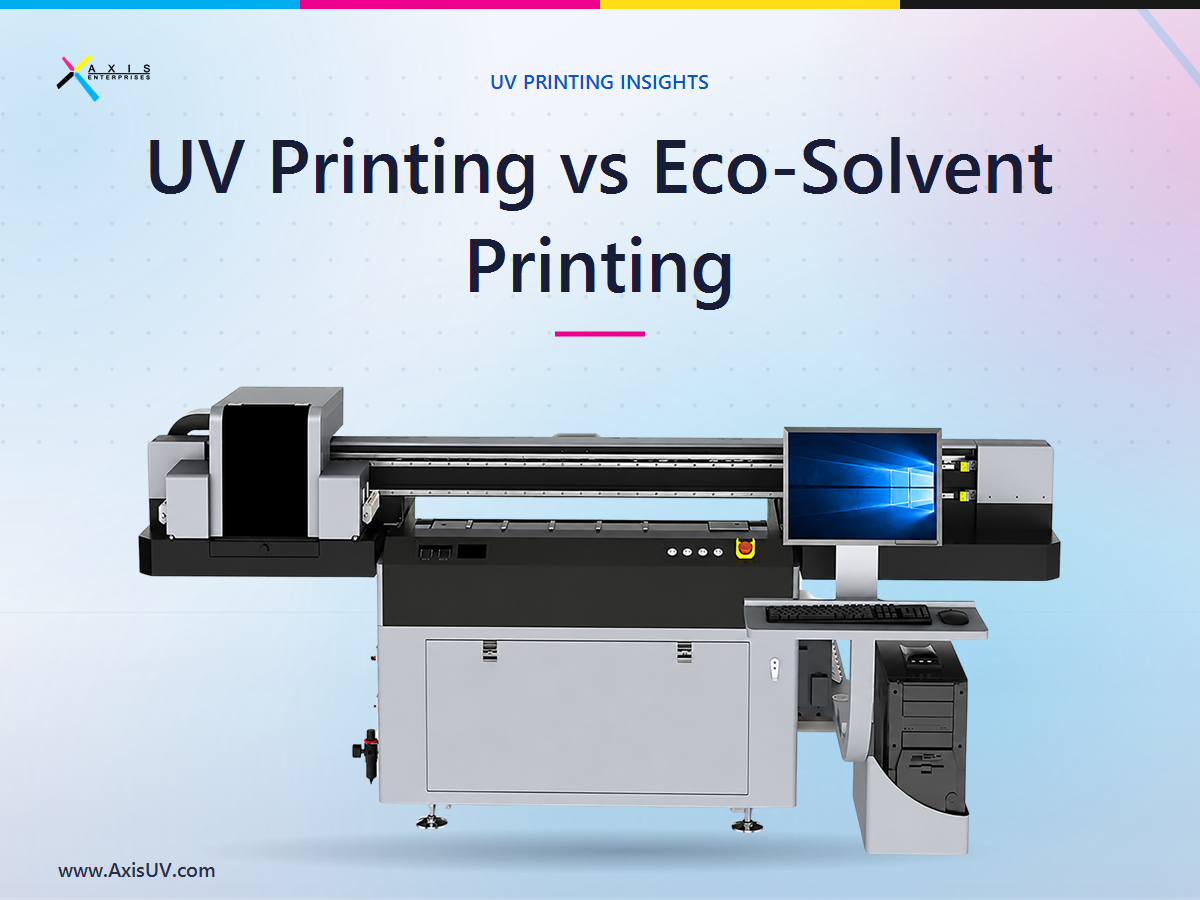
UV printing lays down liquid ink and instantly hardens it using ultraviolet light, a process known as UV curing. Because the ink sets on contact rather than soaking in, it bonds to non-absorbent surfaces. Modern machines use UV LED lamps, and the ink is a photopolymer that contains no evaporating solvent. Most flatbed models sold to Indian businesses fall under the broad category of wide-format printers.
What is eco-solvent printing?
Eco-solvent printing uses inks carried in a mild solvent that evaporates as the print dries, leaving pigment behind. It is a lower-odor version of hard-solvent printing, designed for indoor use. Because it relies on evaporation, the ink needs media that can hold it, and it releases a small amount of solvent vapour, a form of volatile organic compound, as it cures.
Where does eco-solvent printing quietly cost Indian print shops money?
Eco-solvent printing loses money in three hidden places: waiting time, limited materials, and rework. None of these show up on the price tag, which is exactly why they catch first-time buyers by surprise.
The biggest hidden cost is drying time. Mark Sollman, Application Manager at Mimaki Europe, explains in an analysis published by WhatTheyThink that solvent prints need a gas-off period before finishing, and that post-processing can take “at least 6 and sometimes up to 24 hours.” A UV print, by contrast, can be laminated, cut, or handed to the customer immediately.
The second cost is material restriction. Eco-solvent inks need coated or receptive media to work well, which rules out most rigid and industrial substrates. For an Indian SMB trying to add higher-margin products like signage boards, gift items, or panels, that limit caps the catalogue.
The third cost is environment and compliance. Because eco-solvent still emits solvent vapour, indoor shops need proper ventilation, and staff comfort suffers in small units. As formalisation spreads across the sector, with more than 7.83 crore enterprises now registered on the Udyam portal according to IBEF, cleaner processes are becoming a competitive expectation, not a nice-to-have.
UV printing vs eco-solvent printing: how do they actually compare?
On the factors that decide daily profit, curing speed, material range, durability, and emissions, UV printing leads, while eco-solvent holds an edge on upfront cost and on flexible vinyl. The table below sums up the practical differences.
The emissions point is not marketing spin. Jim Bishop, Field Product Manager at Sun Chemical, states in an article by UV+EB Technology that “Energy-curable inks are considered zero VOC or 100 percent solids, thus diminishing the discussion around emissions.” In the same article, Fabien Koehn, Global Head of Product Management at Siegwerk, notes that LED-UV lamps “consume only a fraction of the energy” of older mercury-arc lamps and switch on and off instantly, which lowers running electricity cost.
What should a smart buyer look for before choosing?
The smartest way to choose is to work backward from your product mix and your customers, not forward from the lowest sticker price. A printer is a five to seven year decision, so the buying criteria that matter most are the ones that protect future revenue.
Use these criteria to judge any machine, whichever technology it uses:
- Material range that matches your growth plan: list every product you want to sell in three years, then confirm the printer can handle those surfaces without workarounds.
- Real turnaround, not just print speed: count the time from print to shippable, including any drying or lamination, because that number sets how many jobs you clear per day.
- Total cost of ownership, not just the quote: weigh ink yield, electricity, maintenance, and consumables over years, and remember that as a registered business you can usually claim input tax credit on the Goods and Services Tax (India) paid on capital equipment.
- Local service and spare parts: a printer down for a week can cost more than the price gap between two machines, so response time and parts availability matter more than brochure specs.
- Clean operation: lower emissions and lower energy use protect both your team and your margins, and increasingly your reputation with larger clients.
India already has a deep printing base to compete in, described in the overview of the printing industry in India. Standing out inside it means widening what you can offer, not just cutting your price.
A better way forward for Indian print and signage businesses
For most Indian SMBs weighing this decision, a flatbed UV printer is the more future-proof foundation, because it opens the widest range of products from a single machine and removes the daily drag of drying time. That is the exact problem Axis Enterprises helps businesses solve. At uvprinterindia.com, we help owners match the right UV printing machine to their real product mix and volume, rather than pushing the most expensive model.
If you are still comparing options, it helps to talk through your specific catalogue, floor space, and budget before you commit. You can book a free UV printer buying consultation, and our team will walk you through machine sizes, materials, and running costs in plain terms. Owners who are new to the technology often start by reviewing our range of flatbed UV printers to see what each configuration can produce.
Next step
If you run a print shop, signage business, or product-branding unit and you want a straight answer on which technology fits your goals, take a short, no-pressure buying consultation. Bring your product list and your monthly volumes, and you will leave with a clear recommendation and a realistic cost picture in Indian Rupees. Start at uvprinterindia.com and request your free consultation today.
Frequently asked questions
Can one UV printer really print on acrylic, wood, glass, and metal?
Yes. Because UV ink cures instantly on the surface rather than soaking in, a single flatbed UV printer can print on acrylic, wood, glass, metal, PVC, and many other rigid materials, provided the correct primer and profile are used. This material range is the main reason businesses choose UV over eco-solvent.
Is eco-solvent printing still worth buying in 2026?
Eco-solvent still makes sense for businesses focused mainly on vehicle wraps, flexible vinyl banners, and indoor graphics, where its lower machine cost and vinyl flexibility are real advantages. If your plan is to add rigid products or premium branding, UV printing gives you more room to grow.
Which technology is better for outdoor durability?
Both perform well outdoors. UV prints offer strong scratch and weather resistance and often need no lamination, while eco-solvent prints are durable but usually require lamination for long outdoor life, according to the Mimaki analysis published by WhatTheyThink. For rigid outdoor signage, UV is usually the simpler workflow.
Is UV printing more environmentally friendly than eco-solvent?
Generally yes. UV inks are described by ink makers as zero VOC or 100 percent solids, meaning they release no evaporating solvent, while eco-solvent inks emit a small amount of solvent vapour and need ventilation. UV LED curing also uses less electricity than older lamp systems.
How do I decide between the two for my business?
Start with your product mix. If most of your revenue comes from vinyl and wraps, eco-solvent can work. If you want to sell across materials, ship faster, and charge premium rates, UV printing is the stronger long-term investment. Matching the machine to your catalogue matters more than the sticker price.
Sources
- IMARC Group: India Digital Printing Market
- Mordor Intelligence: UV Printers Market
- WhatTheyThink: UV vs. Solvent, Which is Better for your Business (Mark Sollman, Mimaki Europe)
- UV+EB Technology: Sustainability of Energy-Curable Inks and Coatings (Sun Chemical, Siegwerk)
- IBEF: Over 7.83 crore enterprises registered on Udyam platforms