
Quick answer
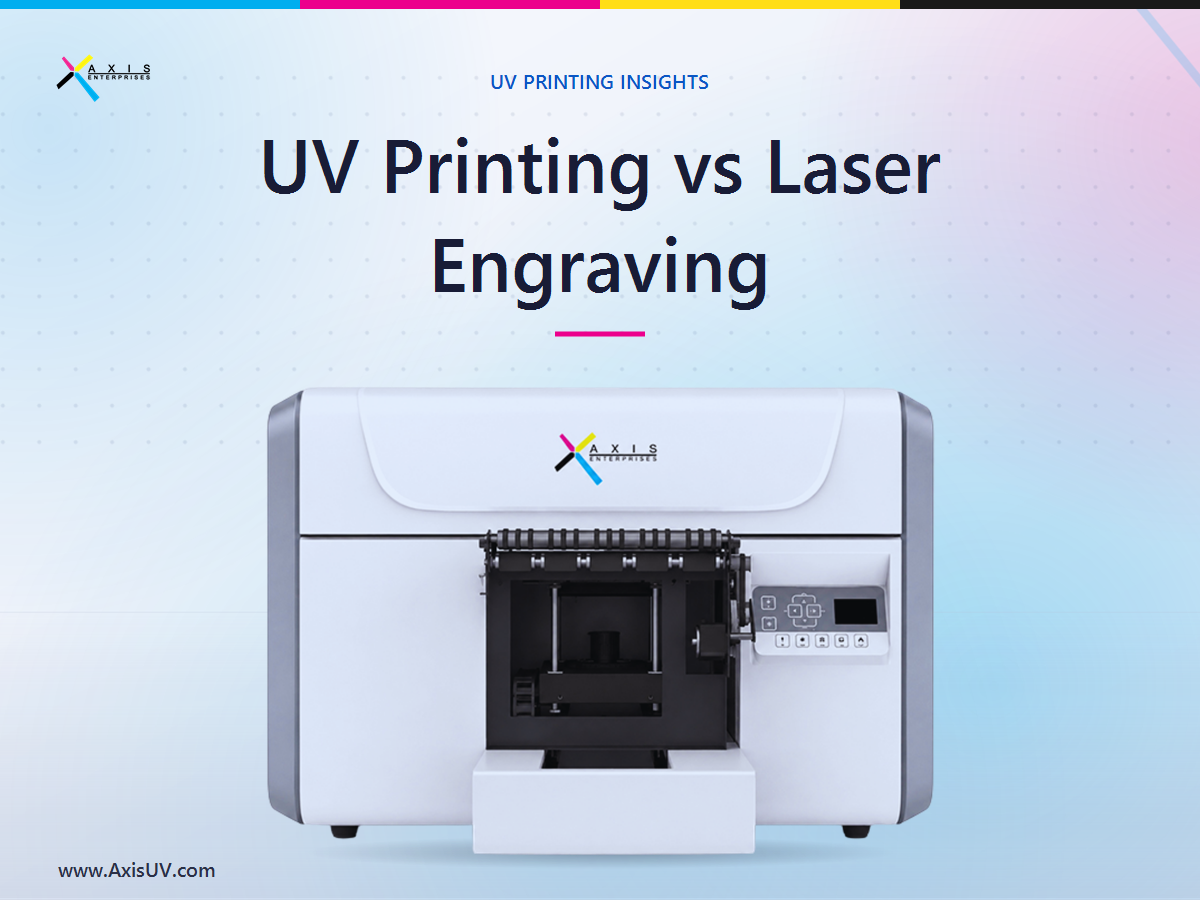
Laser engraving and UV printing solve different problems, so the right choice depends on what you sell, not on which machine sounds more advanced. Laser engraving burns or etches a permanent mark into a surface, so it is ideal for single-color, high-durability marks on metal, wood, and acrylic (serial numbers, logos, industrial nameplates). UV printing lays down full-color ink and cures it instantly with ultraviolet light, so it is the better fit when you need photographic color, gradients, white ink, gloss varnish, or printing across many material types on one machine (phone cases, signage, gift items, packaging, promotional products). If most of your orders are full-color and varied, buy a UV printer. If most of your orders are one-color permanent marking on hard surfaces, buy a laser. Many growing product businesses in India end up choosing UV printing because it covers a far wider range of paying jobs on a single machine.
The decision most product businesses get backwards
Here is something most first-time buyers do not realize: the two technologies are not really competitors. They are growing in parallel because they serve different demand.
According to Grand View Research, the global laser marking machine market was valued at about USD 4.1 billion in 2025 and is projected to reach roughly USD 7.3 billion by 2033, a compound annual growth rate near 7.4 percent. In the same research, the wider marking and engraving segment generated USD 4,445.7 million in 2024 and is expected to reach USD 7,463.2 million by 2030. On the other side, the India inkjet printer market analysis by Mordor Intelligence reports that UV-curable inks are the fastest-growing ink category in the country, advancing at about 5.72 percent a year, faster than the overall inkjet market at 3.76 percent. Both markets are expanding. That tells you the question is never “which technology is winning,” it is “which one earns money on the orders I actually get.”
Why “just buy a marking machine” is costing owners money
The costly mistake is buying for the technology instead of the order book. A laser bought to chase color jobs will disappoint, and a UV printer bought only to etch steel plates is overkill. When the machine and the demand do not match, utilization stays low and the payback period stretches out.
Demand for customization keeps rising. Research from McKinsey finds that 71 percent of consumers now expect personalized interactions from the businesses they buy from, and that personalization can lift revenues by 5 to 15 percent. Deloitte Digital research adds that 1 in 5 consumers are very willing to pay a premium for a product they helped personalize, and half believe customized items make ideal gifts. A large share of that demand is full-color: names, photos, brand logos in exact shades, gradient backgrounds. Single-color engraving cannot capture most of it.
What this means for a small Indian print or product business
India now has a very large base of exactly the kind of business that buys these machines. As reported by the Ministry of Micro, Small and Medium Enterprises (PIB), more than 7.83 crore enterprises are registered on the Udyam platforms, and about 98.9 percent of them are micro enterprises. These are signage shops, gift and personalization studios, packaging and label printers, promotional-product makers, and small manufacturers. For a business this size, one wrong capital purchase hurts. The machine has to earn across many small, varied orders, not one specialized job type.
That is why the color question matters so much. If a customer wants a full-color photo mug, a laser cannot do it. If a customer wants a deep permanent serial number etched into a stainless nameplate that will sit outdoors for years, that is laser territory. Most small Indian product businesses see far more of the former than the latter.
How UV printing and laser engraving actually differ
Understanding the mechanism removes most of the confusion.
What laser engraving does well
Laser engraving uses a focused laser beam to remove or alter the surface of a material, cutting the design physically into the object. Because there is no ink and no tool that touches and wears out, the mark is extremely durable and consumable cost is very low. It excels at permanent, single-color marking on metal, wood, acrylic, and leather. It is the natural pick for industrial traceability, deep engraved logos, and hardwearing plates.
What UV printing does well
A UV printer is an inkjet device that jets tiny droplets of UV-reactive ink and instantly hardens them with ultraviolet light, a process called UV curing. Because it prints actual ink, it produces full CMYK color, photographs, gradients, white ink under-base for dark or clear items, and raised gloss varnish for texture. A single flatbed UV printer can move from acrylic to wood to metal to plastic to glass without changing machines, which is why it appears across so much of the printing industry in India.
The one difference that decides most jobs
Color. Laser gives you one tone, usually a burn or an etch. UV printing gives you the full palette plus white and varnish. If your customers ask for logos in brand colors, product photos, or vibrant designs, that single fact usually settles the decision before any spec sheet is opened.
The smarter way to choose between them
Stop comparing brochures and start with your last 100 enquiries. Sort them into two piles: full-color or multi-material jobs versus single-color permanent-etch jobs. The bigger pile points to your machine. Then weigh these criteria:
- Order mix: How many jobs need color, white ink, or gloss? Those are UV jobs.
- Material range: Do you print on many surfaces, or mostly metal and hard substrates?
- Durability demand: Do customers need marks that survive years of abrasion and weather, or attractive full-color decoration?
- Total cost of ownership: Judge machines on lifetime running cost, not sticker price. A useful frame is total cost of ownership, which includes ink or consumables, maintenance, power, and the value of jobs you can and cannot accept.
- Revenue ceiling: Which machine lets you say yes to more enquiries without buying a second one?
What to look for before you buy either machine
- A clear match between the machine and your real order book, proven with your own sample files.
- A supplier who lets you run a test print or engraving on your actual products before purchase.
- Transparent running-cost figures, including ink or consumable usage per job.
- Reliable after-sales service, spare parts, and operator training in India.
- GST-compliant invoicing so that a registered buyer can claim input tax credit under the Goods and Services Tax (India) system, which lowers the effective cost of the machine.
- Room to grow: white ink, varnish, and multi-material support if your customers are moving toward premium, personalized work.
A better way forward
Given how much of today’s demand is full-color and personalized, most small and mid-size product businesses in India get more paying jobs from a UV printer than from a single-purpose engraver. At Axis Enterprises, we help owners make this exact call without the sales pressure: we look at your product mix and tell you honestly whether UV printing fits, and which configuration matches your volumes. You can book a free UV printing machine buying consultation to walk through your order book with us, or explore our range of UV flatbed printers to see what full-color, multi-material printing looks like for your business. If you are weighing the numbers, our team can also help you estimate running cost and payback for your specific product line.
Frequently asked questions
Can a UV printer do everything a laser engraver can?
Not exactly. A UV printer decorates surfaces in full color and can add texture with gloss varnish, but it prints on top of the material rather than cutting into it. For deep, physically engraved marks on bare metal that must survive heavy abrasion, a laser is still the specialist tool. For color decoration and personalization across many materials, UV printing is far more versatile.
Which lasts longer, a UV print or a laser engraving?
A laser engraving is a physical cut into the material, so it is essentially permanent and resists wear. A well-cured UV print bonds hard to the surface and holds up strongly to handling and indoor use, and it can be protected further with a varnish layer or primer for demanding surfaces. For pure abrasion resistance on metal, laser leads. For durable full-color decoration, UV printing performs very well.
Which machine is better for a personalized gifting business in India?
Usually UV printing. Gifting orders lean heavily on full-color photos, names, and brand logos across mugs, phone cases, bottles, and wooden items. Deloitte Digital research shows half of consumers see customized products as ideal gifts, and most of that work needs color, which is UV territory rather than single-tone engraving.
Is UV printing growing faster than laser marking in India?
Both are growing. Mordor Intelligence reports UV-curable inks as the fastest-growing ink type in India’s inkjet market at about 5.72 percent a year, while Grand View Research puts the global laser marking machine market at roughly 7.4 percent annual growth. The practical takeaway is that demand exists for both, so buy for the jobs you actually receive.
Should I buy both machines?
Only once volume justifies it. Most owners start with the one machine that matches the larger share of their orders, reach healthy utilization, and add the second technology later when specific demand appears. Buying both upfront ties up capital that could be earning.
Next step
If you are deciding between UV printing and laser engraving, do not choose based on which machine sounds more impressive. Choose based on the orders sitting in your inbox. Bring your product list and recent enquiries, and we will help you see clearly which technology pays for itself faster for your business. Visit uvprinterindia.com to book a free, no-obligation UV printing machine buying consultation.
Sources
- Grand View Research, Laser Marking Machine Market Size and Share Report
- Grand View Research, Marking and Engraving (Laser Processing Market) Statistics
- Mordor Intelligence, India Inkjet Printer Market
- McKinsey, What is personalization?
- Deloitte Digital, Personalizing Brand Experiences
- Press Information Bureau, Ministry of Micro, Small and Medium Enterprises (Udyam Registration data)
- Wikipedia, Laser engraving
- Wikipedia, UV curing
- Wikipedia, Inkjet printing
- Wikipedia, Printing industry in India
- Wikipedia, Total cost of ownership
- Wikipedia, Goods and Services Tax (India)