
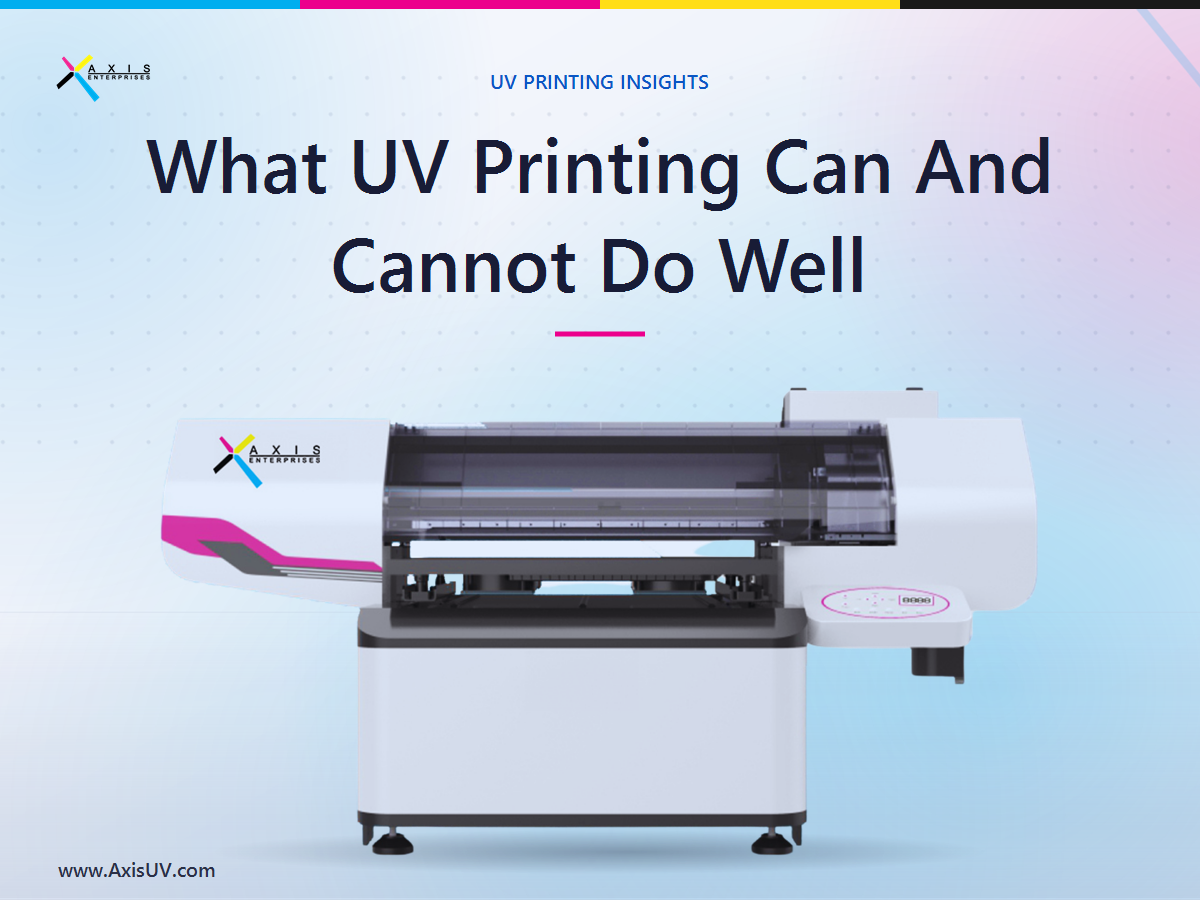
Quick answer: A UV flatbed printer prints full color, often with white ink and clear varnish, directly onto rigid and mostly flat materials such as acrylic, wood, glass, metal, MDF, PVC, tile, leather, and many plastics. It cures each pass instantly with ultraviolet light, so there is no drying time and the print resists water and daily handling. It is excellent for short runs, personalization, and one-off pieces with no minimum order. It is a weaker fit for highly flexible items that bend sharply, deeply curved or round objects without a jig, very large flat-area production at offset-press volumes, and soft fabric garments. Match the machine to your real product mix, not to a feature list.
Why does this question matter before you buy?
Buyers lose money in two directions: by expecting a UV printer to do everything, or by assuming it cannot do the jobs that actually pay. Both mistakes come from treating the machine as magic instead of a tool with a clear sweet spot.
The market is pulling more Indian businesses toward in-house printing every year. According to IMARC Group, the India digital printing market was valued at about USD 1.4 billion in 2024 and is projected to reach USD 2.9 billion by 2033, a compound annual growth rate near 7.8 percent. Demand is real, but it rewards owners who buy for the right reasons.
What is UV printing, in plain terms?
UV printing is a form of inkjet printing that jets liquid ink onto a surface and then hardens it immediately using ultraviolet light, a process called UV curing. Because the ink sets through a photochemical reaction rather than by evaporating, almost all of the ink stays on the surface as a durable layer.
This instant curing is the source of both the strengths and the limits. It lets you print on surfaces that will not absorb ink, and it builds a slightly raised, robust film. That same film is why very flexible or sharply bending products need extra care.
What does UV printing do well?
UV printing is strongest where you need color and detail placed directly on a hard surface, in low to medium volumes, fast. Its core advantages come straight from how UV-curable ink behaves.
- Many materials from one machine. Acrylic, wood, glass, metal, aluminium composite, PVC, foam board, tile, leather, and most rigid plastics can run on the same flatbed with the right profile.
- No drying wait. The ink cures as it prints, so a finished piece is ready to handle in seconds, which shortens turnaround.
- Durability. Cured prints resist water, scratching, and fading far better than ordinary inkjet output, which suits signage, nameplates, and product branding.
- White ink and varnish. UV machines can lay a white underbase for dark or clear materials and a spot gloss varnish for premium, tactile finishes that other methods struggle to match.
- Personalization with no minimum. You can print a single customized piece profitably, which is ideal for gifts, awards, and made-to-order products.
Globally this capability is growing fast. The firm 360iResearch estimated the UV digital inkjet printer market at about USD 3.18 billion in 2025 and projected it to reach roughly USD 7.48 billion by 2032, a compound annual growth rate near 12.98 percent. Within India, Mordor Intelligence reports that UV-curable inks are advancing faster than most ink categories, at about a 5.72 percent CAGR, a sign of where demand is heading.
Where does UV printing struggle?
UV printing is a weaker fit for jobs that fight against a rigid, instantly cured ink film. Knowing these limits up front prevents disappointed customers and wasted material.
- Sharply flexible items. Because cured UV ink forms a solid layer with real thickness, it can crack if the surface is bent hard, so very flexible substrates need flexible ink formulations and testing.
- Round and deeply curved objects. A standard flatbed prints on flat or gently raised surfaces. Bottles, mugs, and curved parts need a rotary attachment or a well-made jig, not the bare bed.
- Soft fabric and garments. UV printing is not the right tool for stretchable t-shirts and apparel, where methods such as screen printing or dye sublimation suit the fabric better.
- Very high flat-area volumes. For huge runs of the same flat graphic at the economics of an offset or flexographic press, those presses can still win on cost per piece at scale.
- Difficult surfaces without preparation. Some glass, metal, and smooth plastics need a primer and clean surface for strong adhesion, so “print on anything” always carries an asterisk.
Capability at a glance
Who should pay closest attention to these limits?
Owners of small and mid-sized Indian businesses carry the most risk from a mismatched machine, because they fund it from working capital and expect it to earn quickly. India has a very large base of such firms: the Ministry of Micro, Small and Medium Enterprises reported through the Press Information Bureau that more than 4.91 crore enterprises had registered on the Udyam portal, and SIDBI notes that MSMEs contribute roughly 30 percent of India’s GDP and about 45.79 percent of its exports.
Signage shops, promotional product makers, gift and personalization businesses, phone-case and drinkware brands, furniture and interior firms, packaging and label units, and small manufacturers are the typical buyers. Each has a different product mix, so the “right” machine is different for each, even though the brochure looks the same.
The common pain is buying on headline features instead of your own order book. A shop that mostly makes curved drinkware needs rotary capability. A sign maker needs bed size and white ink. A gifting brand needs fast setup for tiny runs. One spec sheet cannot serve all three equally.
How should a smart buyer judge a UV printer?
Judge the machine against your actual products first, then against price. The right question is not “what is the best UV printer,” it is “what is the best UV printer for the jobs that pay my bills this year.”
Use these criteria in order:
- Product match. List your top ten current and target products, then confirm the machine prints each one well, including any that are round or flexible.
- Material proof. Ask for a printed sample on your own material with the correct primer and profile, not a generic demo swatch.
- Bed size and configuration. Match the print area to your real pieces, and decide whether you need white ink, varnish, or a rotary device.
- Total cost, not sticker price. Factor ink, maintenance, spares, power, and the 18 percent GST that applies to the machine, remembering that a registered business can usually claim input tax credit on it.
- Support and spares. Confirm local service response time and parts availability before you confirm the price, because downtime costs more than a small discount saves.
What should you look for in a supplier?
Choose a supplier who sizes the machine to your products and tells you honestly what it cannot do. A partner who only lists strengths is selling a brochure, not a business tool.
Look for these signs: a willingness to print a test on your material, a clear explanation of white ink and varnish, honest guidance on round or flexible items, transparent total-cost figures with GST shown, and a service plan with named response times and local spares. These are the habits that keep your machine earning after the sale.
A better way to decide
Once you have mapped your product list against real capabilities, the choice gets simple. This is exactly where a buyer-first conversation helps more than a price list, and it is the approach we take at UV Printer India. Our focus is helping Indian SMBs choose a UV flatbed that fits their products, their volumes, and their budget, rather than overselling features you will never use.
If you are weighing whether UV printing suits your range, you can book a free UV printing machine buying consultation and get an honest read on fit before you spend. We will also run a sample on your own material so you see the result on the surfaces you actually sell, and walk you through configuration, white ink, varnish, and realistic running costs.
Next step
If you are serious about bringing printing in-house, start by listing the products you make most and the ones you want to win next, then test a machine against that list before you commit. When you are ready for a second opinion, you can talk to the UV Printer India team for a no-pressure buying consultation focused on matching the right machine to your work.
Frequently asked questions
Can one UV printer really print on acrylic, wood, glass, and metal?
Yes. A single UV flatbed can print on acrylic, wood, glass, metal, MDF, PVC, tile, and leather, provided you use the correct color profile for each material and a primer on surfaces that need better adhesion. The machine itself does not change; the preparation and settings do.
Can a UV flatbed print on curved or round products?
Not on the bare bed. A flatbed is built for flat or gently raised surfaces, so bottles, mugs, and round items need a rotary attachment or a custom jig that holds the piece correctly. Without one, the print will be distorted or incomplete.
Which material is easiest to start with?
Flat, rigid sheets such as acrylic, PVC foam board, and metal composite panels are the easiest for a new operator. They sit flat, hold ink well with the right settings, and cover high-demand jobs like signage and nameplates while you build skill on trickier surfaces.
Will a UV print scratch off furniture or panels?
A properly cured UV print on a correctly prepared surface is durable and resists scratching and water. Adhesion problems almost always come from skipped surface cleaning, a missing primer, or an incomplete cure, not from the method itself.
Can UV printing replace stickers and labels on products?
In many cases, yes. Printing directly onto the product removes the peeling, edge-lifting, and alignment issues of stickers and gives a cleaner, more premium look. For flexible packaging or very high identical volumes, labels or other print methods may still be more economical.
Sources
- IMARC Group, India Digital Printing Market
- 360iResearch, UV Digital Inkjet Printer Market
- Mordor Intelligence, India Inkjet Printer Market
- MarketsandMarkets, India Large Format Printer Market
- Ministry of Micro, Small and Medium Enterprises, Press Information Bureau
- SIDBI, MSME Contribution to India’s GDP, Exports and Employment
- Wikipedia, UV curing
- Wikipedia, Inkjet printing
- Wikipedia, Goods and Services Tax (India)