

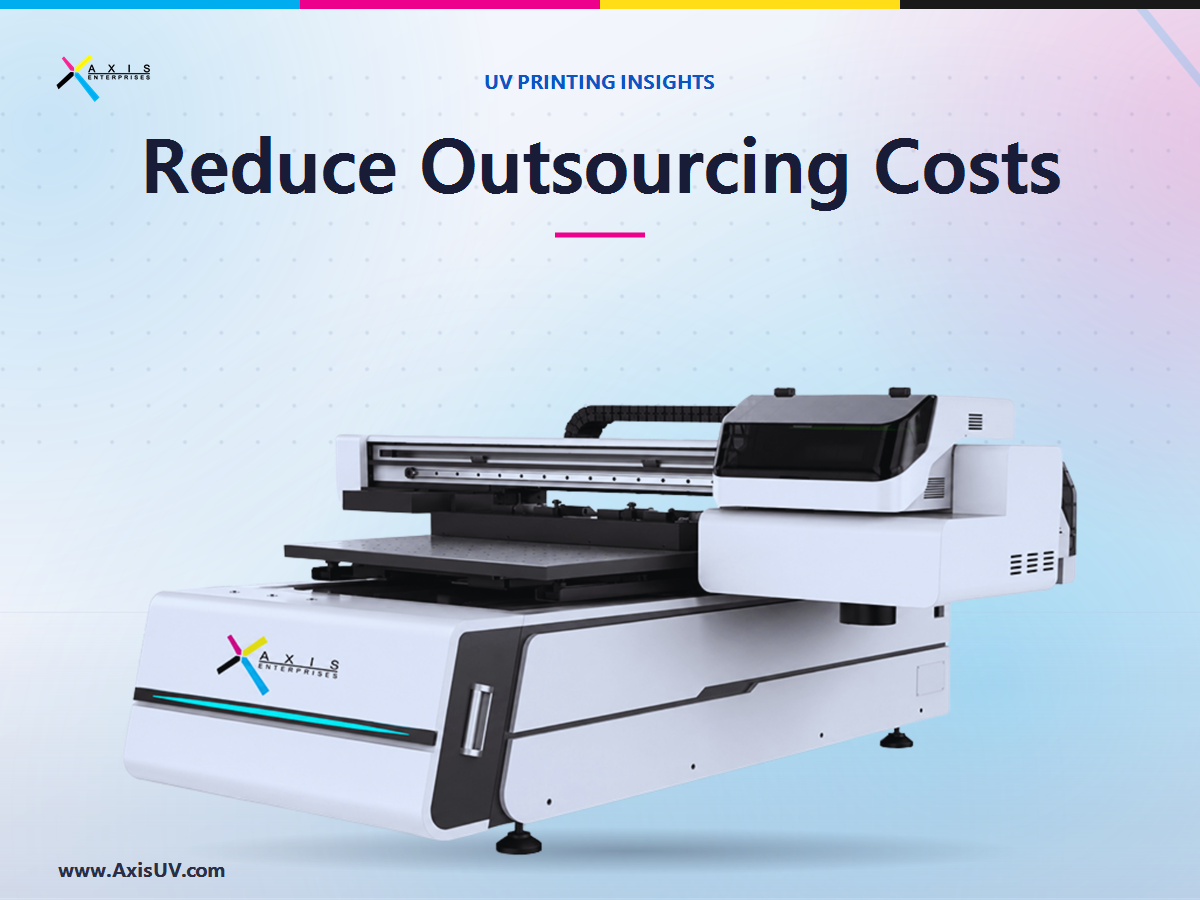
Quick answer
You reduce printing outsourcing costs by moving your high-frequency, repeatable print jobs in-house onto a UV printer, then running the payback math before you buy. Outsourcing charges a per-piece margin, a minimum order quantity, and a delivery delay on every single job, and those three costs compound quietly across a year. When a shop prints the same categories again and again (signage panels, promotional products, phone cases, gift items, packaging samples, industrial labels), bringing that work in-house commonly cuts the per-unit printing cost by roughly 30 to 70 percent, because you stop paying a vendor’s markup and start paying only for ink, substrate, and machine time. To do this well: (1) add up what you spent on outsourced printing over the last twelve months and identify the three job types you repeat most, (2) estimate in-house cost per print (ink plus substrate plus a small share of machine and power cost), (3) divide the machine price by your monthly saving to get a payback period in months, and (4) plan GST correctly, since a UV printer bought for business use is a capital asset on which input tax credit is generally available, subject to conditions. If your repeat volume is real, the machine usually stops being an expense and becomes the cheapest capacity you own. The goal is not to print everything yourself. It is to stop renting out your best margin.
The demand is growing faster than most shops can supply it
Customized, short-run, personalized printing is one of the fastest-moving corners of the Indian economy. The India custom printing market generated about USD 2,451.8 million in revenue in 2024 and is projected to reach roughly USD 4,790.4 million by 2030, growing at a compound annual rate of about 11.8 percent (Grand View Research). The print-on-demand segment is moving even faster, projected to grow from about USD 833.5 million in 2025 to roughly USD 5,931.4 million by 2033, a compound annual rate near 27.8 percent (Straits Research).
Adjacent categories tell the same story. India’s broader digital printing market was valued at around USD 1.4 billion in 2024 and is expected to reach about USD 2.9 billion by 2033 (IMARC Group), while the India digital signage market reached roughly USD 940.5 million in 2024 and is projected to hit about USD 3,415 million by 2033 (IMARC Group). Demand for printed, branded, and personalized products is not a passing trend. It is a structural shift, and it is accelerating.
Here is the uncomfortable part. Most of that demand is being filled by whoever can produce fast, in-house, with no minimum order quantity. A business that still outsources every job is competing for the same orders while carrying a slower, thinner-margin cost structure.
Why outsourced printing quietly leaks margin
Outsourcing feels cheap because each invoice looks small. The leak is in the pattern, not the single bill. Every outsourced job carries three costs at once:
- A vendor markup on every piece. The job-work supplier has to cover their own ink, machine, labour, and profit. That margin is baked into every unit you buy, forever, on work you could eventually run yourself.
- A minimum order quantity. Many vendors will not economically run a job of five or ten pieces, so you either overorder, refuse small custom jobs, or pass them up. In a market where buyers increasingly want one-off, personalized items, that is lost revenue, not saved cost.
- A delivery delay. Sending files out, waiting in the vendor’s queue, and arranging pickup adds days to every order. Slow turnaround loses premium, time-sensitive jobs to faster competitors.
These pressures land hardest on exactly the businesses driving India’s growth. Micro, small, and medium enterprises make up over 63 million firms and contribute about 30.1 percent of India’s GDP and 35.4 percent of manufacturing output (Ministry of MSME, Government of India). For an owner-run business, margin is survival, and a cost that silently repeats on every order is the most dangerous kind.
What this means for print shops, signage makers, and product businesses
If you run a signage shop, a promotional-products business, a gift or phone-case personalization service, a packaging or label operation, or a small manufacturing unit that brands its own products, the outsourcing tax shows up in specific, familiar ways:
- You turn down small custom orders because the vendor’s minimum makes them unprofitable, even though the customer was ready to pay.
- You quote longer delivery times than you would like, because part of your timeline is sitting in someone else’s production queue.
- You absorb quality complaints for prints you did not make and cannot control, from a vendor whose priority is their own throughput, not your customer.
- You watch competitors accept premium, no-minimum, next-day jobs that you technically cannot, and you feel the ceiling on how much you can grow.
The instinct is to treat this as the cost of doing business. The data suggests it is increasingly the cost of staying small.
What is actually changing in your market
Two shifts explain why in-house UV printing has moved from a luxury to a competitive necessity.
First, buyers now expect personalization and will pay for it. McKinsey research finds that 71 percent of consumers expect personalized interactions and 76 percent get frustrated when they do not receive them, and that personalization typically drives a 5 to 15 percent revenue lift for the businesses that deliver it (McKinsey). Deloitte research similarly finds that a meaningful share of consumers, around 20 percent, are very willing to pay a premium specifically for products they can personalize (Deloitte). Demand for the exact jobs a UV printer handles, one-off and customized, is rising.
Second, the technology got cheaper and broader. Digital printing is the fastest-growing technique segment in India, and entry-level digital and UV-capable machines that once required very large capital now start far lower, with some digital printing setups available from around USD 10,000 (Grand View Research). A modern UV flatbed can print directly on acrylic, wood, glass, metal, leather, MDF, PVC, and more, which means one machine can serve signage, gifting, industrial, and packaging work at once. The barrier that justified outsourcing for two decades has largely fallen.
What smart buyers should look for
Bringing printing in-house only saves money if you buy the right machine and, just as importantly, the right partner behind it. Before you commit capital, judge any UV printer against these criteria:
- Material range. The value of UV is versatility. Confirm the machine prints across the substrates your customers actually ask for (acrylic, wood, glass, metal, leather, MDF, PVC), so one purchase replaces several outsourced categories.
- Print quality and finishing. Look for consistent, durable output and premium options such as white ink, varnish, and textured or embossed effects, which let you charge more and win jobs competitors cannot.
- Low maintenance and uptime. Your saving disappears if the printer sits idle. Ask specifically about printhead protection, ease of daily maintenance, and realistic downtime.
- After-sales support and spare parts. The single biggest risk in this category is being stranded after purchase. Prioritise a supplier with fast technical support, available spare parts, and training, not just the lowest sticker price.
- Honest payback math. A trustworthy provider will help you calculate ROI from your real repeat volume, not sell you capacity you cannot fill. Ask them to work the payback period with your numbers.
- GST-aware guidance. Because a printer is a capital asset for business use, input tax credit on the machine is generally available subject to conditions, which changes the true landed cost. A good partner accounts for this in the plan.
A better way forward
This is the problem Axis Enterprises was built to solve. At uvprinterindia.com, we supply UV printing machines to Indian print shops, signage makers, gift and product businesses, packaging units, and manufacturers who want to bring production in-house, print on almost any material, and stop paying a vendor’s markup on every order. We help you match the right machine to the work you actually repeat, run the payback math on your own volumes, and stand behind the purchase with technical support and spare parts, so the machine keeps earning long after it is installed.
Frequently asked questions
How much can I really save by moving printing in-house?
It depends on your repeat volume, but shops that bring their most-repeated jobs in-house commonly cut per-unit printing cost by roughly 30 to 70 percent, because they stop paying a vendor’s markup and pay only for ink, substrate, and machine time. The saving is largest on high-frequency, repeatable work and smallest on rare, one-off jobs, so start by identifying the three job types you outsource most often.
How do I calculate the payback period on a UV printer?
Add up your outsourced printing spend over the last twelve months, estimate your in-house cost per print (ink plus substrate plus a small share of machine and power cost), and calculate your monthly saving. Divide the machine price by that monthly saving to get payback in months. If your repeat volume is genuine, most owners are surprised how short the period is.
What materials can a UV printer actually print on?
A modern UV flatbed prints directly on a wide range of rigid and flexible substrates, including acrylic, wood, glass, metal, leather, MDF, and PVC. This versatility is the core advantage: one machine can serve signage, corporate gifting, phone cases, industrial products, and packaging, replacing several separate outsourced categories.
Is buying a UV printer worth it for a small business?
For any small business with steady, repeatable custom-print demand, in-house UV printing usually pays for itself by removing outsourcing markups, minimum order quantities, and delivery delays. It also lets you accept small, personalized, and time-sensitive jobs you previously had to refuse, which is exactly where demand is growing fastest in India.
How does GST affect the cost of a UV printer?
A UV printer bought for business use is a capital asset, and GST paid on it is generally eligible for input tax credit, subject to the usual conditions, which lowers the effective cost compared with a consumer purchase. Because rules and eligibility vary by business, confirm the treatment with your tax advisor, and always plan the full landed cost inclusive of GST.
Next step
If outsourcing has quietly become the biggest markup in your cost structure, the fastest way to see the numbers clearly is to run them against your own volumes. Book a free UV Printing Machine Buying Consultation at uvprinterindia.com, and we will help you identify which of your jobs are worth bringing in-house, estimate a realistic payback period, and match you to the right machine for your materials and budget. There is no obligation to buy: the goal is simply to show you where your margin is going and what it would take to keep it.
Sources
- Grand View Research, India Custom Printing Market Size and Outlook, 2025 to 2030
- Straits Research, India Print on Demand Market Size, Share and Growth Forecast to 2033
- IMARC Group, India Digital Printing Market Size and Industry Growth
- IMARC Group, India Digital Signage Market Size and Forecast
- McKinsey and Company, research on personalization and consumer expectations
- Deloitte, research on consumer willingness to pay for personalized products
- Ministry of MSME, Government of India (Press Information Bureau), MSME contribution to GDP and manufacturing