
Quick answer
UV printing lets Indian toy and kids’ product makers print full-color, durable designs directly onto plastic, wood, acrylic, MDF, tin, and metal surfaces without screens, plates, or minimum order quantities. A flatbed UV machine uses UV curing to fix each layer of ink instantly, so a printed part is ready to handle the moment it leaves the bed. That makes it a strong fit for short runs, personalized items, licensed-character work, and made-to-order pieces where traditional screen printing is too slow and too expensive to set up. It becomes profitable when you bring high-mix, low-volume jobs in-house and charge a premium for personalization instead of outsourcing them. One caution matters more than any other for children’s products: printed toys sold in India must meet the Toys (Quality Control) Order and the IS 9873 safety limits on phthalates and heavy metals, so you must choose the right ink chemistry and get finished goods lab-tested before selling. The sections below cover the market data, the specific pressures on small manufacturers, and a practical checklist for buying the right machine.
Why the timing for domestic toy makers has never been better
India’s toy trade has flipped in under a decade. According to figures from the Ministry of Commerce reported by the India Brand Equity Foundation (IBEF), toy imports have fallen sharply while exports have climbed, with Indian-made toys now reaching more than 150 countries. Formal employment in games and toys more than doubled, rising from 8,685 workers in 2018 to 2019 to 17,693 in 2023 to 2024, per the same government data.
The domestic market is expanding alongside the export story. The IMARC Group values the Indian toys market at about US$2.09 billion in 2025 and projects it to reach roughly US$4.74 billion by 2034, a compound annual growth rate near 9.5 percent. Demand is shifting toward educational toys, STEM kits, licensed characters, and personalized items, all of which reward short production runs and fast design changes.
Why most small product makers still leak margin
Rising demand does not automatically mean rising profit. Most small toy, gift, and novelty makers still send their printing and branding out to job shops. That means paying a markup on every unit, waiting days for delivery, accepting minimum order quantities that force overproduction, and losing control over quality and timing. When a buyer asks for 50 personalized name plates, a single character variant, or a rush festival order, the outsourced model either says no or quotes a price that kills the deal.
This pressure is not unique to toys. It is the daily reality of the small and medium businesses that power the Indian economy. The Press Information Bureau reports that micro, small, and medium enterprises contribute close to 30 percent of India’s GDP and around 45 percent of its exports. These are exactly the operators, from 30 to 5,000 employees, who feel every rupee of outsourcing cost and every day of delay.
What personalization is doing to buyer expectations
The market is moving toward one-of-one products, and buyers now expect it. Deloitte research indicates that roughly 80 percent of consumers prefer brands that offer personalized experiences and that they spend materially more with them. For a toy or gift maker, that translates into named products, custom colors, birthday and school editions, and small branded batches for corporate and institutional buyers. Screen printing cannot serve that demand economically because every design change means a new screen and a new setup.
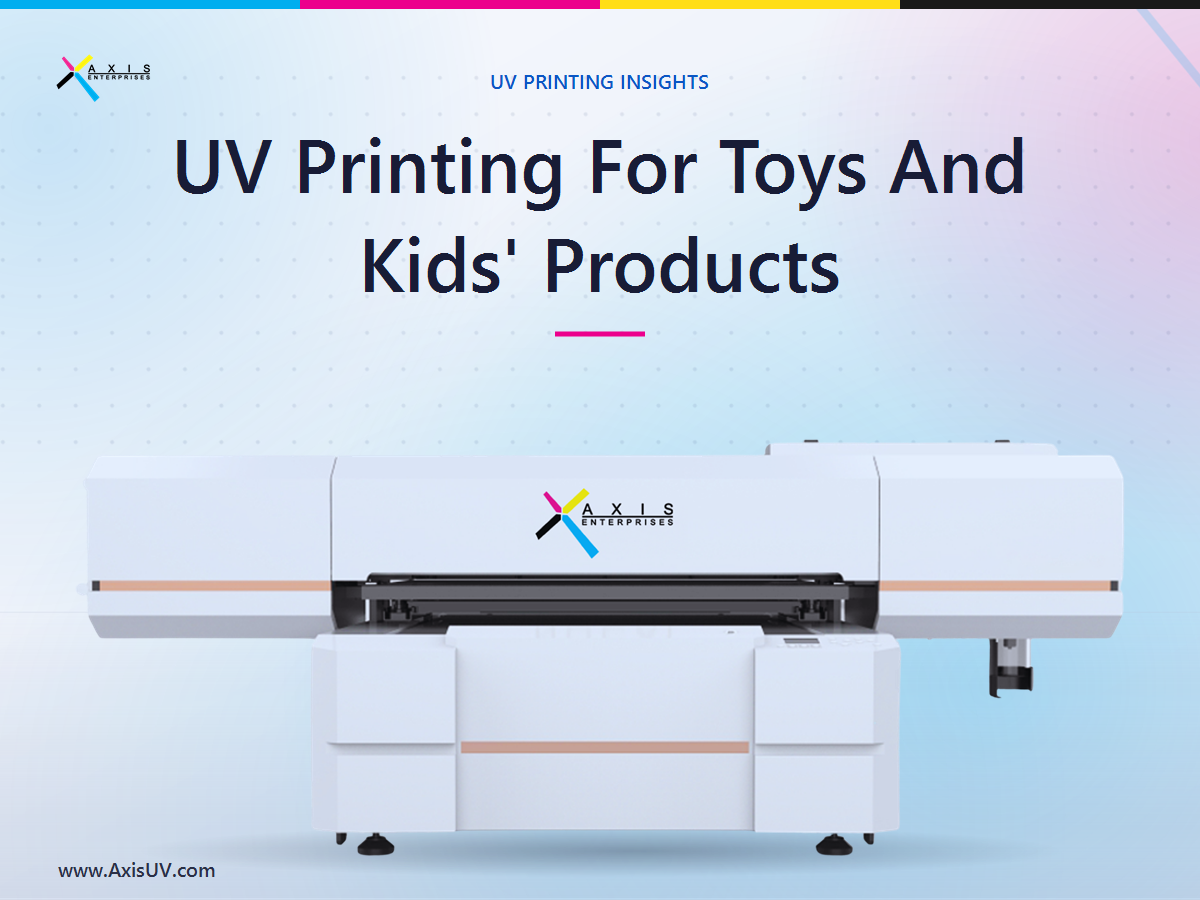
This is where inkjet-based UV technology changes the math. A UV flatbed printer lays down CMYK plus white and varnish, cured on contact, directly onto a rigid object. There are no screens, no plates, and no minimum quantity, so printing one custom piece costs almost the same per unit as printing a hundred. India’s digital printing market, per IMARC Group, grew to about US$1.4 billion in 2024 and is projected to reach US$2.9 billion by 2033, a signal that this shift from analog to digital printing is already well underway.
What smart buyers should look for
Buying a UV printer for kids’ products is not only a print-quality decision. It is a compliance, reliability, and total-cost decision. Weigh these criteria before you compare price tags:
- Substrate range: confirm the machine prints cleanly on the materials your products actually use, such as ABS and other plastics, wood, MDF, acrylic, tinplate, and metal, with reliable white-ink adhesion on dark and transparent surfaces.
- Ink chemistry and safety: children’s products sold in India must comply with the Toys (Quality Control) Order and toy safety standard IS 9873, which caps phthalates and heavy metals. Ask about ink migration behavior, request documentation, and plan to get finished goods lab-tested.
- Total cost of ownership: look past the sticker price to the true total cost of ownership, including ink consumption, white-ink usage, print-head life, spare-part pricing, power, and expected downtime, all viewed on a GST-inclusive basis.
- After-sales support: the print head is the most expensive wear part, so local service response, spare-part availability, and operator training decide whether the machine runs or sits idle.
- Throughput fit: match bed size and print speed to your real order profile, since a machine tuned for large signage may be wrong for small, high-mix toy batches.
- Proven demo: insist on a live sample run on your own products and materials before you commit.
A better way forward
Once you accept that personalization and short runs are where the margin lives, the equipment choice becomes clear. Axis Enterprises builds and supplies UV printing machines for exactly this kind of work, and you can explore the range of UV flatbed printers at uvprinterindia.com. The machines are designed to print directly on the mixed materials that toys, gifts, and kids’ products are made from, with white ink and varnish for premium finishes and lifetime technical support behind them.
If you are weighing your first purchase, the smartest first step is to map your current outsourcing spend against an in-house setup. You can book a free UV printing machine buying consultation to walk through your product mix and volumes, or request a live print demo on your own samples so you see the output on your materials before deciding. For manufacturers who want to compare models on running cost and service, the team at uvprinterindia.com can help you match a machine to your order profile.
Next step
If your business depends on printed toys, gifts, or personalized kids’ products, the fastest way to stop leaking margin to outsourcing is to see the numbers for your own operation. Bring your monthly outsourcing spend, your typical order sizes, and the materials you print on most, and get a clear, no-pressure assessment of whether an in-house UV printer pays back for you. Book your free UV printing machine buying consultation at uvprinterindia.com and start with a demo on your own products.
Frequently asked questions
Are UV inks safe for children’s products?
Fully cured UV ink is a hardened, inert film, but safety for a specific toy depends on the finished product meeting India’s Toys (Quality Control) Order and IS 9873 limits on phthalates and heavy metals. Do not assume any ink is compliant. Ask your supplier for ink documentation and have finished samples tested by a BIS-recognized laboratory before you sell.
Which kids’ products can be UV printed?
Common candidates include plastic and wooden toys, building blocks, educational and STEM kits, name plates, pencil boxes and stationery, tin lunch boxes, sippers and bottles, phone-style play sets, and personalized gift items. Because a UV flatbed prints on rigid surfaces of varying thickness, it suits mixed product lines better than screen or pad printing.
Can I add names and custom designs to individual pieces profitably?
Yes. Since UV printing needs no screens or plates, printing one personalized piece costs nearly the same per unit as printing many. That is what makes named editions, birthday and school runs, and small branded batches profitable, and it is why buyers pay a premium for them.
Do different materials need different settings?
Yes. Plastic, wood, acrylic, and metal each need the correct ink profile, and some surfaces need a primer or a white underbase for adhesion and color pop. Building a tested material-profile library for your regular substrates keeps quality consistent and reduces rework.
How do I price personalized kids’ products?
Price on the value of customization and speed, not on print cost per square inch. Because you can offer no minimum order quantity and fast turnaround, you can charge a personalization premium that outsourced competitors cannot match, while still quoting a GST-inclusive price that protects your margin.
Sources
- India Brand Equity Foundation (IBEF): 52% drop in toy imports, 239% jump in exports, Commerce Ministry data
- IMARC Group: India Toys Market Size, Share and Growth Report
- IMARC Group: India Digital Printing Market Size and Industry Growth
- Deloitte: Personalization strategy and consumer behavior in retail
- Press Information Bureau, Government of India: Contribution of MSMEs to the GDP
- India Briefing: BIS Toy Certification and the Toys Quality Control Order guide