
Published: August 15, 2026. Last updated: August 15, 2026.
Quick answer
UV printing lets a small business decorate cosmetic and personal-care packaging (jars, caps, tubes, compacts, droppers, and rigid boxes) directly, in short runs, with no plates and no minimum order. India’s beauty and personal-care market is worth roughly USD 31 billion in 2025, according to the IMARC Group, and hundreds of new direct-to-consumer brands need small, premium, fast packaging batches. In-house UV printing turns a slow, high-minimum outsourced job into a same-day, high-margin service. The machine to look for is a flatbed or hybrid UV printer that supports white ink, spot varnish, and an adhesion primer, sized to the substrates you handle most.
Why is cosmetic packaging suddenly a printing opportunity in India?
Cosmetic packaging is a growing opportunity because demand is expanding faster than traditional print supply can serve it. The IMARC Group values India’s beauty and personal-care market at about USD 31.19 billion in 2025, and long-run forecasts see steady annual growth through the next decade. That volume is no longer concentrated in a handful of large houses.
The bigger shift is who is buying. Coherent Market Insights estimates India’s direct-to-consumer beauty and personal-care segment at USD 4.09 billion in 2025, growing at a 36.4 percent compound annual rate toward USD 35.92 billion by 2032. Mordor Intelligence sizes the wider Indian direct-to-consumer market at USD 12 billion to USD 15 billion in 2025.
These brands launch many small stock-keeping units, refresh artwork often, and sell online where the pack is the product’s first physical impression. That behaviour is a poor fit for old, high-minimum decoration methods, and a strong fit for on-demand printing.
Why does outsourced packaging decoration quietly eat margin?
Outsourcing eats margin because the cost of a decorated pack is dominated by setup and minimums, not by the printing itself. Screen printing, hot foiling, and offset carton work all carry plate or screen charges, colour-matching runs, and minimum order quantities that can run into thousands of units per design.
For a brand launching 500 to 2,000 units of a new serum or balm, those minimums force one of two bad choices: over-order packaging that may never sell, or pay a steep per-unit premium for a small run. Lead times of two to four weeks also stall launches and make quick design fixes expensive.
Reprints make it worse. A single change to an ingredient list, a shade name, or a batch code can scrap an entire pre-printed inventory. The waste is invisible on any one job, but across a year it is a serious drag on profit.
What does this mean for small brands and job-work print shops?
For small brands and job-work shops, the gap between what buyers need and what suppliers offer is now a business you can own. Founders want short runs, fast turnaround, and premium finishes without committing to five-figure minimums. Very few local suppliers can say yes to all three.
India’s small enterprises are built to fill exactly this kind of gap. The Ministry of Micro, Small and Medium Enterprises reports that the sector contributes about 30.1 percent of India’s GDP and 45.73 percent of its exports, and packaging decoration is a classic value-added service for a nimble operator.
A print shop that can decorate a client’s jars, tubes, and boxes on demand becomes a partner, not a vendor. That relationship is stickier and better paid than one-off, price-shopped work.
What is UV printing, and why does it fit cosmetic packaging?
UV printing is a digital process that jets ink directly onto an object and then hardens it instantly with ultraviolet light. It combines inkjet printing with UV curing, so the ink dries the moment it is laid down rather than soaking in or air-drying. There are no plates, no screens, and no separate drying rack.
That instant cure is why it suits packaging. It prints on plastic, glass, aluminium, coated card, and acrylic, which covers most primary and secondary cosmetic packaging. With white ink and a clear varnish, one machine can lay down opaque colour on dark or transparent containers and add a raised gloss or matte effect that reads as premium.
Premium matters more here than in most categories. A survey by the Paper and Packaging Board, conducted by Ipsos, found that 72 percent of consumers say packaging design can influence their purchasing decision, rising to 81 percent when the item is a gift. For beauty brands sold on shelf appeal and unboxing, the finish is not decoration, it is conversion.
How do the economics compare with screen printing or outsourcing?
At low and medium volumes, direct UV printing usually wins on total cost because it removes setup charges and minimums. The trade-off is that at very high, single-design volumes, older analog methods can still be cheaper per unit. The table below shows where each method fits.
The market is voting for the digital option. Grand View Research valued the global UV-curable ink digital printing segment at about USD 8.48 billion in 2023 and projects a 7.2 percent compound annual growth rate through 2030, with packaging among the fastest-growing applications.
Tax treatment helps the case in India. A UV printer is capital equipment, so registered buyers can generally claim input tax credit on the Goods and Services Tax paid on the machine and on consumables, which lowers the real acquisition cost. Always confirm the current rate and eligibility with your accountant before you budget.
What should a smart buyer look for in a UV printer for packaging?
The right machine is the one matched to your substrates, your run sizes, and your service needs, not the one with the biggest spec sheet. Cosmetic and personal-care work has specific demands, so weigh these points before you buy.
- Bed size and object height: confirm the printer can hold the tallest jar, tube, or filled box you plan to decorate, not just flat card.
- White ink and varnish channels: essential for opaque colour on clear or dark containers and for the raised, glossy finish beauty brands expect.
- Adhesion primer support: glass, metal, and some plastics need a primer for the print to survive handling, filling, and transport.
- A rotary or jig attachment: needed to wrap artwork around round bottles, sticks, and cylindrical caps.
- Print head quality and serviceability: ask about head life, replacement cost, and how quickly clogs can be cleared.
- Software and colour management: a capable print engine that holds brand colours consistently across repeat orders.
- Local service, warranty, and AMC: a machine that runs a service business must be supportable near you, with spares and trained engineers.
A practical way to start
Given everything above, the smart move is to size a machine to the packaging you will actually decorate, then prove the economics on a real job. This is the work we do every day at Axis Enterprises: helping owners choose a UV printer that fits their substrates, run sizes, and budget rather than overspending on capacity they will not use. You can book a free UV printing machine buying consultation to walk through your specific products.
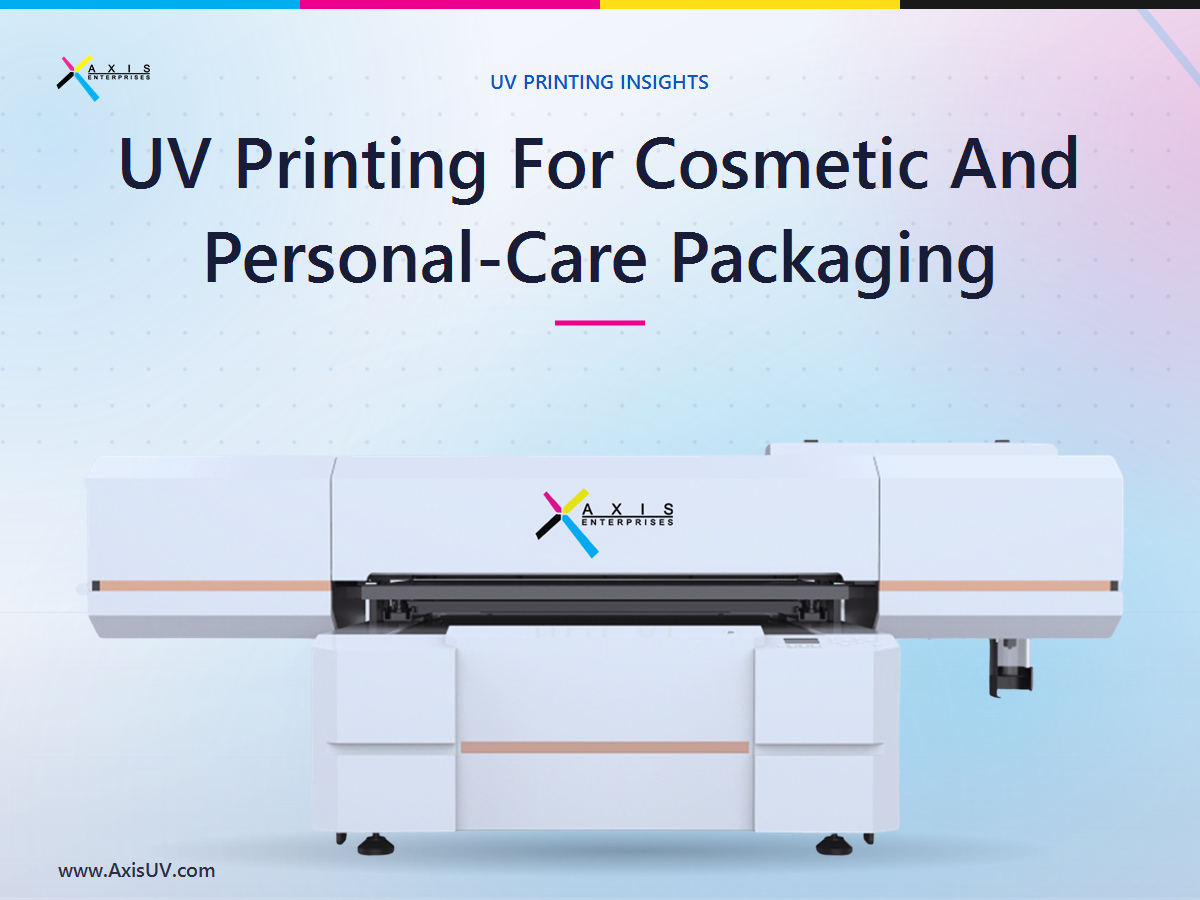
If you want to see the options first, the UV printer range at Axis Enterprises covers flatbed and hybrid models suited to jars, tubes, boxes, and bottles. It helps to start from the containers you handle most and work backwards to the bed size, ink set, and jigs you need. When you are ready, you can talk to the team at uvprinterindia.com about print heads, white ink, and adhesion for your materials.
Before committing to any machine, test it on your own packaging. You can request a live print sample on your own cosmetic containers so you can judge colour, opacity, and durability on the exact substrate you sell. Seeing your own jar printed and cured is worth more than any brochure.
If you run a beauty or personal-care brand, or a print shop that serves one, and you are weighing whether to bring packaging decoration in-house, the next step is simple and low-risk. Book a free UV Printing Machine Buying Consultation at uvprinterindia.com, bring the products you want to decorate, and get a clear, numbers-first view of the machine and the margin before you spend anything.
Frequently asked questions
Can UV printers print directly on cosmetic jars and bottles?
Yes. A flatbed UV printer prints directly on flat and rigid items such as compacts, palettes, and boxes, and with a rotary or jig attachment it wraps artwork around round jars, bottles, and cylindrical caps. White ink allows opaque colour on clear glass or dark plastic, and an adhesion primer helps the print survive handling and filling.
What is the minimum order for UV-printed packaging?
There is effectively no minimum. Because UV printing uses no plates or screens, you can print a single unit as economically as a batch, which is why it suits new brands launching small runs and frequent design changes. This removes the thousands-of-units minimums that screen printing and offset cartons usually require.
Is UV printing on packaging durable and safe to handle?
UV-cured ink bonds to the surface and hardens instantly, giving a scratch and smudge resistant finish suitable for retail handling, provided the correct primer is used for glass and metal. Note that the print sits on the outer surface of the container, so it decorates the packaging rather than contacting the product inside. Always follow your ink supplier’s guidance for the substrate.
How much does a UV printer cost in India, and is GST recoverable?
Prices vary widely by bed size, print heads, and features, so the honest answer is that the right budget depends on your run sizes and substrates. As capital equipment, a UV printer generally allows registered businesses to claim input tax credit on the Goods and Services Tax paid, which lowers the effective cost. Confirm the current rate and your eligibility with your accountant.
Which industries beyond cosmetics can use the same machine?
The same UV printer that decorates cosmetic packaging can also print on signage, gifts, promotional products, electronics panels, awards, and industrial nameplates. That versatility is a major reason owners buy one: it lets a single machine serve several revenue streams rather than one seasonal niche.
Sources
- IMARC Group, India Beauty and Personal Care Market
- Coherent Market Insights, India D2C Beauty and Personal Care Market
- Mordor Intelligence, India D2C E-commerce Market
- Market Research Future, India Cosmetic Packaging Market
- Grand View Research, UV-Curable Ink Digital Printing Market
- Paper and Packaging Board and Ipsos, Packaging Design Survey
- Press Information Bureau, Government of India, Ministry of MSME statistics