
Quick answer
For an Indian print shop, signage business, or small manufacturer, customer retention is the cheapest growth you can buy. Landing a new customer costs roughly 5 to 25 times more than keeping an existing one, and lifting your retention rate by just 5 percent can raise profits by 25 to 95 percent, according to research popularised by Harvard Business Review. The practical lever most owners miss: repeat orders are won on speed, small-batch flexibility, and personalisation. Businesses that bring short-run, customised printing in house (instead of outsourcing every reorder) reply faster, protect margin, and give customers a reason to come back. If your reorders are slow, generic, or routed to a vendor who controls your timeline, you are quietly funding your competitor’s retention instead of your own.
The number most owners underestimate
Almost every business plan is built around finding new customers. The data says that is the expensive half of the job. According to Harvard Business Review, acquiring a new customer is anywhere from 5 to 25 times more expensive than retaining an existing one. The same body of work, traced back to Frederick Reichheld’s research at Bain and Company, found that a 5 percent increase in retention can lift profits by 25 percent or more.
There is a second number that reframes the whole game. As summarised by Invesp, the probability of selling to an existing customer sits around 60 to 70 percent, while the probability of selling to a brand new prospect is only 5 to 20 percent. Existing customers also spend more per order over time. In other words, the buyer who already trusts you is the single highest-return asset in your business, and most owners are not set up to keep serving that buyer quickly.
Why retention is getting harder for everyone
Two market shifts are squeezing repeat business across categories.
First, buyers now expect personalisation as a default, not a premium. The 2021 McKinsey and Company personalisation research reported that 71 percent of consumers expect companies to deliver personalised interactions, and 76 percent get frustrated when they do not. That same research found that companies which grow faster drive around 40 percent more of their revenue from personalisation than slower-growing peers. A customer who wanted a plain product last year now wants their name, logo, batch code, or design on it, and they want it without a long wait.
Second, acquisition keeps getting costlier as ad platforms mature and competition rises. When the cost to win a new customer climbs, the business that keeps its existing customers busy and satisfied simply keeps more of its profit. Retention is not a soft, feel-good metric. It is the hedge against rising acquisition costs.
What this means for print shops, signage makers, and small manufacturers
India’s small and medium enterprises are the exact businesses caught in this squeeze. The country has roughly 63 million MSMEs, and the sector contributes about 30 percent of national GDP and close to 46 percent of exports, per the Ministry of MSME (Government of India) and industry data compiled by IBEF. That is a vast, crowded field of owners competing for the same repeat customers.
If you run a signage shop, a promotional-products business, a phone-case or gift personalisation service, a packaging or label unit, or a small manufacturer that brands its own products, your retention problem usually looks like this:
- Reorders are slow. A repeat customer wants 40 personalised units by Friday. You outsource, wait in the vendor’s queue, and miss the window. The customer tries someone else.
- Small batches are unprofitable. Screen printing and pad printing carry setup costs that make short runs painful, so you either decline the job or price yourself out of it.
- Personalisation is a bottleneck, not a service. Every custom name, colour, or design change adds a delay, when it should be the reason the customer chose you.
- You do not control your own timeline. When a third party prints your reorders, they control your delivery date, your quality, and effectively your customer relationship.
Each of those is a retention leak. And retention leaks are expensive precisely because, as the numbers above show, the repeat buyer was the cheapest and most profitable customer you had.
The insight: retention is a production problem before it is a marketing problem
Owners tend to treat retention as a loyalty-programme or discount question. For product and print businesses, it is mostly a capability question. You retain the customers you can serve fast, flexibly, and personally. You lose the ones who have to wait, who cannot get a short run, or whose custom request becomes a hassle.
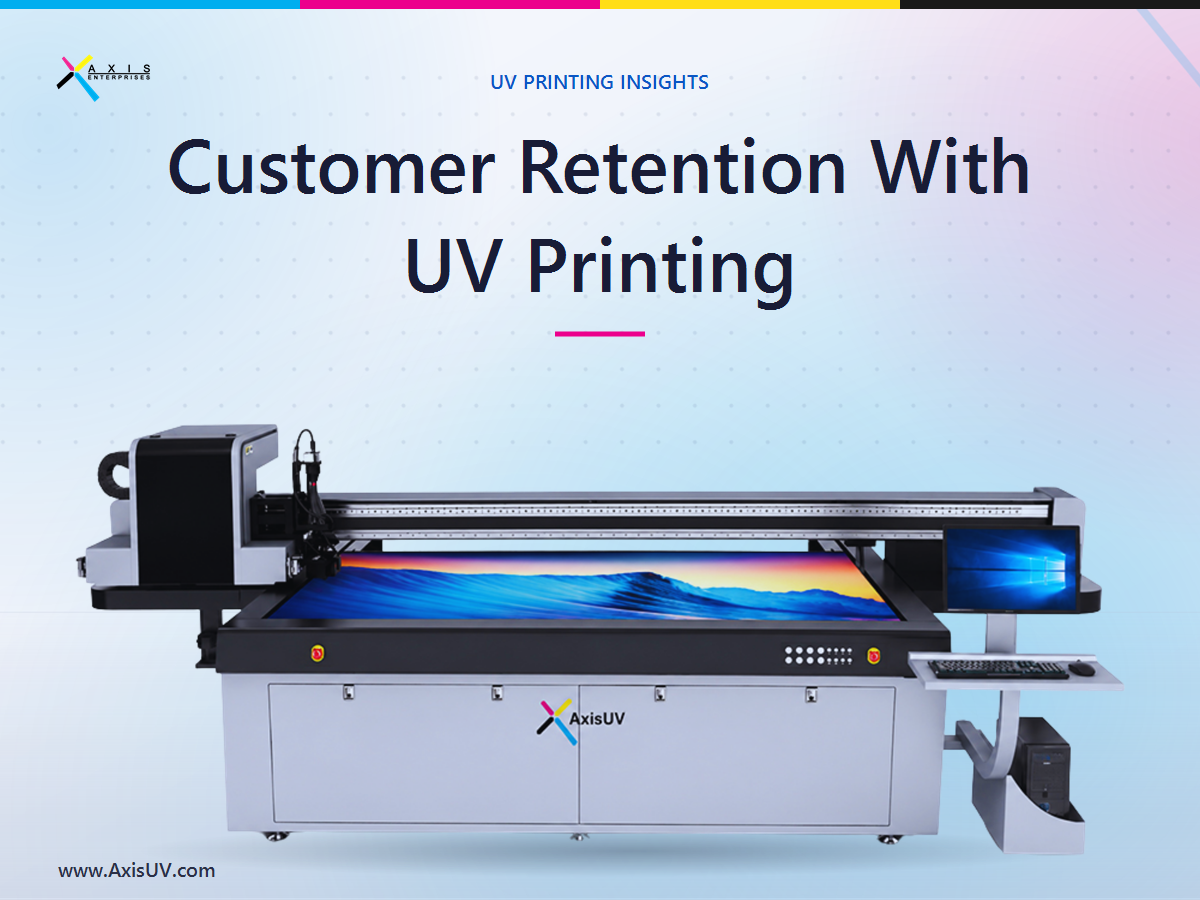
This is where digital printing technology has quietly changed the economics. UV curing printing (which uses ultraviolet light to instantly cure ink as it is jetted onto a surface) prints directly onto a very wide range of materials, from acrylic and glass to wood, metal, plastic, leather, and more, with no plates and almost no setup. That combination (no plates, instant cure, direct-to-object) is what makes a batch of one, or a batch of fifty, viable to print in house on the same day. For a business trying to keep customers, that is the difference between saying yes now and losing the reorder.
Put plainly: the same machine that lets you print a personalised, short-run reorder today is a customer retention tool, even though nobody sells it that way.
How to think about it: retention math for a small print business
The value of retention compounds through customer lifetime value. A customer who orders once is a transaction. A customer who reorders every quarter for three years is an annuity. When you can fulfil personalised reorders in house, quickly, you increase both the number of reorders and the share of each order you keep as profit (because you are not paying an outside vendor’s margin).
Two forces stack here. Repeat buyers convert far more reliably (that 60 to 70 percent probability from Invesp), and personalised offers lift revenue (the roughly 40 percent revenue skew toward personalisation leaders from McKinsey). A business that can print personalised products on demand is positioned to capture both.
What smart buyers should look for in a production setup that protects retention
If retention is the goal, do not evaluate a printing machine on speed sheets alone. Evaluate it on whether it lets you say yes to the reorders that keep customers. A retention-friendly setup should offer:
- Genuine short-run economics. The cost and effort of printing one unit or fifty units should be low, with no plates or heavy setup, so small reorders stay profitable.
- Fast turnaround under your own roof. In-house capability means you control the timeline and can meet tight deadlines that outsourcing would blow.
- Material versatility. One machine that prints across acrylic, glass, wood, metal, plastic, and more lets you serve a wider set of repeat customers without buying separate equipment.
- Effortless personalisation. Changing a name, logo, colour, or design between jobs should be a file change, not a re-tooling exercise.
- Predictable running cost and uptime. Retention depends on reliability. A machine that is down cannot fulfil a reorder, so service, spares, and support matter as much as the spec.
- Sensible total cost, GST included. Look at landed cost and running cost together, and remember that registered businesses can usually claim the Goods and Services Tax paid on capital equipment as input tax credit, which changes the real cost picture.
A better way forward
Once you see retention as a production capability, the buying decision gets clearer. The businesses that keep their customers are the ones that can fulfil personalised, small-batch reorders quickly and profitably without handing control to an outside vendor. That is precisely the capability a well-chosen UV printing machine gives an Indian SMB. This is the problem we help owners solve at uvprinterindia.com: matching your product mix, order sizes, and materials to the right UV printing machine so your reorders stay in house and on time.
If you are weighing whether in-house printing is right for your shop, you can talk through your numbers with our team and see a realistic view of turnaround, running cost, and the range of surfaces you could print. You can also explore the UV printing machine options suited to short-run, personalised production, and request a live print demo on your own material so you can judge quality before you invest.
Frequently asked questions
Is it cheaper to keep an existing customer or find a new one?
Keeping an existing customer is far cheaper. Harvard Business Review reports that acquiring a new customer costs 5 to 25 times more than retaining one, and that raising retention by 5 percent can increase profits by 25 to 95 percent. For a small print or product business, that makes fast, reliable reorder fulfilment one of the highest-return investments you can make.
How does in-house UV printing help me retain customers?
It lets you fulfil personalised and short-run reorders quickly, on your own timeline, and profitably. Because UV printing needs no plates and cures ink instantly, a batch of one or fifty units is viable to print the same day. That speed and flexibility is what makes a repeat customer choose you again instead of a competitor with a faster answer.
What kinds of businesses benefit most from this?
Signage and display makers, promotional-product and gifting businesses, phone-case and personalisation services, packaging and label units, sign shops, and small manufacturers that brand their own products. Any business whose customers place repeat, customised, or small-batch orders benefits directly from bringing that production in house.
Does personalisation really affect repeat business?
Yes. McKinsey research found that 71 percent of consumers expect personalised interactions and 76 percent are frustrated when they do not get them, and that faster-growing companies earn about 40 percent more of their revenue from personalisation. A production setup that makes personalisation easy turns that expectation into a reason customers come back.
How should I judge the real cost of a UV printer for this?
Look at landed cost and running cost together, not the sticker price alone. Factor in cost per piece on your typical order sizes, uptime and service support, material range, and the GST input tax credit a registered business can usually claim on capital equipment. The right frame is total cost of ownership against the reorders the machine helps you keep.
Next step
Retention is the cheapest growth available to any print shop, signage maker, or small manufacturer, and for product businesses it is won or lost on production speed and flexibility. If you want to see whether an in-house UV printing machine would help you hold on to more of your repeat customers, book a free UV Printing Machine Buying Consultation at uvprinterindia.com. Bring your typical order sizes and materials, and we will give you a straight, numbers-first view of whether it fits your business.
Sources
- Harvard Business Review, The Value of Keeping the Right Customers
- Bain and Company (Frederick Reichheld), Prescription for Cutting Costs
- Invesp, Customer Acquisition vs Retention Costs
- McKinsey and Company, The Value of Getting Personalization Right or Wrong Is Multiplying
- Press Information Bureau, Ministry of MSME (Government of India)
- India Brand Equity Foundation (IBEF), MSME Industry Report