
Published: August 27, 2026
Quick answer
UV printing lets sports goods and fitness manufacturers decorate bats, balls, dumbbells, helmets, water bottles, gym equipment, and packaging directly, in full colour, with no plates or screens. It cures ink instantly with ultraviolet light, prints on wood, metal, plastic, leather, and glass, and handles short, personalized runs profitably. For Indian units in clusters like Meerut and Jalandhar, bringing decoration in-house on a UV printer cuts outsourcing costs, shortens turnaround, and opens higher-margin custom and branded orders. The right machine choice depends on your product sizes, materials, daily volume, and after-sales support, not on headline price alone.
Why India’s sports goods boom is also a printing opportunity
India makes and ships sports goods at scale, and almost every one of those products needs branding, logos, or personalization printed on it. According to a 2025 India Briefing report on India’s sports goods manufacturing and export outlook, the sector employs close to 500,000 people and India exported around US$275 million of sports equipment in 2024.
The production is heavily concentrated. That same India Briefing report notes that Meerut in Uttar Pradesh and Jalandhar in Punjab together account for roughly 75 to 80 percent of national output, with Meerut alone hosting more than 35,200 registered units and contributing about 40 percent of India’s sports goods exports.
The government wants that number far higher. The NITI Aayog report on realising the export potential of India’s sports equipment sector lays out an ambition to grow exports many times over. Decoration and branding quality is one of the visible differences between a commodity product and an export-grade one.
Where sports goods makers quietly lose margin on decoration
Most decoration cost leaks out through outsourcing, rework, and slow turnaround, not through the printing itself. When branding is sent to a third party, every custom order carries a markup, a minimum quantity, and a waiting period that you do not control.
The pain shows up in specific ways for a sports goods or fitness equipment unit:
- Minimum order quantities from screen printers make small, personalized runs (a club’s 40 branded bottles, a gym’s logo dumbbells) unprofitable or impossible.
- Multi-material jobs force you to juggle different vendors for wood bats, plastic bottles, metal weights, and leather grips.
- Turnaround delays of several days on outsourced printing push back dispatch and tie up working capital.
- Colour and quality drift between vendors weakens the consistency that export buyers demand.
These are exactly the buyers who benefit most from digital, on-demand decoration. India’s digital printing market was worth about US$1.4 billion in 2024 and is projected to reach US$2.9 billion by 2033, a compound annual growth rate of 7.8 percent, according to the IMARC Group India digital printing market report, driven largely by e-commerce and demand for personalized products.
What UV printing actually is, and why it fits sports goods
UV printing is a form of digital inkjet printing where liquid ink is jetted onto a surface and cured instantly by ultraviolet light instead of drying by evaporation. Because the ink hardens on contact, it bonds to non-absorbent materials and builds a durable, scratch-resistant, often raised layer of colour.
Two ideas explain the fit. The first is UV curing, the photochemical process that turns wet ink into a solid film in a fraction of a second. The second is inkjet printing, which places tiny droplets precisely enough to reproduce photographs, gradients, and fine logos.
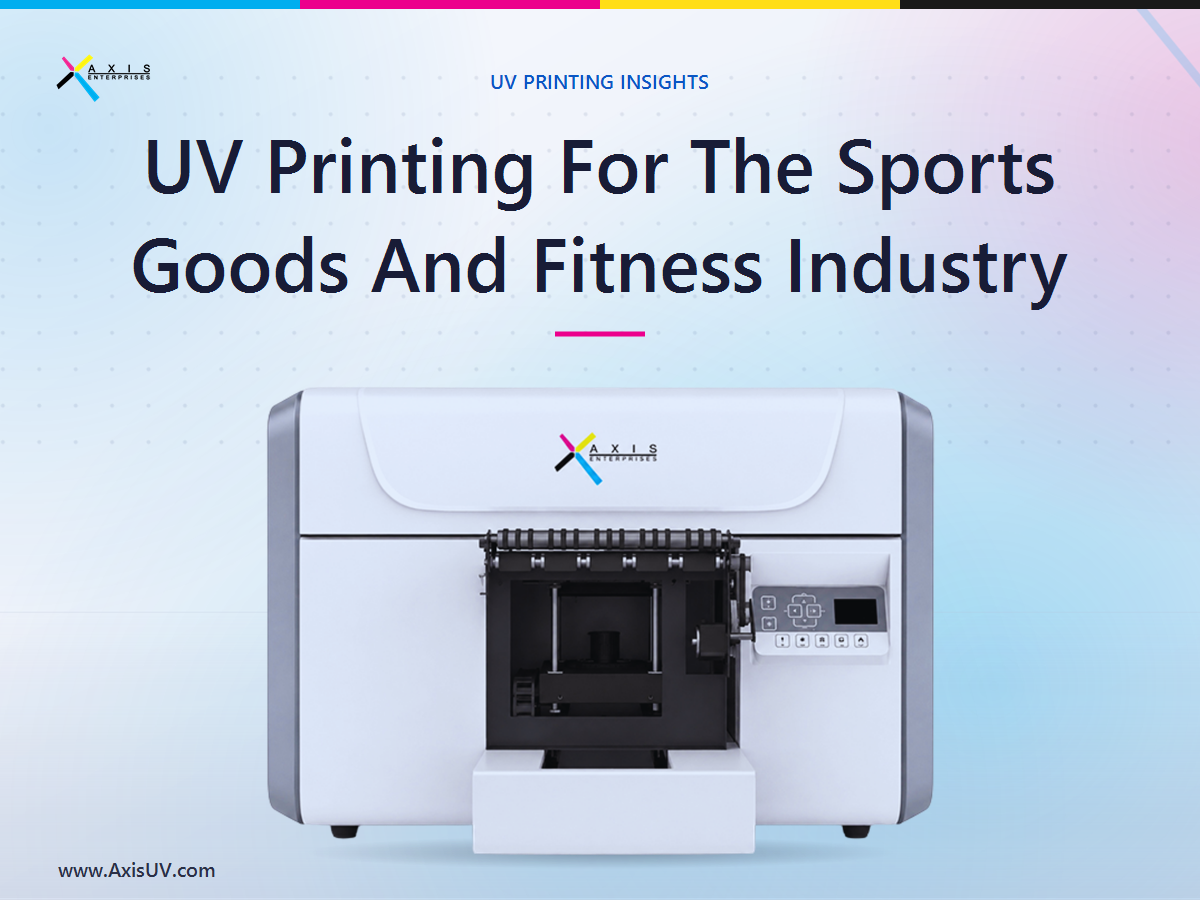
For the diverse materials used across sports equipment, this combination matters. A single flatbed UV printer can print a full-colour logo on a wooden cricket bat, a plastic water bottle, a metal weight plate, and a leather boxing glove tag, with no screens, plates, or heat transfers to change between jobs.
The economics: outsourcing decoration versus printing in-house
The core decision is whether decoration should be a variable cost you pay per order or a fixed asset you own. A UV printer converts a recurring outsourcing bill into an in-house capability that also unlocks new revenue from custom work.
The table below frames the trade-off for a typical Indian sports goods unit. Figures are illustrative and depend on your product mix and volumes.
The demand side supports the shift. Deloitte’s 2024 research found that 80 percent of consumers prefer brands offering personalized experiences and spend up to 50 percent more with them, as reported by Retail TouchPoints. McKinsey similarly estimates that personalization can lift revenue by 5 to 15 percent, in its analysis of the next frontier of personalized marketing. In-house printing is how a manufacturer captures that premium instead of passing it to a vendor.
What smart buyers should look for in a UV printer
Choose a UV printer on total cost of ownership and fit to your products, not on the sticker price. The cheapest machine is rarely the cheapest to run once you factor in ink, uptime, and support. Understanding total cost of ownership is the single most useful habit a first-time buyer can build.
A sound buying checklist for a sports goods or fitness unit looks like this:
- Print area and object height: confirm the bed accepts your largest items (long bats, tall bottles, thick weight plates) and the jig options for cylindrical products.
- Material range and adhesion: check that it prints reliably on wood, plastic, metal, leather, and glass, with primers where needed.
- Print head quality and white ink handling: white and varnish channels matter for coloured and dark sports gear.
- Running cost per print: ask for real ink consumption figures, not just the machine price.
- After-sales support and spares: local service, training, and parts availability decide your real uptime.
- GST and financing clarity: UV printers in India typically attract 18 percent GST, which registered businesses can usually claim as input tax credit under the Goods and Services Tax (India) regime.
This matters because sports goods manufacturing sits inside India’s vast small-business economy. The Ministry of MSME reports that the country’s micro, small and medium enterprises now number about 63.4 million and contribute 45.73 percent of India’s exports, per a 2025 Press Information Bureau release. Buying capital equipment wisely is how these units stay competitive.
A better way forward
Given everything above, the practical next move for a sports goods or fitness manufacturer is to match the right UV printer to your specific products and volumes before you buy. That is precisely what we help with at Axis Enterprises through uvprinterindia.com.
We supply UV flatbed and UV DTF printers suited to Indian conditions and help owners work through print area, materials, running cost, and after-sales support before committing. You can book a free UV printing machine buying consultation and get an honest read on whether a machine fits your order book.
If you are still comparing options, it helps to talk to a specialist about UV printer running costs and see live samples on your own products. The aim is a machine that pays for itself through in-house decoration and new personalization revenue, not the flashiest specification sheet.
The UV ink market itself signals where this is heading. The global market for UV-cured printing inks is forecast to reach about US$16.4 billion by 2030, growing at 15.57 percent a year, according to the IndustryARC UV-cured printing inks market report. Manufacturers who bring this capability in-house early build a durable edge.
Frequently asked questions
Can a UV printer print on cricket bats, dumbbells, and water bottles?
Yes. A UV flatbed printer prints directly on rigid items such as wooden bats, metal weight plates, and plastic or steel bottles, and cylindrical jigs let it wrap logos around round products. Because the ink is cured by ultraviolet light, it bonds to these hard, non-absorbent surfaces and resists scratching.
Is UV printing durable enough for sports and gym equipment?
UV-cured prints are hard, scratch-resistant, and generally water and fade resistant, which suits handled and outdoor sports gear. Durability depends on correct surface preparation, primers for difficult materials, and a proper varnish or white ink layer where needed. Ask any supplier for abrasion samples on your exact material.
How much does a UV printer cost in India?
Entry-level compact UV flatbed printers in India are commonly available from a few lakh rupees, with larger industrial machines costing significantly more. UV printers usually attract 18 percent GST, which a registered business can typically claim as input tax credit. Focus on running cost and support, since these determine the real cost over the machine’s life.
Should a small sports goods unit buy a printer or keep outsourcing?
If you regularly pay for outsourced branding, face minimum order quantities, or turn away small custom jobs, an in-house UV printer usually pays back through saved outsourcing cost and new personalization revenue. The break-even depends on your monthly decorated volume. A short consultation with real numbers is the fastest way to know.
What materials can one UV printer handle across a product range?
A single UV printer typically prints on wood, plastic, metal, glass, acrylic, and leather, which covers most sports and fitness products and their packaging. This is a core advantage over screen printing, where each material and design change adds setup. Primers extend adhesion to the trickier surfaces.
Next step
If you manufacture or trade sports goods or fitness equipment and decoration is eating your margin or slowing your dispatch, the smartest first step is a no-pressure conversation about what a UV printer would do for your specific products. Bring your order mix and volumes, and get a clear view of costs, materials, and payback before you spend anything. You can start by booking a free UV printing machine buying consultation at uvprinterindia.com.
Sources
- India Briefing, India’s Sports Goods Manufacturing and Export Outlook 2025
- IBEF, NITI Aayog Report on Realising the Export Potential of India’s Sports Equipment Manufacturing Sector
- IMARC Group, India Digital Printing Market Size and Growth
- IndustryARC, UV Cured Printing Inks Market 2024 to 2030
- Retail TouchPoints, Deloitte Loyalty Trends and Personalization Data 2024
- McKinsey and Company, Unlocking the Next Frontier of Personalized Marketing
- Press Information Bureau, Government of India, MSME Contribution to GDP and Exports