

Quick answer: Open a second UV printing location only after your first site is running near full capacity, documented well enough that someone other than you can run a shift, and throwing off steady profit for at least two to three quarters. For most owners the smarter first move is to add capacity at the existing site (a second machine, a second shift, or automation) because a new branch multiplies rent, staffing, and quality risk before it multiplies revenue. Expansion fails most often from timing, not ambition: roughly half of all businesses close within five years (U.S. Bureau of Labor Statistics data), and about 74% of high-growth companies that fail do so because they scaled before their model was proven (Startup Genome). Treat a second location like a copy of a working system, not a rescue for a shaky one.
Published: 11 September 2026. Last updated: 11 September 2026.
Why so many print shop owners start eyeing a second location
The pull is real and the market is growing. India’s printed signage market was valued at roughly ₹7,600 crore (about USD 0.91 billion) in 2025 and is expanding at close to 6.8% a year, according to Fortune Business Insights. The wider India digital printing market is projected to grow at 7.8% a year through 2033 to reach around USD 2.9 billion, per the IMARC Group.
When demand climbs and your machine runs full, a second shop in the next city feels like the obvious next step. Small firms drive a huge share of this activity: micro, small and medium enterprises now contribute about 30.1% of India’s GDP and 45.73% of exports, as reported by the Press Information Bureau (Government of India). Of every enterprise registered on the Udyam platform, roughly 98.64% are micro units, which tells you most UV printing businesses are small and thinly capitalised.
That last fact matters. A second location is a big-company move funded from a small-company balance sheet. The question is not whether the market is there. It is whether your business is built to be copied yet.
What the failure data actually says about expanding too fast
Growth and scaling are not the same thing, and confusing them is expensive. The most cited study on this, the Startup Genome analysis of more than 3,200 companies, found that about 74% of high-growth firms that failed did so because of premature scaling: hiring, spending, and adding footprint before the core model was validated. In that same dataset, 93% of companies that scaled prematurely never crossed a healthy monthly revenue threshold.
Baseline survival odds are sobering on their own. Using U.S. Bureau of Labor Statistics figures, the Commerce Institute reports that about 20.4% of businesses close in their first year and 49.4% are gone within five years. A second location does not average with your first: it starts its own clock at year one, with its own year-one failure risk.
The pattern behind most expansion failures is the same. The operating model, the leadership, and the systems were designed for one site, and they crack when stretched across two. The owner becomes the bottleneck, quality drifts at the new shop, and cash that kept the first location healthy gets pulled thin.
The real question: do you need a second location, or just more capacity?
Most owners who think they need a second branch actually need more output. Before signing a new lease, separate the two paths clearly, because they carry very different cost and risk profiles.
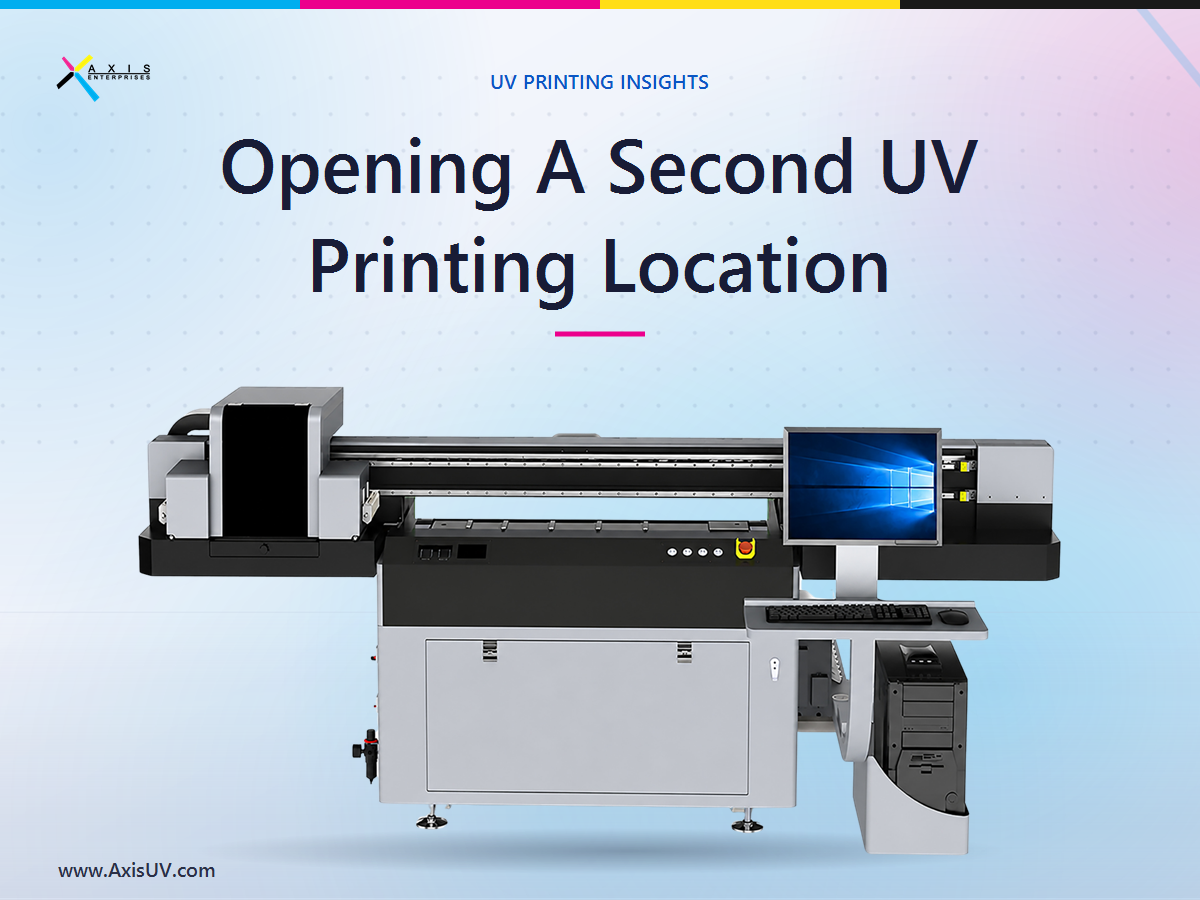
A second machine at one address shares your rent, your supervision, and your trained operators. A second address duplicates all of those before it earns a rupee. If your bottleneck is machine hours rather than geography, adding capacity almost always beats adding a branch.
A second location earns its keep only in specific cases: your customers are concentrated in another city, freight or travel is eating your margins, or turnaround time is losing you jobs because you are physically too far from the work.
How do you know your first location is truly ready to be copied?
You are ready to copy a system, not export a problem. A second site amplifies whatever your first site already is, so the readiness test is about repeatability, not enthusiasm.
- Capacity is genuinely maxed. Your existing UV printer is running near full wide-format capacity across a normal week, not just during festival-season spikes.
- The work does not depend on you. A trained operator can run a full production day, from file prep through UV curing and dispatch, without you standing over the machine.
- Your numbers are clean. You know your true cost per print, your monthly break-even, and your net margin, not just your top-line sales.
- Profit is steady. The first site has been consistently profitable for at least two to three quarters, not one good month.
- Demand is proven elsewhere. You already turn away or ship to customers in the target city, so you are following demand rather than guessing at it.
If two or more of these are shaky, the honest answer is that you are not ready to open a second location. You are ready to fix the first one.
What smart owners look for before funding a second UV printing site
Once the readiness test is passed, the decision becomes financial and operational discipline. Reset your buying criteria around these questions.
- Full landed cost, not sticker price. Budget the machine plus installation, spares, inks, training, and downtime, which is the honest total cost of ownership. On a UV printer bought for a business, the 18% GST is an input tax credit you can set off, so plan cash flow around the credit timing, not just the invoice.
- Runway that survives a slow start. Assume the new site earns little for its first few months and keep enough working capital that a slow start does not drain the profitable location.
- Compliance across state lines. A branch in another state usually needs its own GST registration and correct e-way bill handling for stock moved between sites.
- Systems before staff. Documented standard operating procedures, a fixed quality checklist, and clear pricing rules travel to the new site so quality does not depend on who is on shift.
- A remote quality plan. Decide in advance how you will inspect output, handle reprints, and hold standards at a shop you cannot visit daily.
What to look for in the equipment and supplier behind a second site
Your choice of machine and supplier decides how smoothly a second location runs, because a remote site punishes weak support far more than a shop you can walk into. When you scale, judge the equipment behind this decision on more than headline speed.
- Reliable uptime. A second site cannot afford a machine that stalls, because you are not there to nurse it. Ask about realistic uptime and mean time to repair.
- Fast service response across cities. Confirm how quickly service and spares reach a location in a different city, not just your home base.
- Consistent output. The same file should produce the same colour and finish on both machines, which keeps inkjet print quality identical across locations.
- Real operator training. Structured onboarding matters more at a remote site, where you cannot correct mistakes in person.
- Transparent running costs. Clear ink and maintenance economics let you model the new site’s break-even before you commit.
A calmer, lower-risk way to plan your expansion
Given everything above, the right sequence is usually to prove and document one site, saturate its capacity, and only then copy the system into a second city with eyes open. That is where a specialist buying partner earns its place: matching machine capacity to your real order volume, and helping you decide between adding a machine and adding a branch. At uvprinterindia.com, the focus is helping owners make that call with numbers rather than nerves.
If you are weighing a second location, start by pressure-testing the plan rather than the ambition. You can book a free UV printing machine buying consultation to size the right machine for your current and projected volume, or compare UV printer models and running costs before you commit capital to a new site. Owners who prefer to model the finances first can request a running-cost and payback breakdown for a single strong location versus two.
Frequently asked questions
When should a UV printing business open a second location?
Open a second location only when the first site runs near full capacity across normal weeks, has been consistently profitable for two to three quarters, and can operate without the owner present. Real demand should already exist in the target city. If the first site is not yet self-running and profitable, adding capacity there is the safer move.
Is it cheaper to add a second machine or open a second branch?
Adding a second machine at your existing site is almost always cheaper and less risky, because it shares rent, supervision, and trained staff. A second branch duplicates rent, staffing, and overheads before it earns revenue. Choose a second branch only when demand is genuinely in another city and freight or travel is hurting your margins.
What are the biggest risks of expanding a UV printing business too soon?
The main risks are cash strain, quality drift at the site you cannot supervise daily, and the owner becoming the bottleneck across two locations. Startup Genome data links about 74% of high-growth business failures to premature scaling. The fix is proving and documenting the model before copying it.
Do I need a separate GST registration for a second location in another state?
Yes. A location in a different state generally requires its own Goods and Services Tax registration, and stock moved between your sites needs correct e-way bill handling. The GST paid on a business UV printer is available as an input tax credit, so plan cash flow around when that credit is realised.
How much capacity should my first location reach before I expand?
As a rule of thumb, your existing UV printer should be running near full capacity across ordinary weeks, not only during seasonal peaks, before you consider a second site. If spare machine hours remain, a second shift or added automation usually returns more than a new branch, at a fraction of the risk.
Sources
- Fortune Business Insights: Printed Signage Market (India market size and growth)
- IMARC Group: India Digital Printing Market (CAGR and 2033 forecast)
- Press Information Bureau, Government of India: MSME contribution to GDP, exports and Udyam registrations
- Startup Genome: Premature Scaling, A Deep Dive
- Commerce Institute: Business Failure Rate (U.S. Bureau of Labor Statistics survival data)