
Published: 11 October 2026. Last updated: 11 October 2026.
Quick answer: Are there government subsidies for buying a UV printer in India?
Yes. A UV printer counts as plant and machinery for a manufacturing or service micro or small enterprise, so an Indian business can part-fund it through several central schemes. The Credit Linked Capital Subsidy Scheme (CLCSS) gives a 15 percent capital subsidy of up to ₹15 lakh on a bank term loan for new machinery. The Prime Minister’s Employment Generation Programme (PMEGP) gives a 15 percent to 35 percent margin money subsidy on a new project. The Pradhan Mantri Mudra Yojana now lends up to ₹20 lakh under its Tarun Plus category.
The gateway to almost all of these is a free Udyam registration. None of them pays for a machine outright, but used together with input tax credit on the Goods and Services Tax you pay, they can cut the effective, out-of-pocket cost of a UV printer substantially and spread the balance over monthly EMIs.
Why does equipment cost stop so many print businesses from growing?
Equipment cost is the single biggest reason small print, signage and gifting businesses keep outsourcing work instead of bringing it in-house. The lump sum feels large, so owners treat the machine as a cost they cannot carry, even when the monthly outsourcing bill would comfortably cover an EMI.
That hesitation sits on top of a sector that is anything but small. According to figures from the Union Minister for MSME, Jitan Ram Manjhi, reported by The Week in July 2025, the MSME sector contributes 30.1 percent of India’s GDP, 35.4 percent of manufacturing output and 45.73 percent of the country’s exports.
Formalisation is accelerating too. The Ministry of MSME Year End Review 2025, summarised by Drishti IAS, records that more than 7.30 crore enterprises had registered on the Udyam and Udyam Assist platforms by December 2025. Many of these registered owners are eligible for machinery subsidies they have never claimed.
The demand side is growing in parallel. MarketsandMarkets values the India UV curing system market at USD 150.5 million in 2026 and projects it to reach USD 324.5 million by 2031, a compound annual growth rate of 13.7 percent. Owners who bring UV printing in-house now are positioning for that growth instead of renting it from a vendor.
What is an MSME, and what changed in 2025 to make more buyers eligible?
An MSME is a micro, small or medium enterprise as defined under the Micro, Small and Medium Enterprises Development Act, 2006, classified by investment in plant and machinery and by annual turnover. Most capital subsidies are reserved for micro and small units, so your classification decides which schemes you can use.
The limits were revised upward with effect from 1 April 2025, which pulls many more print and signage businesses into the eligible bands. As set out by Taxmann, citing Notification S.O. 1364(E) dated 21 March 2025, the micro-enterprise investment ceiling rose from ₹1 crore to ₹2.5 crore and the turnover ceiling from ₹5 crore to ₹10 crore.
The practical takeaway: almost every independent UV printing business in India falls within the micro or small band, which is exactly where the richest machinery subsidies sit.
Which government schemes can fund a UV printer purchase?
Three central schemes do most of the heavy lifting for a machinery purchase of this size: CLCSS for a capital subsidy on a bank loan, PMEGP for a new project with a built-in subsidy, and the Mudra Yojana for the loan itself. Here is how each one works, with its headline numbers.
Credit Linked Capital Subsidy Scheme (CLCSS). CLCSS gives a 15 percent capital subsidy on the loan taken for new plant and machinery, on a maximum loan of ₹1 crore, which caps the subsidy at ₹15 lakh. As explained in a CLCSS guide published by Razorpay, the applicant must be a Udyam-registered micro or small enterprise, the machine must be financed through a term loan, and the application must be filed at or before loan sanction rather than after you have already bought the machine.
Prime Minister’s Employment Generation Programme (PMEGP). PMEGP is for new units and pays a margin money subsidy as a share of the project cost. Per the PMEGP details published by the State Bank of India, the subsidy runs from 15 percent (general category, urban) to 35 percent (special category, rural), with the beneficiary contributing only 5 percent to 10 percent. The PMEGP scheme guidelines published by the Government of Tripura’s Industries department set the maximum project cost at ₹50 lakh for a manufacturing unit and ₹20 lakh for a service unit, which comfortably covers a UV printer plus working capital.
Pradhan Mantri Mudra Yojana. Mudra provides the underlying loan for smaller setups. A Press Information Bureau release confirms that the loan ceiling was doubled to ₹20 lakh under a new Tarun Plus category, announced in the Union Budget 2024-25 on 23 July 2024 and effective from 24 October 2024, for borrowers who have repaid an earlier Tarun loan.
How much can these schemes actually save on a UV printer?
The saving is the subsidy plus the tax you can recover, not just the sticker discount. Consider a UV flatbed priced at ₹10 lakh before tax, bought by a Udyam-registered small unit on a bank term loan.
Under CLCSS, a 15 percent capital subsidy on that ₹10 lakh loan returns roughly ₹1.5 lakh to the business. Separately, a GST-registered buyer can usually claim input tax credit on the Goods and Services Tax (India) charged on the machine, so that tax is set off against output tax rather than lost as cost, subject to the usual GST rules.
Stacked together, the capital subsidy and the recovered tax can lower the effective cost well below the headline price, while the remaining balance is carried as a monthly EMI that your current outsourcing spend often already covers. The sticker price, in other words, is rarely the real price for a business that plans the purchase properly.
What should smart buyers look for before they apply?
Judge a UV printer purchase on its effective cost after subsidy and tax credit, and on whether it is financeable, not on the quoted price alone. A slightly higher-priced machine that qualifies cleanly for a scheme and comes with proper paperwork can cost you less in the end than a cheaper one that does not.
Use this checklist when you evaluate a machine and a supplier:
- Udyam-ready structuring: confirm your business is Udyam registered as a micro or small enterprise before you apply, because it is the gateway to CLCSS and most other schemes.
- Scheme-ready documentation: look for a supplier who provides a proper GST tax invoice, a detailed quotation and a clear machine specification sheet, since lenders and scheme portals ask for all three.
- Term-loan financeable: choose a machine and a supplier that banks recognise, so the purchase can be routed through a sanctioned term loan that CLCSS requires.
- New machinery, genuine upgrade: remember CLCSS funds new, technology-upgrading machinery, not a like-for-like replacement, so plan the purchase as a capability upgrade.
- Timing: file the subsidy application at or before loan sanction, never after you have paid for the machine.
- Service and spares: pick a supplier with local service response and spare-parts availability, because downtime on a financed machine is expensive.
A better way to plan your UV printer purchase
Given everything above, the real task is not finding the cheapest machine. It is matching the right UV printer to the right scheme, with the right paperwork, so your out-of-pocket cost is as low as the rules allow. That is where buyer-side guidance pays for itself.
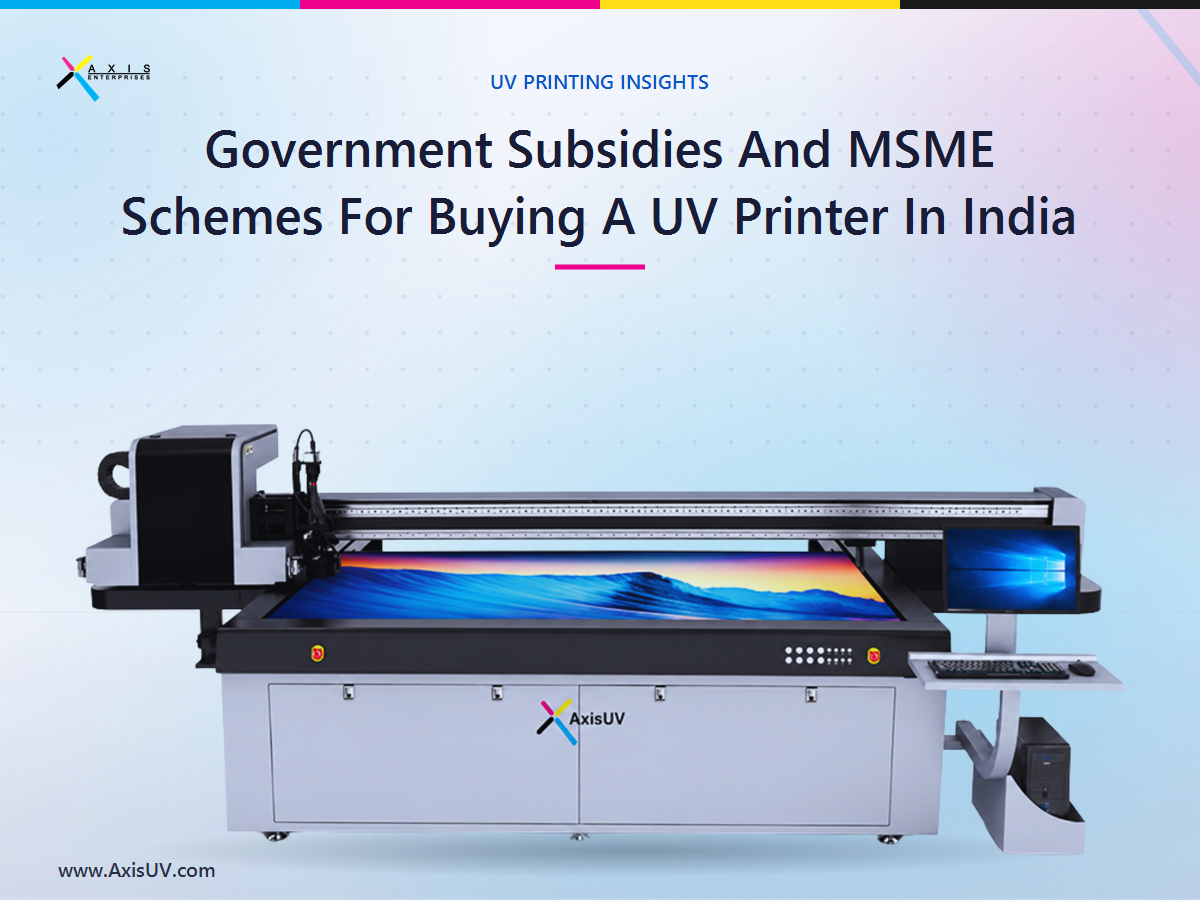
At Axis Enterprises (uvprinterindia.com), we help Indian print, signage, gifting and small-manufacturing businesses choose a UV printer that fits both their work and the schemes they qualify for. A UV printer uses inkjet printing heads to lay down ink that is instantly hardened by UV curing, which is what lets one machine print on acrylic, wood, glass, metal, leather and more. You can compare UV printing machines on our site and ask for a specification sheet and quotation that are ready for a bank or a scheme application.
Next step
If you are weighing a UV printer and want to buy it in the most cost-efficient, scheme-aware way, start with a conversation rather than a catalogue. You can book a free UV printing machine buying consultation with our team, and we will walk you through machine options, financing, and the subsidy routes your business may qualify for. For a quick starting point, request a free machine recommendation from Axis Enterprises and tell us what you print today and what you want to bring in-house.
Frequently asked questions
Is there a direct government subsidy specifically for UV printers?
There is no scheme named after UV printers, but a UV printer qualifies as plant and machinery under general MSME schemes. CLCSS, PMEGP and the Mudra Yojana all treat it like any other eligible machine, so the subsidy comes through those routes rather than a printer-specific grant.
Do I need to register as an MSME to claim these schemes?
In practice, yes. A free Udyam registration is the gateway to CLCSS and most machinery schemes, and the Ministry of MSME reports more than 7.30 crore enterprises already registered, so the process is well established and quick.
Can a brand-new print business get a subsidy, or only existing units?
Both can. PMEGP is designed for new units and pays a 15 percent to 35 percent margin money subsidy on the project cost, while CLCSS is aimed at existing micro and small units upgrading their machinery. Your stage of business decides which door you use.
Can I claim GST input tax credit on a UV printer?
A GST-registered business can usually claim input tax credit on the GST paid on a capital machine, setting it off against output tax instead of treating it as a cost, subject to the standard GST rules. This is separate from, and can be combined with, a capital subsidy such as CLCSS.
How much of a UV printer’s cost can schemes realistically cover?
CLCSS alone returns 15 percent of the machinery loan, capped at ₹15 lakh, and PMEGP can return 15 percent to 35 percent of a new project’s cost. Combined with recovered GST and an EMI structure, the effective cost to the buyer is often far below the quoted price.
Sources
- The Week: MSME sector accounts for almost half of India’s exports (July 2025)
- Drishti IAS: Year End Review 2025, Ministry of Micro, Small and Medium Enterprises
- Taxmann: Revised MSME Classification, Investment and Turnover Limits
- Razorpay: Credit Linked Capital Subsidy Scheme (CLCSS) for MSMEs guide
- State Bank of India: Prime Minister’s Employment Generation Programme (PMEGP)
- Government of Tripura, Industries and Commerce Department: PMEGP Scheme Guidelines
- Press Information Bureau: Mudra loan limit raised to ₹20 lakh under Tarun Plus
- MarketsandMarkets: India UV Curing System Market