
Published: October 12, 2026 | Last updated: October 12, 2026
Quick answer
For most Indian SMBs that print on rigid products (boards, panels, gift items, signage substrates, industrial parts), a UV flatbed printer is usually the better buy, because it prints directly onto flat rigid surfaces with precise registration and no lamination step. A roll-to-roll UV printer suits businesses whose core work is long flexible media such as banners, vinyl, wallpaper and flex. A hybrid machine does both, but costs more and compromises slightly on each job type. Decide by your dominant job type, substrate rigidity and monthly volume, not by the lowest sticker price. Match the machine to roughly 80 percent of your orders, then confirm total cost of ownership, service response and the GST inclusive landed cost before you sign.
What is the difference between a UV flatbed and a roll-to-roll UV printer?
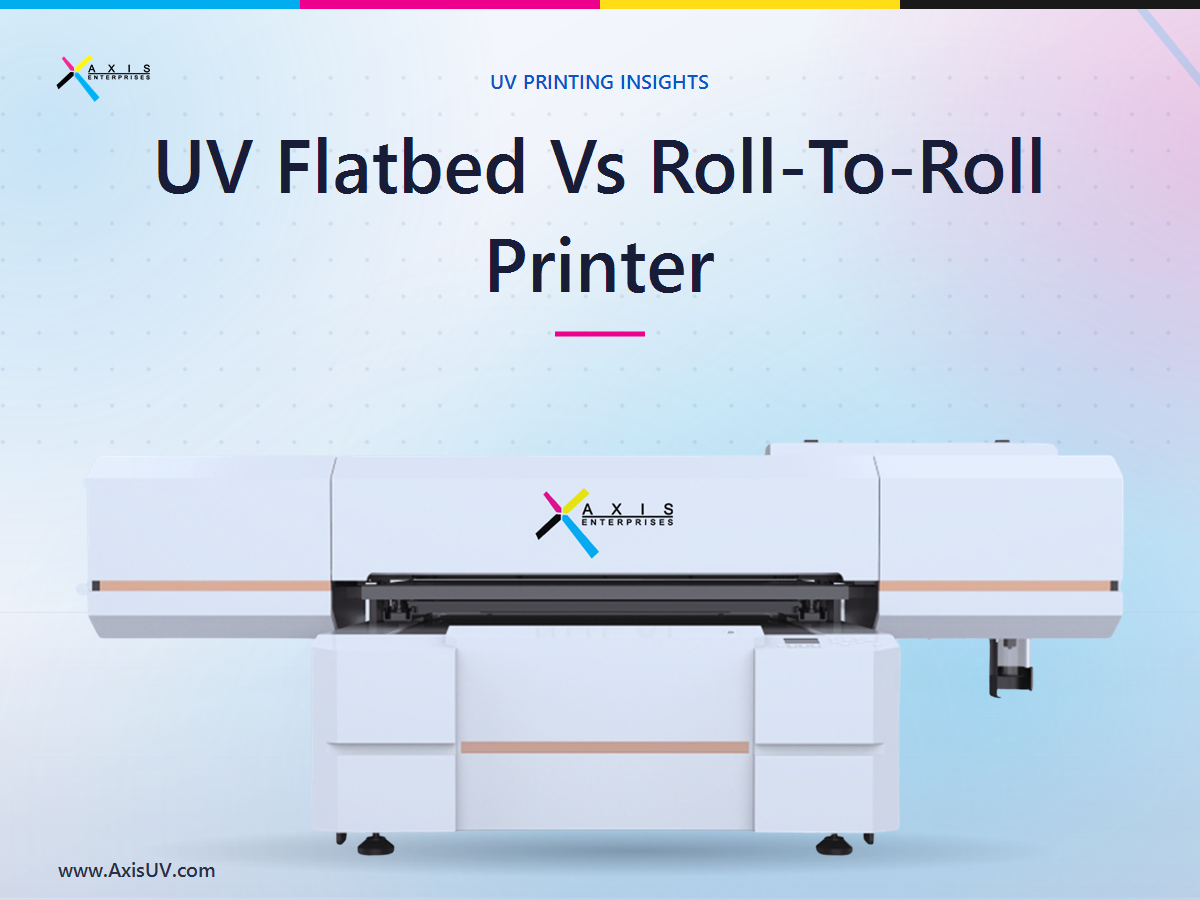
The core difference is how the material moves and what shape it can be. A UV flatbed printer holds a rigid sheet or object still on a flat vacuum bed and moves the printhead over it, while a roll-to-roll printer feeds a continuous flexible roll past the printhead and winds it up at the other end.
Both use the same basic chemistry. They jet liquid ink through an inkjet printing head, then fix it instantly with ultraviolet (UV) curing, so the ink dries on contact rather than soaking in or air drying.
A flatbed is a type of wide-format printer built for flat rigid stock. A roll-to-roll machine uses a roll-to-roll process designed for flexible media delivered on rolls. A hybrid combines a flat bed with a roll feeder so one machine can switch between the two.
What can each one print?
A flatbed prints directly on rigid items: acrylic, wood and MDF, glass, metal, ceramic tiles, PVC boards, phone cases, bottles and panels. A roll-to-roll prints on flexible stock: self adhesive vinyl, banner flex, wallpaper, films and labels. If your orders are mostly rigid and personalized, the flatbed is doing the real work.
Why the wrong machine choice quietly drains margin
The wrong machine does not fail loudly. It just makes every job slower, every quote weaker and every month less profitable than it should be, because you keep outsourcing or rejigging work the machine was never suited for.
Demand for this kind of printing is real and growing. Grand View Research reports that the global large format printer market is anticipated to reach USD 12.70 billion by 2030 at a 5.0 percent CAGR, and it notes that the UV cured ink segment is expected to grow at the fastest rate because it bonds to glass, ceramics and metal (Grand View Research).
In India the base is smaller but faster. MarketsandMarkets values the India large format printer market at USD 233.1 million in 2025, rising to USD 346.7 million by 2030 at an 8.3 percent CAGR (MarketsandMarkets). A buyer who picks the wrong configuration is competing in a growing market with a handicap.
What does this cost a small print shop?
The hidden cost is lost jobs and thin margins. If 80 percent of your enquiries are rigid product printing and you buy a roll-to-roll machine, you either turn that work away or jig flexible media onto rigid stock, which is slow and error prone. Every reprint and every outsourced job eats the margin the machine was supposed to create.
What is actually changing in the printing market
Printing is shifting from long analog runs to short, digital, customized jobs, and that shift rewards whoever owns the right in house machine. Digital work is where the growth is concentrated.
The IMARC Group estimates the India digital printing market at about USD 1.50 billion in 2025, projected to reach about USD 2.94 billion by 2034 at a 7.64 percent CAGR (IMARC Group). Short runs, variable data and personalization are driving that curve, and most of those jobs land on rigid, branded products.
This buyer base is large. According to the Press Information Bureau, India’s micro, small and medium enterprises contributed 30.1 percent of national Gross Value Added in 2022 to 2023 and 45.73 percent of exports in 2023 to 2024 (Press Information Bureau, Government of India). Those are the signage shops, gift makers, packaging units and manufacturers who need custom printing, and they increasingly want it done in house.
Ink economics reinforce the point. MarketsandMarkets sizes the printing ink market, in which UV curable ink is a key type, at USD 19.0 billion in 2022 and projects USD 28.6 billion by 2028 at a 7.0 percent CAGR (MarketsandMarkets). UV curing is growing because it prints on surfaces that older methods cannot.
Flatbed vs roll-to-roll vs hybrid at a glance
How should a smart buyer decide between them?
Decide on evidence from your own order book, not on the salesperson’s demo. Four questions settle it for most buyers.
1. What shape are 80 percent of your jobs? If most orders are rigid products, buy a flatbed. If most are flexible rolls, buy roll-to-roll. If the split is genuinely close to even and will stay that way, consider a hybrid.
2. What is the real total cost, not the sticker price? Weigh the full total cost of ownership: ink and primer, printheads, maintenance, power, operator time and the GST inclusive landed cost, not just the headline machine price.
3. How fast is local service? A machine that is down is losing money every hour. Service response time and local spare parts matter more than a small price difference.
4. Will your mix change in two to three years? If you expect to add rigid product lines, buying flatbed capability now is cheaper than replacing a roll-to-roll later.
What to look for before you buy
- Substrate match: Confirm the machine prints your actual materials with the correct primer and ink profile, tested on your own samples.
- White ink and varnish: For gifts, signage and premium branding, look for white ink and spot varnish capability, which flatbeds handle well on dark and clear materials.
- Bed size and object height: Make sure the bed fits your largest common job and that the clearance handles thicker objects you plan to print.
- Service and spares in India: Insist on a documented service response time and locally stocked consumables before price.
- Transparent running cost: Ask for cost per print on your own job, including ink, primer and maintenance, so your quotes stay profitable.
- Room to grow: Choose a configuration that covers the work you expect to win, not only the work you have today.
A better way to choose your UV printer
Given everything above, the smartest move is to match the machine to your real order book before you compare prices. At Axis Enterprises (uvprinterindia.com) we help Indian business owners do exactly that: we match a UV flatbed or hybrid printer to your product mix rather than selling a one size fits all box.
If you are weighing flatbed against roll-to-roll, you can compare our UV flatbed and hybrid models and see which substrates each one handles. For a buyer who is not sure where their 80 percent sits, our team will review your typical jobs and recommend the right configuration with a clear, GST inclusive quote.
Next step
If you are planning to bring printing in house or replace an ageing machine, the cheapest insurance against a wrong purchase is a short, honest conversation about your actual jobs. Bring your three most common order types and your rough monthly volume, and get a configuration and a transparent landed cost in return. You can book a free UV printing machine buying consultation with our team and make the decision with evidence instead of guesswork.
Frequently asked questions
Can one UV printer really print on acrylic, wood, glass and metal?
Yes. A UV flatbed prints directly on acrylic, wood, MDF, glass, metal, ceramic tiles and PVC, because UV curing fixes the ink on the surface instantly. You usually need the correct primer and ink profile for each material, tested on a sample first.
Which material is easiest for a beginner to start with?
Flat rigid sheets like acrylic and PVC board are the easiest starting point, because they sit flat on the bed and need minimal jigging. Harder surfaces such as glass and metal perform best once you learn the right primer and profile.
Is a hybrid machine a safe middle choice?
A hybrid is sensible only when rigid and roll work are genuinely close to even and will stay that way. If one type clearly dominates, a dedicated flatbed or roll-to-roll usually gives better value, because a hybrid costs more and compromises slightly on each job.
How do I compare running cost between machines?
Ask each supplier for cost per print on one of your own real jobs, including ink, primer, printhead wear and maintenance, not a generic figure. Then add power, operator time and the GST inclusive landed cost to get the true total cost of ownership.
Does a flatbed support white ink and varnish?
Most production UV flatbeds support white ink and spot varnish, which is what makes premium finishes on dark, clear and metallic materials possible. Confirm the specific model’s white ink circulation and varnish capability before buying.
Sources
- Grand View Research: Large Format Printer Market, global size, 2030 forecast and UV cured ink growth
- MarketsandMarkets: India Large Format Printer Market size and CAGR
- IMARC Group: India Digital Printing Market size and forecast
- Press Information Bureau, Government of India: MSME contribution to GVA and exports
- MarketsandMarkets: Printing Ink Market, including UV curable ink type