
Published: November 27, 2026. Last updated: November 27, 2026.
Quick answer: can a UV printer decorate curved and cylindrical products?
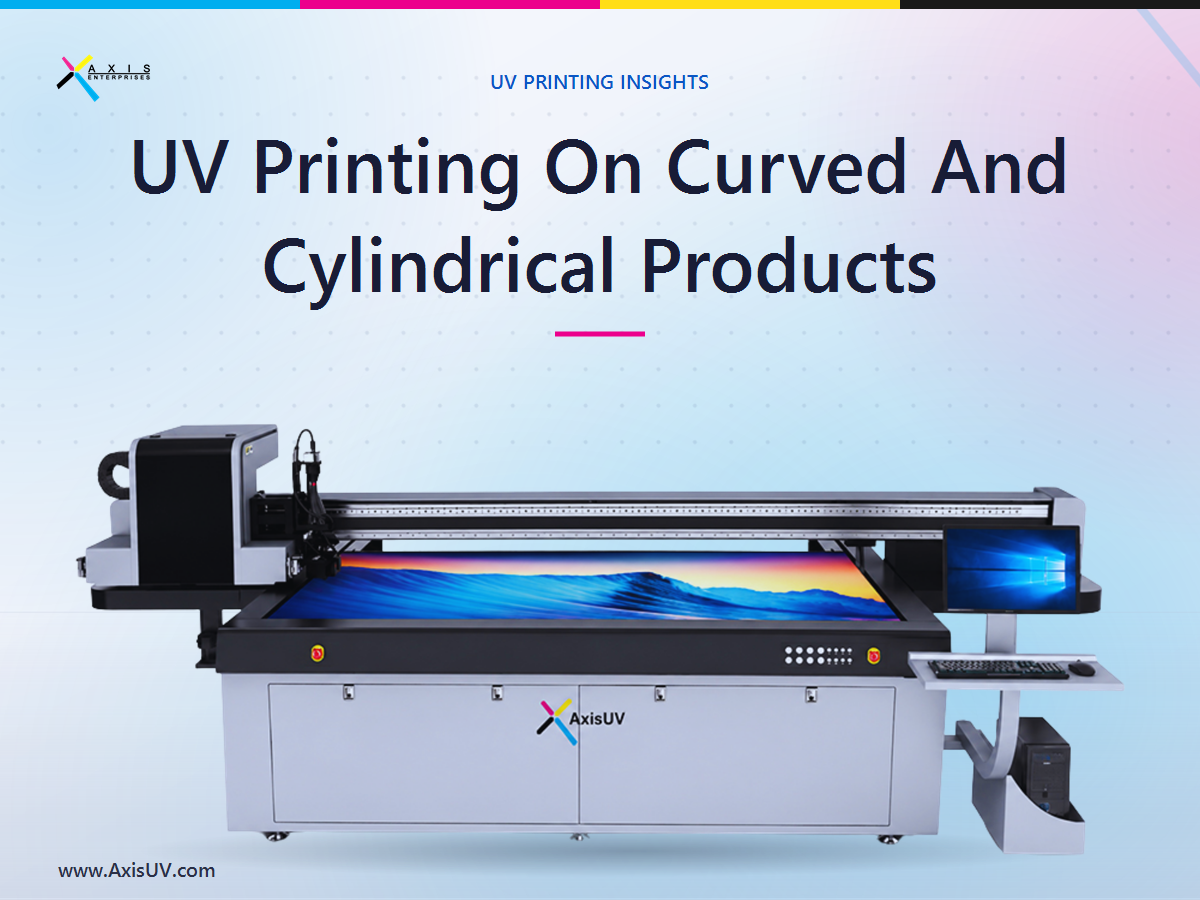
Yes. A flatbed UV printer fitted with a rotary attachment can print full-colour, durable graphics directly onto bottles, tumblers, jars, pens, candles, cosmetic tubes and other round or tapered items. The rotary device turns the object slowly while the printhead moves across it, so the design wraps evenly around the surface. This removes screens, transfers and minimum order quantities, which is why many small manufacturers and print shops now bring curved-product decoration in-house rather than outsourcing short runs.
What is rotary UV printing, in plain terms?
Rotary UV printing is direct printing onto a round object while a motorised cradle rotates it under the printhead. The ink is cured instantly by ultraviolet light, so it bonds to glass, metal, plastic or wood without drying time. The process is a form of inkjet printing combined with UV curing, where the light triggers a photochemical reaction that hardens the ink on contact.
Two setups exist. A rotary attachment bolts onto a flatbed UV printer you may already own. A dedicated cylindrical UV printer is a stand-alone machine built only for round work. Both reach the same outcome: a wrap-around print with no screens and no setup fees.
Why does this matter for Indian print and product businesses right now?
Demand for personalised, short-run products is climbing while buyers resist large minimum orders. According to Fortune Business Insights, the global personalized gifts market is estimated at USD 35.95 billion in 2026 and is projected to grow at a 7.58% CAGR through 2034. Curved items like bottles, mugs and tumblers sit at the centre of that demand.
The Indian base is large too. As reported by IMARC Group, the India gifting market was valued at around USD 75.16 billion in 2024, with personal gifting the dominant purpose. A shop that can decorate a single custom bottle profitably captures orders that a large factory, built for bulk, will not touch.
The machine demand is real, not hype
The equipment side is growing in step. Per Mordor Intelligence, the global UV printers market is worth about USD 1.10 billion in 2026 and is forecast to reach USD 1.58 billion by 2031, a 7.59% CAGR. The same source notes that print service providers held 62.31% of the UV printer market in 2025, while industrial OEMs were the fastest-growing user group at an 8.28% CAGR.
What are most buyers losing without curved-surface capability?
Most print shops that only handle flat work quietly hand away their highest-margin jobs. Drinkware, promotional bottles and cosmetic packaging are repeat-order categories, and sending them to a vendor means paying that vendor’s markup and waiting on their schedule.
- Lost repeat revenue: drinkware and promotional bottles are reordered often. Outsourcing each batch leaks margin every single time.
- Slow turnaround: a local gifting client who needs 50 printed bottles for an event next week cannot wait for a vendor’s bulk queue.
- Minimum order barriers: traditional methods like pad printing and screen printing need setup per design, so small custom orders are refused or priced out.
For context on scale, the Press Information Bureau and PolicyEdge report that MSMEs contribute about 31.1% of India’s GDP and 48.58% of exports, with over 8.84 crore enterprises registered on the Udyam platforms by mid-2026. That is a vast base of businesses that buy branded bottles, promotional drinkware and custom packaging, and almost all of it is short-run, personalised work.
Why does curved printing exist as a separate problem at all?
A flat printhead cannot stay in focus across a curved surface on its own, which is the whole reason rotary technology was developed. On a round object, the distance between the printhead and the surface changes constantly, so a standard flatbed pass would blur or band.
The rotary attachment solves this by holding the object at a fixed radius and turning it at a controlled speed, keeping a steady gap under the printhead. As the equipment review site SignLink noted when covering a new cylindrical UV printer in 2026, these machines are built specifically to customise products such as cups, tumblers, bottles and candle holders that flat printers cannot handle cleanly.
Manufacturers have moved fast here. Roland DG launched its RC-300 Series for direct cylindrical printing on bottles, tumblers, drinkware and packaging, and Inkcups released its Helix High Throw UV cylindrical printer in 2026 for irregular drinkware, conical products, planters and pet bowls. The category is maturing, not experimental.
Rotary attachment or dedicated cylindrical printer: which should you choose?
Choose a rotary attachment if you already run a flatbed and curved jobs are a growing side of the business. Choose a dedicated cylindrical printer if round products are your main volume and speed is the priority. The table below compares the two on the factors that decide profit.
How should a smart buyer judge a curved-printing solution?
Judge it on fit, reliability and total cost, not on the lowest sticker price. The right questions reframe the decision away from a cheap machine and toward a profitable production line.
- Object range: what diameters, lengths and tapers can it hold? A cradle that fits only straight cylinders will reject conical tumblers and stepped bottles.
- Ink adhesion and white ink: glass and metal usually need a primer and a white underbase for colour to show. Confirm the machine runs white ink and that the supplier provides tested material profiles.
- Support and spares in India: a printhead or rotary motor fault stops production. Local parts and fast service matter more than a small price difference.
- Total cost of ownership: look past the machine price to ink, primer, maintenance and operator time. This is where total cost of ownership decides real profit.
What should you look for before you buy a rotary or cylindrical UV printer?
Use this checklist as objective buying criteria. Each point protects margin after the machine lands on your floor.
- Look for a supplier who lets you run a sample print on your own products, including your hardest curved item, before you pay.
- Look for documented material profiles for the surfaces you sell: glass, stainless steel, powder-coated metal, and common plastics.
- Look for white ink and varnish capability, since these are what let you charge premium prices on dark and transparent items.
- Look for a rotary cradle range that matches your real product mix, not just the demo bottle.
- Look for a supplier who stocks spare printheads and rotary parts within India and quotes a clear service response time.
- Look for honest guidance on GST input credit and depreciation, so your numbers reflect the real, post-tax cost of the asset.
How do you work out whether the numbers make sense?
Start from the jobs you already outsource, then compare in-house cost per piece against your vendor’s price. Curved-product decoration earns its keep when you combine high per-unit margins with steady reorders.
A plain calculation of return on investment should use the extra profit a machine adds, not its raw utilisation. Count the outsourcing you stop paying for, the premium you can charge for personalisation, and the new product lines a round-object capability opens. For an India-specific view, GST input credit on the machine and consumables, plus depreciation under the Income Tax Act, both lower the effective cost of the asset.
A practical way forward for curved-product printing
If curved and cylindrical products are a real part of your market, the most reliable path is to match the machine to your exact product mix with a supplier who stands behind it in India. At uvprinterindia.com, Axis Enterprises helps printing businesses, signage makers, manufacturers and gifting brands choose flatbed UV printers and rotary solutions that fit their products, their volumes and their budget.
Rather than sell a machine and leave, the focus is on helping you decide what actually earns a return: the right configuration, tested material profiles, white ink capability and dependable after-sales support. You can compare flatbed and rotary options and request a tailored machine recommendation based on the products you plan to print.
Frequently asked questions
Can one UV printer print on both flat and curved products?
Yes. A flatbed UV printer with a rotary attachment handles flat work normally and switches to curved items when the attachment is fitted. This dual use is why many small businesses start with one flatbed machine and add rotary capability as curved orders grow.
What curved products are most profitable to print?
Drinkware leads: steel and glass bottles, tumblers and mugs, all of which are reordered often. Cosmetic tubes, candles, pens and jars are also strong because they carry branding and personalisation that buyers pay a premium for.
Do I need primer and white ink for glass and metal bottles?
Usually yes. Smooth, non-porous surfaces like glass and metal often need a primer for adhesion, and a white ink underbase for colours to appear solid. A supplier should provide tested profiles for each material so you are not guessing.
Is a rotary attachment cheaper than a dedicated cylindrical printer?
Generally yes, if you already own a compatible flatbed UV printer. Upgrading with a rotary attachment and the right firmware costs less than buying a stand-alone cylindrical machine, though a dedicated unit may suit very high curved-product volumes.
How durable is UV printing on bottles and tumblers?
UV-cured ink resists scratching, water and fading far better than standard inkjet on hard surfaces, because the ink is crosslinked by UV light rather than simply dried. For items washed often, test adhesion on your specific product and cleaning method before committing to a large run.
Sources
- Fortune Business Insights, Personalized Gifts Market (2026)
- IMARC Group, India Gifting Market
- Mordor Intelligence, UV Printers Market
- The Policy Edge, Government Expands Credit and Formalisation Push for MSMEs (2026)
- India Brand Equity Foundation (IBEF), Udyam MSME Registration Data (2026)
- SignLink, Cylindrical UV Printer Launch Coverage (2026)
- Precedence Research, Roland DG Industrial UV Printing Solutions
- Impressions Magazine, Inkcups Helix High Throw UV Cylindrical Printer (2026)
- Wikipedia, UV curing