
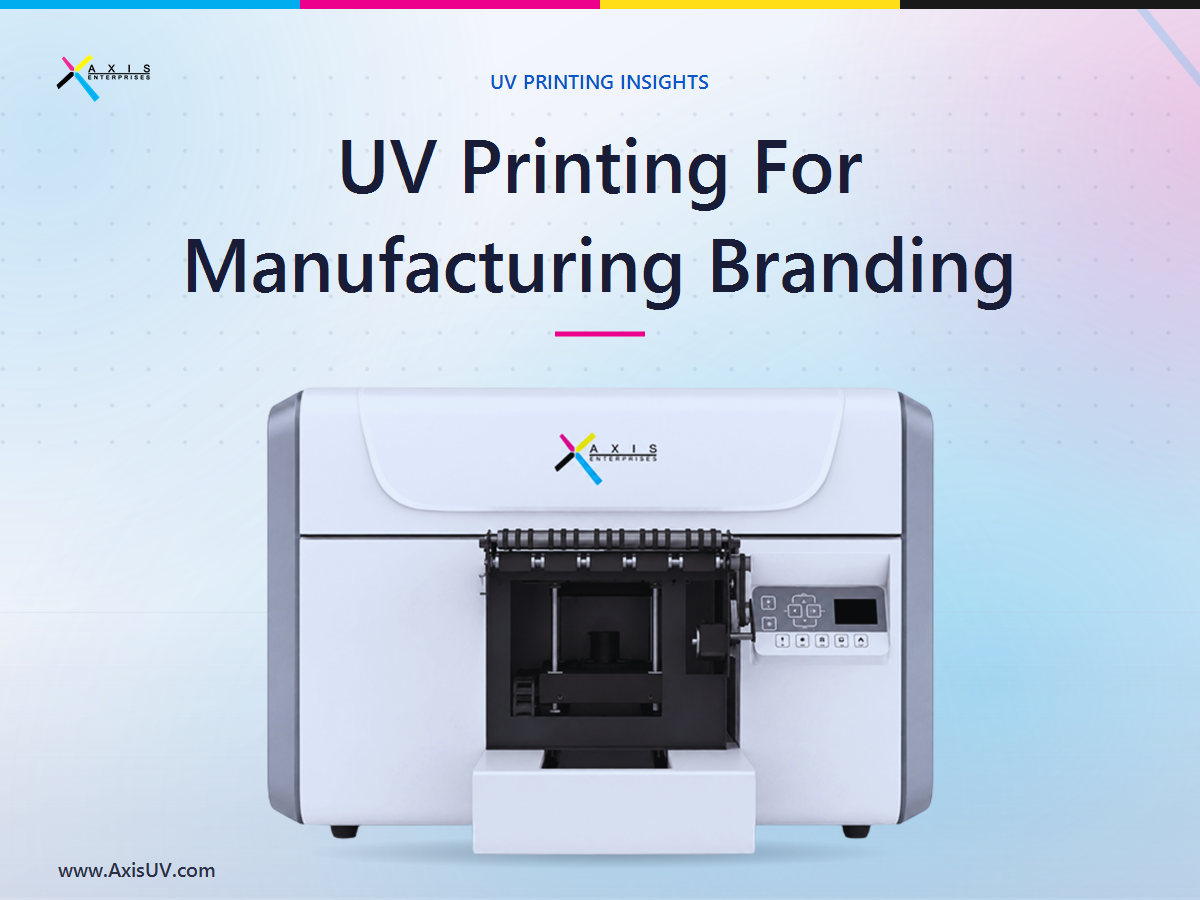
Quick answer: Manufacturing branding is the practice of printing your logo, product name, specification details, model numbers, safety marks, and decorative finishes directly onto the products and components you make, instead of relying on stickers, engraved plates, or outside vendors. A flatbed UV printer lets an Indian manufacturer do this in-house on almost any material (metal, acrylic, wood, plastic, glass, MDF, and leather) with durable, scratch-resistant, full-color output. It shifts branding from a bought-in cost and a delivery bottleneck into an owned, same-day capability that raises perceived value and protects margins. The right machine is chosen on product size, material mix, ink system (including white ink for dark surfaces), service support, and total cost of ownership, not headline price alone.
The branded product is quietly becoming the default in Indian manufacturing
India is not just making more products. It is making more branded, customized, and short-run products. According to Grand View Research, the India custom printing market generated roughly USD 2,451.8 million in revenue in 2024 and is projected to reach about USD 4,790.4 million by 2030, a compound annual growth rate near 11.8 percent. Buyers now expect a product to look finished, marked, and brand-ready before it leaves the factory.
The wider printing shift points the same way. Grand View Research reports the India digital printing market at about USD 1,457.4 million in 2023, growing to a projected USD 2,674.0 million by 2030 at close to a 9.3 percent CAGR. Product identity and labelling ride on the same wave: Mordor Intelligence values the India print label market at around USD 2.46 billion in 2025, with growth near 13.29 percent CAGR toward roughly USD 4.59 billion by 2030. Demand for names, marks, and finishes on physical goods is expanding faster than the broader economy.
Why this matters for the people who actually build things
Manufacturing is not a niche in India, it is the backbone. The Press Information Bureau (Government of India) reports that the MSME sector accounts for about 30.1 percent of India’s GDP, 35.4 percent of manufacturing output, and 45.73 percent of exports. Most of those small and medium enterprises make components, hardware, tools, panels, fittings, and finished goods that all need marking, identification, or branding at some stage.
Here is the quiet problem. Most manufacturers still outsource that branding step. Logos, rating plates, warning labels, model badges, and decorative panels go out to a vendor and come back days later, at a per-piece cost, with minimum order quantities that punish small batches. The result is a familiar squeeze:
- Margin leak: every outsourced logo or spec plate carries a markup you pay on top of your own product cost.
- Delivery drag: a finished product can sit idle for days waiting on printed identity parts.
- Minimum order pain: vendors want volume, so short runs and one-off custom orders either get refused or cost a premium.
- Inconsistency: colors and placement drift between vendor batches, which shows on your product, not theirs.
- Lost premium orders: when a client wants their own branding on your product, you either say no or lose the margin to a middleman.
What UV printing actually does, in plain terms
A UV printer is an inkjet machine that lays down ink and then instantly hardens it with ultraviolet light, a process called UV curing. Because the ink cures on contact rather than soaking in or air-drying, it bonds to rigid and non-porous surfaces that normal printing cannot handle: aluminium, stainless steel, acrylic, glass, ABS and other plastics, powder-coated metal, wood, and MDF.
For a manufacturer, three properties matter most:
- Direct-to-product: you print straight onto the finished part or panel, so there is no label to peel, bubble, or fall off.
- Durability: cured UV ink resists scratching, handling, and everyday wear, which is exactly what a rating plate or brand mark needs.
- White ink and layering: a white underbase lets full-color logos show up cleanly on dark metal, black plastic, or transparent acrylic, and spot varnish adds a premium raised finish.
In branding terms, this means your logo, product name, batch and serial numbers, QR codes, compliance marks, and decorative graphics can all be produced on the same machine, on the same day, on the actual product.
Reframing the buying decision: from “print cost” to owned capability
Most first-time buyers evaluate a UV printer the way they evaluate an outsourced print job: what does each print cost. That is the wrong lens. The smarter question is what capability you are bringing in-house permanently, and what that capability protects and unlocks. Branding is high-margin work. When you own the machine, the branding markup you used to pay a vendor becomes your margin instead.
Read the decision through total cost of ownership, not sticker price. A machine that is slightly cheaper but suffers frequent printhead failures, slow local service, and expensive spares can cost far more over three years than a well-supported machine at a higher upfront figure. Factor in Goods and Services Tax (India) as well: capital equipment is typically bought with GST that a registered business can set against output liability through input tax credit, so your working number is the effective post-credit cost, not the invoice headline.
What smart buyers should look for
If manufacturing branding is the goal, evaluate any UV printing machine against criteria that map to real production, not showroom demos:
- Bed size matched to your products: the flatbed must comfortably fit your largest common part or panel, with margin to spare.
- Material range and adhesion: confirm the machine and its ink and primer system are proven on your specific materials, especially metal and coated surfaces.
- White ink capability: essential for branding on dark, colored, or transparent products.
- Print durability: ask for adhesion and scratch tests on your material, since a brand mark that wears off damages your reputation.
- Local service and spare parts: response time and parts availability in India matter more than a marginally lower price.
- Operator simplicity: repeatable presets and clear workflows so branded output stays consistent across shifts.
- Honest running-cost picture: ink usage, printhead life, and maintenance load, framed over years.
A better way forward
Once branding lives inside your factory, the economics change. You stop paying a per-piece markup on your own identity, you deliver branded products the same day, and you can finally accept the premium and custom orders you used to turn away. That is the case for bringing UV printing in-house, and it is why so many Indian manufacturers are moving from stickers and outside vendors to direct-to-product branding.
At Axis Enterprises, we build flatbed UV printing machines for exactly this work. If you want to see how it fits your products, you can explore flatbed UV printers built for manufacturers and compare configurations by product size and material. When you are weighing options, our team can help you match the right machine to your product mix and walk through the total cost picture, GST included. We are glad to arrange a live demo on your own material so you can judge adhesion and finish before you decide, and every purchase is backed by reliable after-sales support and service across India.
Frequently asked questions
Why should manufacturers invest in branding?
Branding turns an anonymous component into a recognizable, higher-value product. It supports premium pricing, builds repeat recognition with buyers, and, when done in-house, converts a cost you used to outsource into retained margin. In a market where custom and branded printing is growing near 11.8 percent a year (Grand View Research), branding is increasingly the expectation, not the extra.
Can UV printing strengthen product branding?
Yes. UV printing places durable, full-color logos, names, and finishes directly on the product surface, including metal, acrylic, plastic, and glass. Because the ink is UV cured, the mark resists scratching and wear, so your branding stays intact through handling, storage, and use.
How does branding increase perceived value?
A clean, permanent brand mark signals quality and accountability. Buyers associate consistent, professional identity on a product with a manufacturer that stands behind it, which supports higher prices and stronger differentiation against unbranded competitors.
Which branding products generate repeat orders?
Items that recur in production cycles tend to drive repeat work: rating and specification plates, serial and batch number panels, control and machine overlays, model badges, and branded decorative panels. Because these are needed on every unit or batch, in-house printing removes an ongoing outsourcing dependency.
Can UV print serial numbers, QR codes, and compliance marks directly on parts?
Yes. Variable data such as serial numbers, batch codes, and QR codes can be printed directly onto components alongside your logo, which is useful for traceability, warranty, and regulatory marking without a separate labelling step.
Next step
If your products currently leave the factory wearing someone else’s printing markup, it is worth seeing what bringing branding in-house would do to your margins and turnaround. Book a free UV Printing Machine Buying Consultation at uvprinterindia.com, tell us your products and materials, and we will help you work out whether a flatbed UV printer earns its place on your floor.
Sources
- Grand View Research, India Custom Printing Market Size and Outlook
- Grand View Research, India Digital Printing Market Size and Outlook
- Mordor Intelligence, India Print Label Market Report
- Press Information Bureau, Government of India, MSME Contribution to GDP, Manufacturing and Exports
- Mordor Intelligence, UV Printers Market Report