
Published: September 4, 2026. Last updated: September 4, 2026.
Quick answer
A personalized gifting business turns plain products (mugs, bottles, frames, pens, phone cases, wooden plaques) into custom, made-to-order items that sell at a premium. UV printing is the core enabling technology because it prints full colour directly onto almost any hard surface, cures instantly, and needs no minimum order quantity. In India, the customised gift segment is growing at roughly 25 to 28 percent a year, and Deloitte research shows about one in five consumers will pay a 20 percent premium for a personalized product. The margin on a single custom item is high, but it only holds if you control production cost and turnaround. That is decided almost entirely by the printing method you choose, not by the products you buy.
Why is personalized gifting suddenly a real business, not a hobby?
Because the demand data has moved from anecdote to trend. The Indian gifting market is large and shifting toward customisation, and personalization now carries a measurable price premium.
According to market research firm IMARC Group, the India gifting market is worth hundreds of millions of dollars and continues to expand as buyers move away from generic gifts. The faster-growing slice sits inside it: Actual Market Research estimates the India personalized gift market will cross USD 540 million by the end of this decade.
Willingness to pay is the part most owners underestimate. The Deloitte Consumer Review on mass personalisation found that around 20 percent of consumers would happily pay 20 percent extra for a personalized product or service. That premium is the entire business model. You are not selling a mug, you are selling their mug.
How big is the buying audience for custom-printed gifts?
Large, and mostly reachable online. Two forces feed a gifting business: a growing base of small businesses that need branded merchandise, and a booming direct-to-consumer retail channel.
India has more than 6.3 crore (63 million) micro, small and medium enterprises, a sector that contributes 30.1 percent of GDP, according to the Ministry of MSME (Press Information Bureau, 2025). Every one of those firms is a potential buyer of branded diaries, bottles, awards, and welcome kits.
On the consumer side, Mordor Intelligence values India’s direct-to-consumer (D2C) e-commerce market at about USD 87.5 billion in 2025, projected to reach USD 322.1 billion by 2031 at a 24.3 percent CAGR. Custom, made-to-order gifting rides this wave through print on demand storefronts on Instagram, Amazon, and brand websites.
Where does the money actually leak in a gifting setup?
The leak is almost always in how the printing is done, not in what is sold. Most first-time owners assemble a patchwork of processes, and each one quietly erodes the premium they just charged.
- Outsourcing every order: sending each mug or plaque to a job printer eats 40 to 60 percent of the margin and adds days of turnaround you cannot control.
- Single-material methods: sublimation only works well on polyester-coated items, so a shop limited to it cannot say yes to glass, metal, wood, leather, or acrylic requests.
- Minimum order quantities: screen printing and pad printing need setup per design, which kills the “order of one” that makes personalization profitable.
- Rework and colour mismatch: without accurate colour, custom orders get reprinted, and every reprint is pure loss on a one-piece job.
Each of these is a structural cost, not a one-off mistake. They compound on exactly the small, varied, personal orders that are supposed to be your highest-margin work.
How does UV printing change the economics of personalization?
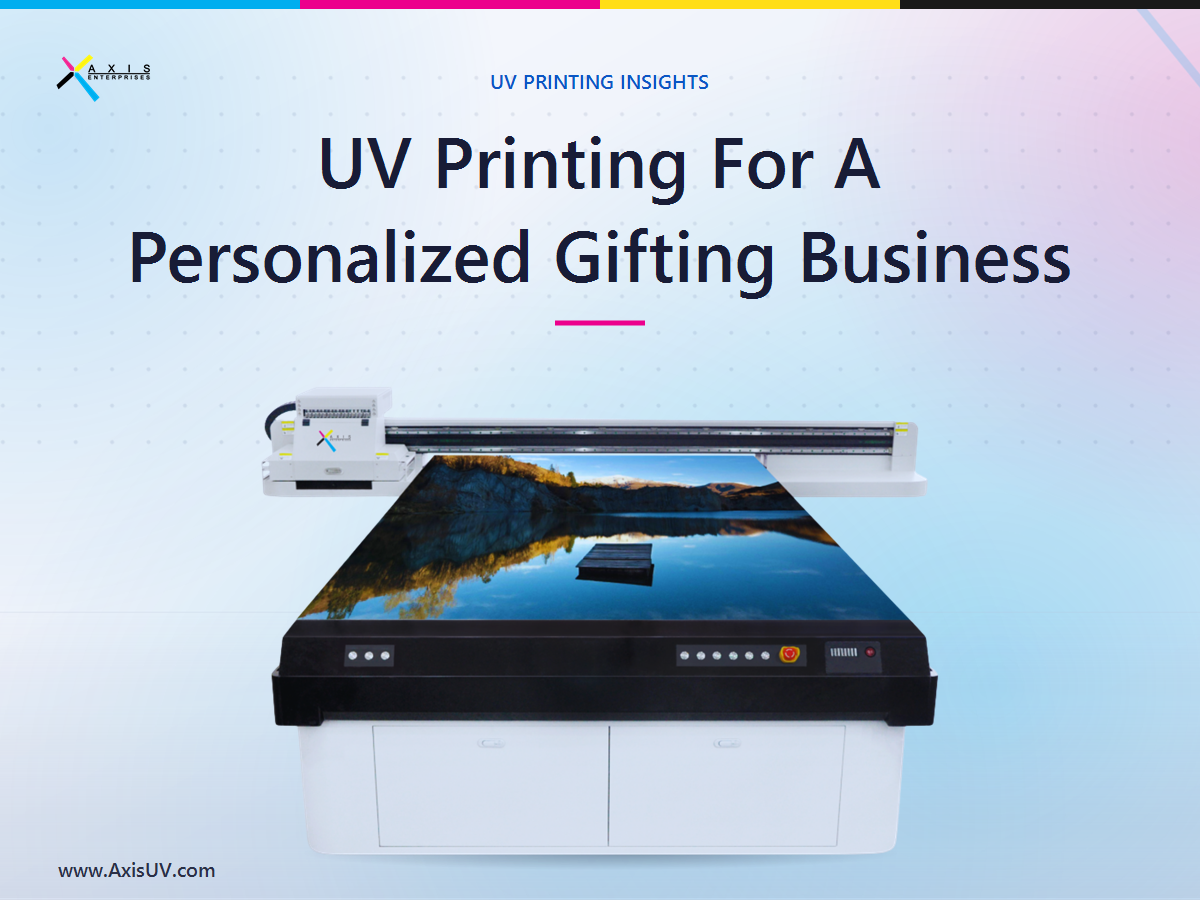
It removes the material limits and the minimum-quantity problem in one step. UV printing uses ultraviolet light to cure ink the instant it hits the surface, a process known as UV curing. Built on inkjet printing technology, a UV flatbed prints full colour directly onto rigid, uneven, and heat-sensitive items that other methods refuse.
Three properties matter for a gifting business. First, one machine prints on wood, glass, metal, acrylic, leather, PVC, stone, and ceramic, so you can accept almost any custom request. Second, ink cures instantly, so a finished, touch-dry gift comes off the bed in minutes, enabling same-day personalization. Third, there is no minimum order quantity, so a single monogrammed bottle is as viable as a batch of 500.
This is why capital is flowing into the category. The UV digital inkjet printer equipment market was valued at about USD 3.18 billion in 2025 and is projected to reach USD 7.48 billion by 2032, a CAGR near 13 percent, according to 360iResearch. Grand View Research similarly ties digital printing growth to rising packaging customisation and e-commerce demand.
What should a smart buyer look for in a UV printer for gifting?
Judge the machine by the jobs it lets you say yes to and the cost it lets you keep, not by headline speed alone. Use this checklist before you spend a rupee.
- Surface range and jig support: can it hold and print curved items (bottles, tumblers) as well as flat ones? Range is what expands your catalogue.
- White ink and varnish: essential for printing on dark or transparent gifts and for raised, textured finishes that justify premium pricing.
- Colour accuracy and RIP software: good colour management is the difference between one pass and a costly reprint on a one-piece order.
- Reliable curing and print-head life: the running cost and uptime of your whole business ride on these two components.
- Local service, spares, and training: a printer down for a week during a festival rush is lost revenue you never recover.
- Honest total cost of ownership: weigh ink, maintenance, and power against price, and factor the 18 percent Goods and Services Tax (India) and input-tax-credit position into your real landed cost.
Notice that none of these criteria is “cheapest sticker price.” The cheapest machine that cannot hold a bottle or match a colour is the most expensive decision you can make in this business.
A better way forward
Once the criteria above are clear, the buying decision gets simple: choose a supplier who sells the machine and stands behind it with training, spares, and service. That is exactly how we work at Axis Enterprises. We help owners building a personalized gifting or custom-product business match the right UV printer to the products they actually plan to sell, so the machine pays for itself instead of sitting idle.
If you are comparing options, you can explore the UV printer range at uvprinterindia.com and see which flatbed or specialised model fits your product mix and workspace. Our team walks you through the surface range, white-ink capability, and real running cost for your specific gift categories, and helps you plan the true landed cost, including GST, before you commit. For owners who are still testing demand, we can also advise on starting small and scaling your UV printing setup as orders grow.
Next step
If you are planning a personalized gifting business, or want to add high-margin custom products to an existing print shop, the fastest way to avoid an expensive mistake is a short, no-pressure conversation about your product mix and volumes. Book a free UV Printing Machine Buying Consultation at uvprinterindia.com, and we will help you choose a machine that matches the gifts you want to sell and the margins you want to keep.
Frequently asked questions
What products can I make in a personalized gifting business with a UV printer?
A UV flatbed prints directly onto mugs, bottles, tumblers, wooden plaques and photo frames, acrylic awards, glass, metal nameplates, phone cases, pens, keychains, diaries, and leather goods. Because UV printing bonds to most rigid materials, one machine covers most gift categories without switching processes.
Is UV printing better than sublimation for custom gifts?
For a broad gifting catalogue, yes. Sublimation works only on polyester-coated or specially treated items, while UV printing works on wood, glass, metal, acrylic, leather, and more. UV also cures instantly and needs no heat press step, which speeds up same-day personalization.
How much does a UV printer cost in India, and what about GST?
Prices vary widely by size and print head, from compact desktop flatbeds to larger production machines. UV printing machinery attracts 18 percent GST, which a registered business can typically claim as input tax credit. Always compare the total landed cost (price, GST, ink, and maintenance) rather than the sticker price alone.
Do I need a minimum order quantity to make personalization profitable?
No. That is the core advantage of UV printing. Because there is no per-design setup, a single custom item is profitable on its own, which is what allows the 20 percent personalization premium that Deloitte identified to flow straight to your margin.
Can a small business or solo founder run a UV gifting setup?
Yes. Many personalized gifting businesses in India start with one compact UV flatbed, a laptop with RIP software, and a small workspace. The bottleneck is rarely staff; it is choosing a machine with the right surface range, reliable curing, and local service support.
Sources
- IMARC Group, India Gifting Market Size, Share and Analysis Forecast
- Actual Market Research, India Personalized Gift Market Size, Share, Analysis and Trends
- Deloitte Consumer Review, Made-to-order: The Rise of Mass Personalisation
- Press Information Bureau, Ministry of MSME (MSME sector accounts for 30.1% of India’s GDP)
- Mordor Intelligence, India D2C E-commerce Market Size and Share Analysis
- 360iResearch, UV Digital Inkjet Printer Market Size and Share, 2025 to 2032
- Grand View Research, Digital Printing Market Size and Share Report