
Published: October 25, 2026 | Last updated: October 25, 2026
Quick answer: A flatbed UV printer can produce many of the brand-protection features manufacturers now ask for: serialized QR and batch codes printed as variable data, tamper-evident surface marks, raised tactile varnish, spot gloss over matte, and covert details that only show under certain light. Because the ink is printed and cured directly onto the product or its packaging, these features are far harder to copy than a stuck-on label. For an Indian print shop or small manufacturer, that turns anti-counterfeiting into a higher-margin service you control in-house, rather than a job you outsource or decline.
How big is the counterfeiting problem right now?
It is large and growing. The 2025 OECD and EUIPO report Mapping Global Trade in Fakes estimated that global trade in counterfeit and pirated goods reached about USD 467 billion in 2021, which the EUIPO put at 2.3% of total global imports.
India feels this sharply. The ASPA and CRISIL study State of Counterfeiting in India estimated that counterfeit products make up 25% to 30% of the market in India, hitting FMCG, apparel, and agrochemicals hardest. A later ASPA and CRISIL update, State of Counterfeiting in India 2025, reported that 35% of Indians encountered a fake product in the last year alone.
For a buyer evaluating equipment, that is the real headline: brand owners are under pressure, and they are looking for suppliers who can help them answer it.
Why does ordinary packaging keep getting faked?
Because most of it is easy to reproduce. A plain printed carton, a standard adhesive label, or a basic logo can be scanned, copied, and reprinted by anyone with a commodity press, so the genuine product and the fake look identical on the shelf.
Real deterrence comes from features that are hard to copy and easy to verify: unique serialized codes, variable information that changes on every unit, tamper-evidence, and physical finishes that a scanner cannot capture. This is the domain of security printing, and it is exactly where standard outsourced printing falls short.
Nakul Pasricha, President of the Authentication Solution Providers’ Association (ASPA), framed the stakes directly in an Autocar Professional interview, saying “by using an authentication solution, industry can hit counterfeiters hard” and that “a brand owner who employs an authentication solution is likely to increase his business.”
What does this mean for Indian print shops and small manufacturers?
It means a steady, high-value demand you can serve. Brand protection is no longer only a concern for large pharma companies: FMCG makers, cosmetics brands, auto-parts suppliers, and agro-input sellers all need it, and most of them are small and medium enterprises buying from local vendors.
The money is following the problem. Precedence Research valued the global anti-counterfeit packaging market at USD 207.58 billion in 2025 and projected USD 717.63 billion by 2035, a 13.21% CAGR from 2026 to 2035. The supporting label industry is growing too: IMARC put the India print label market at USD 1,655.8 million in 2025, heading to USD 2,269.3 million by 2034.
That demand sits inside a huge customer base. NITI Aayog data reported by India CSR shows micro, small, and medium enterprises contributing close to 30% of India’s GDP and around 40% of exports, and 97% of them are micro units. These are the small and medium enterprises that need affordable, in-house brand protection, not a lab in another city.
Which brand-protection features can a UV printer actually produce?
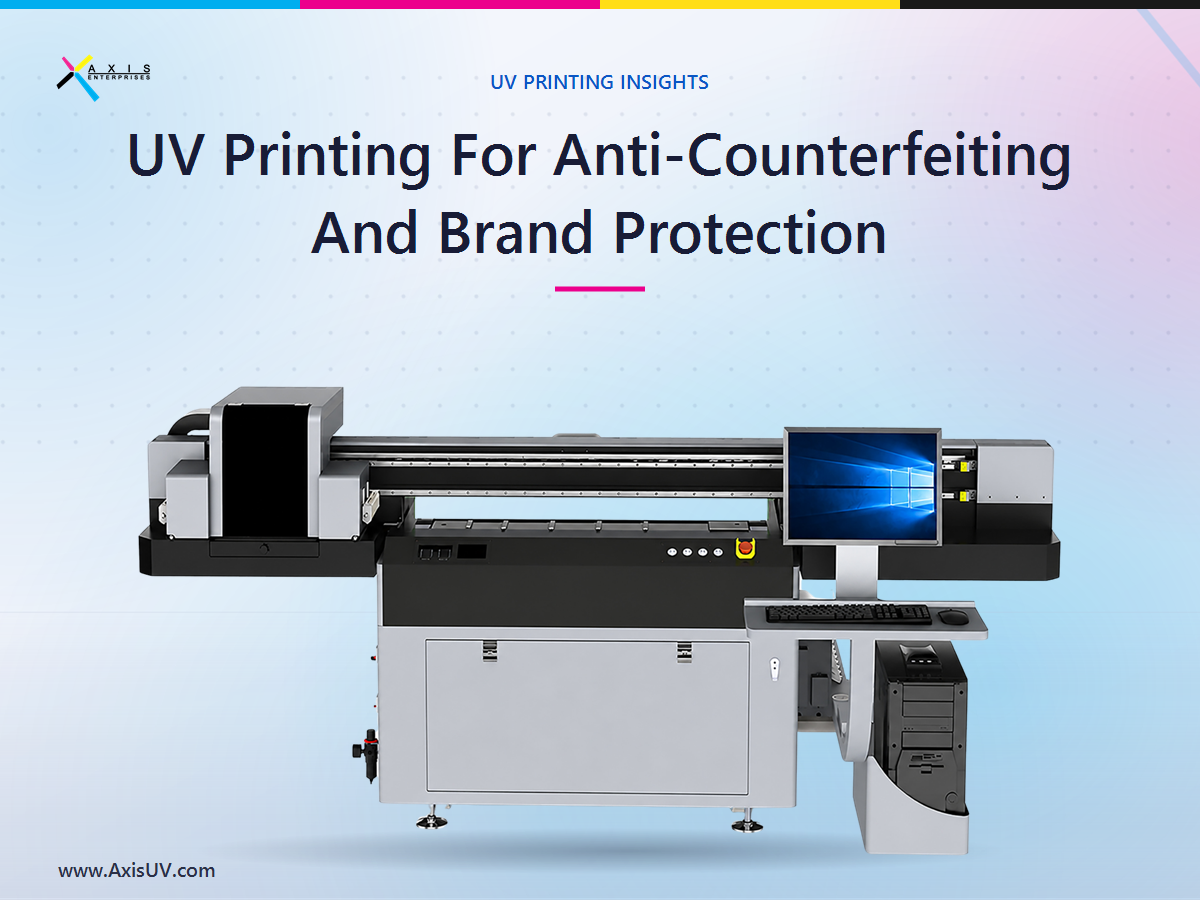
More than most owners expect. A flatbed UV printer builds up cured ink directly on the surface, so it can combine information, texture, and finish in a single pass. The table below maps common anti-counterfeiting needs to what the machine delivers.
The printing method matters here. UV ink is cured instantly by ultraviolet light the moment it lands, which is what lets it sit on top of the surface as a raised, tactile layer rather than soaking in like conventional ink that soaks into the surface. That physical layer is the part counterfeiters struggle most to copy.
What should smart buyers look for in a UV printer for security work?
Judge the machine by the features that make brand-protection jobs repeatable and profitable, not by sticker price alone. The right checklist looks like this:
- Variable data capability: the RIP software must change a code, serial, or batch number on every single print without manual resetting, or serialized traceability is impossible.
- White ink and varnish channels: these drive tamper marks, covert detail, and the tactile finishes that resist copying, so they are essential, not optional extras.
- Registration accuracy: security marks only work if they land in the exact same place every time, which depends on precise bed and head alignment.
- Material range: look for a flatbed that prints on cartons, labels, plastics, metal, and glass, so you can serve many brand-owner clients with one machine.
- Service and spare parts in India: downtime on a security job can hold up a client’s entire dispatch, so local support and parts availability matter more than a small price gap.
- Total running cost clarity: ask for ink consumption and consumable costs per unit so you can quote brand-protection work at a confident margin.
A practical way to bring brand protection in-house
If adding anti-counterfeiting work to your line sounds worthwhile, the starting point is matching a machine to the products and clients you already serve. At Axis Enterprises we supply flatbed UV printers to Indian manufacturers, signage makers, packaging and label units, and personalization businesses, and we help owners work out which configuration fits brand-protection jobs. You can explore flatbed UV printers built for this kind of work and see the material range each one handles.
It helps to test before you commit. You can request a sample print on your own product or packaging so you can see the serialized codes, varnish, and tactile finishes on the exact material your clients use. Pricing is quoted on a GST-inclusive, landed-cost basis so your numbers are clear from the start, and the team can walk you through service and spare-parts support across India before you decide.
Frequently asked questions
Can a UV printer really stop counterfeiting on its own?
No single tool stops it completely, and no honest supplier should claim that. What a UV printer does is let you add layered, hard-to-copy features: unique serialized codes, tamper marks, and tactile finishes printed directly on the product. Layering several of these together is what makes a fake impractical to produce at scale.
What is variable data printing, and why does it matter for brand protection?
Variable data printing means each printed item carries different information, such as a unique serial number or QR code, instead of the same artwork repeated. It matters because unit-level codes let a brand owner and a customer verify authenticity one item at a time, which a copied print run cannot replicate.
Which industries in India need anti-counterfeiting printing the most?
FMCG, pharmaceuticals, cosmetics, automotive components, and agro-inputs face the heaviest counterfeiting pressure, which is why the ASPA and CRISIL study named FMCG, apparel, and agrochemicals among the hardest hit. Most of these buyers are small and medium enterprises sourcing from local print and packaging suppliers.
Is UV printing durable enough for product codes and seals?
Yes. UV ink is cured hard onto the surface, so it resists scratching, rubbing, and moisture better than many surface inks, which is important when a code or seal must survive handling and transit to stay verifiable at the point of sale.
Do I need a large machine to offer brand-protection services?
Not necessarily. Many print shops start with a compact flatbed that handles labels, cartons, and small products, then scale up as demand grows. The decisive capabilities are variable data support, white ink and varnish channels, and registration accuracy, not raw bed size.
Next step
If brand protection is a service your clients are starting to ask about, the smartest move is to see the features on your own materials before you invest. Book a free UV printing machine buying consultation at Axis Enterprises, and the team will help you match a flatbed UV printer to the products, clients, and margins you are aiming for. Visit uvprinterindia.com to book your free consultation and get a sample print on the material your customers use.
Sources
- OECD: Global trade in fake goods reached USD 467 billion (2025 press release)
- EUIPO and OECD: Mapping Global Trade in Fakes 2025
- PrintWeek India: 25% to 30% of the market in India is counterfeit (ASPA and CRISIL report)
- IT Voice: ASPA and CRISIL State of Counterfeiting in India 2025
- Precedence Research: Anti-Counterfeit Packaging Market Size
- IMARC Group: India Print Label Market
- India CSR: MSMEs contribute about 29% to India’s GDP (NITI Aayog)
- Autocar Professional: Interview with Nakul Pasricha, President, ASPA