
Published: November 1, 2026 | Last updated: November 1, 2026
Two printing technologies that owners often treat as rivals are actually growing on separate tracks, and the gap is widening in 2026. The global market for UV printers is expanding faster than the market for thermal transfer consumables, which tells you something about where durable, high value printing work is heading.
If you buy the wrong technology for your products, you lock capital into a machine that fights your order book every day. So before you compare prices, compare what each method is actually built to do.
Quick answer: should you choose UV printing or thermal transfer?
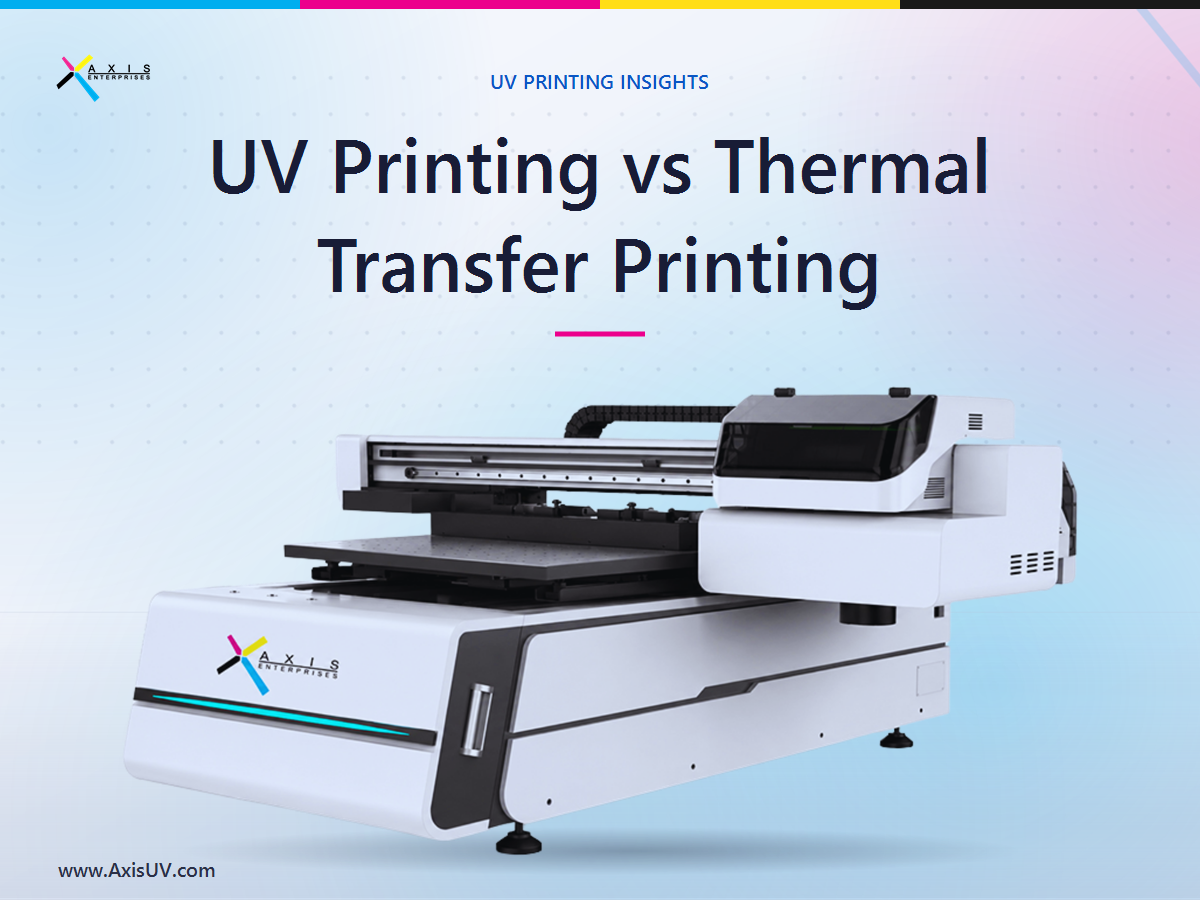
UV printing and thermal transfer printing solve different jobs. Thermal transfer melts a wax or resin ribbon onto labels and tags, and it is strongest for barcodes, shipping labels, and compliance marking. UV printing cures liquid ink with ultraviolet light and prints full color, including white ink and raised varnish, directly onto rigid products such as acrylic, wood, metal, glass, and plastic. If your core business is high volume identification labels, thermal transfer fits. If you want to decorate finished products, offer premium finishes, and bring varied jobs in house, a flatbed UV printer is the stronger long term investment.
What is the difference between UV printing and thermal transfer printing?
The difference is how the image is formed and what it can be formed on. Thermal transfer printing is a method that melts a wax or resin ribbon onto paper or synthetic label stock, mainly to produce durable identification labels and barcodes.
UV printing is a form of inkjet printing that sprays liquid ink and then hardens it instantly through UV curing, a light driven reaction that solidifies the ink the moment it lands. Because the ink cures on contact, it bonds to materials that ribbon based methods cannot handle.
In short: thermal transfer is a label technology, and UV is a product decoration technology. That single distinction decides most buying mistakes.
Why are print businesses losing margin on the wrong machine?
Many shops lose margin because their technology caps what they can sell, not because their prices are too low. India’s overall commercial printing market is projected to grow only modestly, from USD 37.54 billion in 2026 to USD 46.65 billion by 2034, a 2.76% CAGR, according to IMARC Group. In a slow growing market, the only reliable way to raise profit is to move up into higher value work.
Ribbon based printing keeps you in a consumable loop. The global thermal transfer ribbon market, valued at USD 2.61 billion in 2026 and forecast to reach USD 4.18 billion by 2035 at a 5.3% CAGR, reflects how much businesses keep spending on ribbons year after year, as reported by Global Market Insights.
That spend is fine if labels are your product. It is a drain if your customers actually want printed signage, gifts, panels, and packaging that a label printer can never produce.
Where does each printing technology actually fit?
Each technology wins in a clear zone, and the overlap between them is small. Thermal transfer owns long runs of identification labels, while UV printing owns short to medium runs of decorated products on almost any surface. The table below maps the real fit.
What is changing in printing right now that buyers should know?
The clearest shift is demand moving toward direct to product, full color printing, and regulation is accelerating it. The global UV printers market is set to grow from USD 1.10 billion in 2026 to USD 1.58 billion by 2031, a 7.59% CAGR, according to Mordor Intelligence, which also reports that Asia Pacific is already the largest region at 38.43% of 2025 revenue.
Two forces drive this. First, buyers increasingly want personalized and decorated products rather than plain labels, which plays to UV strengths. Second, tighter emission rules in states such as Maharashtra and Gujarat are pushing solvent based shops toward UV LED workflows that need no exhaust ducting.
Thermal transfer is not disappearing, but its growth is narrower. Grand View Research values the global thermal printer market at USD 6.0 billion in 2026, rising to USD 9.3 billion by 2033, with direct thermal, not thermal transfer, holding the largest share at 56.6% in 2025.
How should a smart buyer evaluate print technology in 2026?
Judge a technology by the profit it unlocks over its life, not by its sticker price. Indian small businesses carry real weight in the economy, with MSMEs contributing about 30.1% of India’s GDP in 2022-23 and 45.79% of exports in 2024-25, per India’s Ministry of MSME, so every capital decision has to earn its keep.
Use these criteria before you commit:
- Substrate range: count how many materials your customers ask for, then pick the technology that prints the most of them without outsourcing.
- Total cost of ownership: add machine, ink or ribbon, maintenance, and downtime across several years, not just the purchase cost. This is the real total cost of ownership, and it often favors the machine that opens more revenue.
- Value add finishes: prefer a method that lets you charge more through white ink, spot varnish, and texture, because premium finishes defend your margin.
- Durability on the actual product: make sure the print survives handling and weather on the surface you sell, not just on a test sheet.
- Tax and capex clarity: factor in Goods and Services Tax (India) and available depreciation benefits, since the landed and after tax cost is what hits your books.
What should you look for in a UV printing machine?
Look for a machine and a supplier that match your products and protect your uptime. The checklist below separates a printer that grows your business from one that sits idle.
- A flatbed design that handles the full range of materials your customers request, so you stop turning jobs away.
- Reliable, industrial grade printheads, since head health drives print quality more than headline resolution numbers.
- White ink and varnish capability, so you can sell premium finishes that flat label printing cannot match.
- Strong color management and RIP software, so repeat orders stay consistent across batches.
- Local service, fast spare part availability, and a clear maintenance plan, because downtime costs more than any price difference.
- Proper operator training, since most quality and maintenance issues trace back to how the machine is run, not the machine itself.
A better way forward
If your goal is to decorate products, add premium finishes, and bring varied jobs in house instead of renting capability from outsourcers, a flatbed UV printer is the natural answer to everything above. At Axis Enterprises, through uvprinterindia.com, we help Indian manufacturers, signage makers, gifting businesses, and print shops match the right UV printing machine to the products they actually sell. You can book a free UV printing machine buying consultation and get an honest read on whether UV fits your order book before you spend a rupee.
Frequently asked questions
Is UV printing more durable than thermal transfer printing?
Both are durable, but in different ways. Thermal transfer produces hard wearing labels, while UV cured ink bonds directly to the product surface and resists scratching, water, and fading. For items that are handled, displayed, or used outdoors, UV printing usually holds up better because the image is cured onto the product itself.
Can a UV printer replace my thermal transfer setup?
It depends on your main product. If you mostly print barcodes and shipping labels at high volume, thermal transfer remains efficient for that narrow task. If you want to print on products, signage, gifts, and packaging, a UV printer covers far more applications and opens higher value work that a label printer cannot do.
Which costs less to run over time, UV or thermal transfer?
For plain high volume labels, thermal transfer can be cheaper per piece because ribbons are simple. For full color and decorated work, UV printing often wins on total cost because there is no ribbon per print and each job can command a premium price. Always compare the full cost over several years, not the cost of a single print.
What materials can a flatbed UV printer print on?
A flatbed UV printer prints on a wide range of rigid and flat materials, including acrylic, wood, glass, metal, leather, MDF, and PVC. This versatility is the core reason businesses choose UV: one machine can serve many product lines. Testing each material with the correct profile before production keeps quality consistent.
Is UV printing a good fit for small Indian businesses?
Yes, for businesses that want to bring printing in house and sell decorated or personalized products. UV printing lets a small shop take on signage, gifting, and product branding work without outsourcing, which protects margins in a slow growing print market. The key is matching machine capability to the products you already have demand for.
The next step
Choosing between UV printing and thermal transfer is really a decision about what you want to sell next year, not just this week. If that answer includes decorated products, premium finishes, and work you currently outsource, UV printing is worth a serious look. Talk to the Axis Enterprises team and request your free UV printing machine buying consultation at uvprinterindia.com, and bring your real product list so the advice fits your business.