
Published: July 24, 2026
Quick answer: Should a manufacturer print its own nameplates and asset labels?
Yes. For most Indian manufacturers, engineering firms, and panel builders, bringing nameplate and asset-label production in-house with a UV printer pays back quickly. Industrial identification (rating plates, serial and QR tags, control-panel legends, warning labels, and asset tags) is low-volume, high-mix, and deadline-sensitive, which is exactly where outsourcing hurts most.
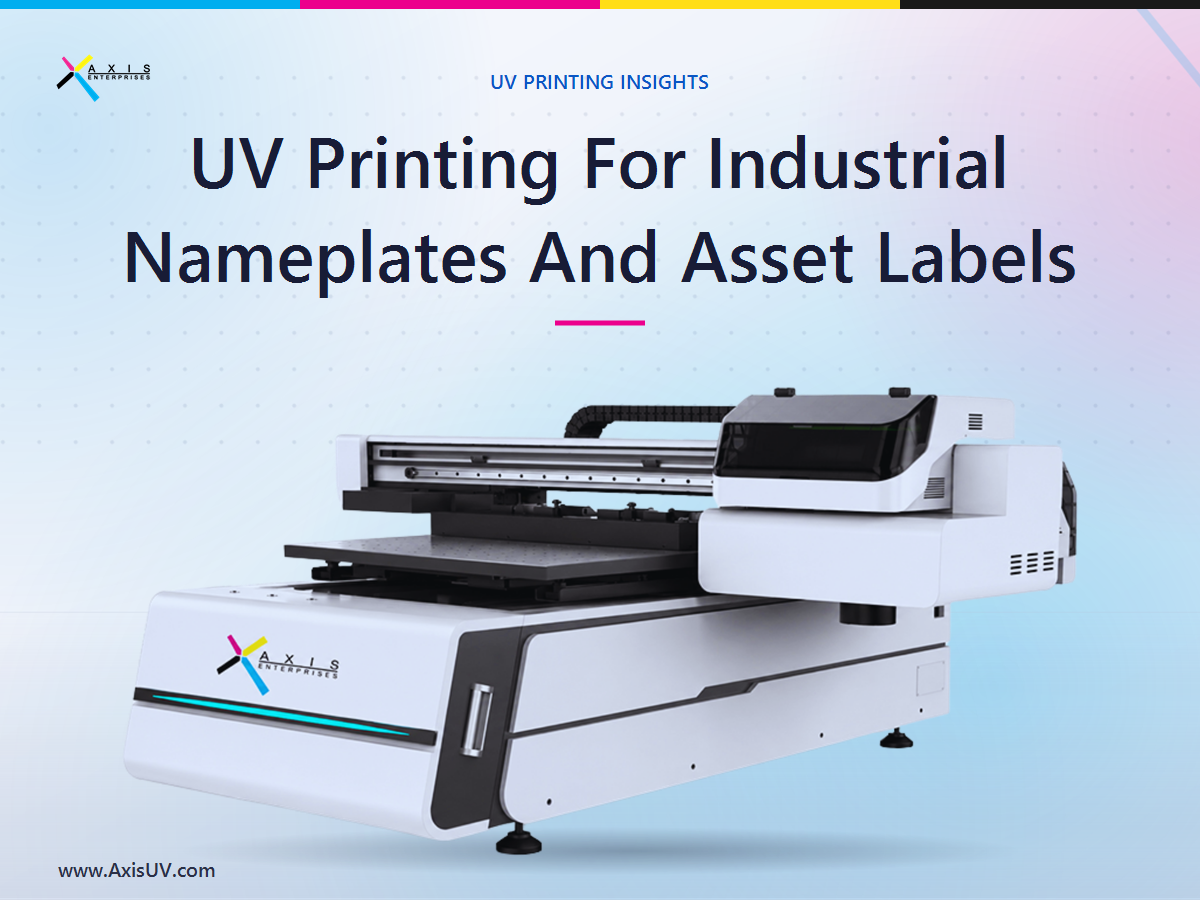
A UV flatbed printer prints full-colour, durable graphics directly onto metal, acrylic, polycarbonate, and ABS without stickers or engraving. That removes vendor delays, cuts minimum-order penalties, and keeps traceability data under your own control. The global market agrees on direction: the industrial labels market was valued at USD 68.96 billion in 2025 and is projected to reach USD 132.53 billion by 2034, and within it the equipment asset labels segment is the largest by type, according to Fortune Business Insights.
Why is industrial identification suddenly a bigger deal?
Because traceability has moved from a nice-to-have to a compliance and quality requirement. Every manufactured product now carries specifications, safety markings, and serialized identifiers that must stay legible for its whole life. When that identification fails, the cost lands squarely on quality, compliance, and delivery.
The scale of the opportunity in India is large. The Ministry of Micro, Small and Medium Enterprises reports that the MSME sector accounts for 30.1% of India’s GDP, 35.4% of manufacturing output, and 45.73% of exports, with 6.5 crore units registered on the Udyam portal supporting employment for 28 crore people as of July 2025. Every one of those manufacturers puts a nameplate, rating label, or asset tag on something.
Demand for the labels themselves is climbing fast. The India print label market was worth USD 2.46 billion in 2025 and is forecast to reach USD 4.59 billion by 2030, a 13.29% CAGR, according to Mordor Intelligence, with a clear shift toward digital printing for short runs, personalization, and variable data such as serial numbers.
What does this mean for a small manufacturer or panel builder?
It means the jobs you outsource are the ones a machine on your own floor could finish the same day. Nameplates and asset labels are rarely bulk orders. They are 20 plates here, 50 QR tags there, a revised control-panel legend before a dispatch. Vendors treat these as low-priority, so you wait days and often pay a minimum-order charge on a job worth a few hundred rupees.
The deeper risk is quality. Faded, peeling, or wrong labels break the link between a physical product and its records. As Sonia Ortiz, Quality Director at Armis, writes in Quality Magazine, “When labeling systems degrade or fail, gaps in traceability emerge, compliance risks become more prevalent and manufacturers lose visibility into the processes that protect product quality and integrity.”
Outsourcing also caps what you can offer. If a customer wants a full-colour logo, a durable QR code, and a rating table on a single anodized nameplate, a screen printer or engraver often cannot do all three in one pass.
How does UV printing actually solve this?
UV printing cures ink instantly with ultraviolet light, bonding a hard, scratch-resistant layer directly onto rigid surfaces. The process, called UV curing, uses a piezo inkjet head to lay down CMYK plus white and clear varnish in one workflow. The result is a full-colour, abrasion-resistant plate that does not need lamination.
That matters for industrial parts, which face heat, chemicals, and handling. A UV-printed plate keeps part numbers, hazard markings, and scannable codes readable through the product lifecycle, which is the whole point of a durable label.
The technology itself is maturing and getting cheaper to own. The UV LED printers market was valued at roughly USD 477.65 million in 2025 and is projected to reach USD 1,070.05 million by 2035, an 8.4% CAGR, per Future Market Insights. UV LED curing also runs cooler and lasts longer than older mercury lamps, which lowers running cost.
What should a smart buyer look for in a UV printer for this work?
Match the machine to industrial identification, not to generic photo printing. The needs of a nameplate shop are specific: adhesion on metal and plastic, fine detail for small serial fonts and QR codes, and reliability for daily short runs. Use the checklist below before you compare prices.
That last point is the one buyers miss most. The right lens is total cost of ownership: ink, primer, maintenance, and uptime over years, weighed against the outsourcing bills and delays you remove.
A better way forward
Once you frame it this way, the choice is less about buying a printer and more about owning your identification workflow. A UV flatbed sized for metal and plastic lets you print rating plates, asset tags, panel legends, and warning labels on demand, in full colour, with your traceability data staying in-house. At Axis Enterprises, this is exactly the problem we help Indian manufacturers solve, and you can explore the range of UV printing machines built for industrial substrates.
Because our machines are aimed at Indian SMBs, the economics are practical: GST input credit on the machine purchase, financing options, and lifetime technical support. If you want to see whether the numbers work for your order mix, book a free UV printing machine buying consultation and we will map your current outsourcing spend against an in-house setup.
You can also compare UV flatbed printer models for nameplate and asset-label production, or simply talk to the team at uvprinterindia.com about substrates, primers, and jigs for your specific parts.
Frequently asked questions
Can a UV printer print on stainless steel and aluminium nameplates?
Yes. UV printers bond ink directly to metals such as stainless steel, anodized aluminium, and brass, usually with a suitable primer for maximum adhesion. This produces full-colour rating plates and asset tags without engraving or stickers.
Can UV printing replace engraved nameplates?
In most cases, yes, and it adds colour and photographic detail that engraving cannot. Engraving cuts into the surface, while UV printing lays a durable, full-colour image on top, which suits logos, warning graphics, and scannable codes on a single plate.
Can I print QR codes and serial numbers on industrial parts?
Yes. UV printers with variable-data workflows print sequential serial numbers, barcodes, and QR or data-matrix codes at high resolution. Fine-detail print quality is what keeps those codes reliably scannable through the product lifecycle.
How durable are UV-printed labels in harsh conditions?
UV-cured ink forms a hard, abrasion-resistant layer, and adding clear varnish improves resistance to scratching and chemicals. Correct substrate preparation and the right ink profile are the biggest factors in long-term durability.
What materials work best for UV-printed nameplates?
Common choices are aluminium, stainless steel, acrylic, polycarbonate, and ABS. The best material depends on the environment the part faces, so match substrate and primer to expected heat, chemicals, and handling.
Next step
If nameplates, asset tags, and panel labels are quietly draining your delivery times and margins, the fix is to stop renting that capability from a vendor and own it. Take one week of outsourced identification jobs, add up the cost and the waiting, and weigh it against printing them yourself. When you are ready to see the machine that fits your order mix, reach out for a free, no-pressure buying consultation and we will help you decide with real numbers, not guesswork.
Sources
- Fortune Business Insights, Industrial Labels Market Size, Share, and Industry Analysis, Forecast 2026-2034
- Press Information Bureau, Government of India, MSME sector accounts for 30.1% of India’s GDP, 35.4% of manufacturing and 45.73% of exports
- Mordor Intelligence, India Print Label Market Size and Share Outlook to 2030
- Future Market Insights, UV LED Printers Market Size and Demand 2025 to 2035
- Sonia Ortiz, Quality Magazine, Durable Labels: The Overlooked Driver of Product Quality and Traceability