
Published: July 24, 2026
Quick answer: is wedding stationery still worth printing in 2026?
Yes, and the money is moving toward the print shops that can personalize. India hosts roughly 10 million weddings a year, and wedding stationery (invitations, RSVP cards, envelopes, tags and gift boxes) is shifting from long offset runs to short, highly personalized batches. UV printing, which uses ultraviolet light to instantly cure ink on cardstock, acrylic, wood, metal and more, lets a shop produce monogrammed, textured and foil-like invitations in-house, on demand, without minimum-order pain. For Indian print MSMEs, that means capturing margin currently lost to outsourcing and to premium personalization buyers. This article covers the market shift, the numbers behind it, and what to look for before you invest.
How big is India’s wedding stationery opportunity in 2026?
The opportunity is large, growing double digits, and recession-resistant because weddings happen regardless of the economy. According to the India Brand Equity Foundation (IBEF), India hosts close to 10 million weddings every year, and the wedding economy is among the country’s largest consumer sectors.
The formal wedding-services market was valued at USD 32.98 billion in 2025 by IMARC Group. Separately, Grand View Research projects India’s wedding-services market to grow at a 14.3% compound annual rate from 2025 to 2030, reaching about USD 228.69 billion by 2030.
Invitations are the first purchase in almost every wedding, and each event often orders several hundred cards plus matching envelopes and boxes. Multiply that by 10 million weddings and the stationery slice alone is a steady, repeatable print category.
Why are print shops losing wedding-card margin to outsourcing?
Most shops lose margin because they can only offer commodity offset runs and send anything premium (foil, emboss, spot gloss, printed acrylic or wood invites) to a third party. Every outsourced job hands away the highest-margin part of the order and adds days to delivery.
The economics are unforgiving. A plain offset invitation is a low-margin, high-minimum product, while the personalized and textured work couples actually want carries the premium, and that premium usually leaves the building.
India’s digital printing market, the technology base for short-run and personalized work, reached USD 1.4 billion in 2024 and is forecast by IMARC Group to nearly double to USD 2.9 billion by 2033. Grand View Research separately calls India the fastest-growing digital printing market in Asia Pacific, at a 9.1% annual rate through 2030. Shops without in-house short-run capability are competing for the shrinking commodity end of that market.
What is changing in how couples buy wedding invitations?
Buyers are moving from bulk uniform cards to personalized, small-batch and multi-material invitations, and they will pay more for it. Monograms with the couple’s initials, QR codes linking to wedding websites and RSVPs, and premium finishes are now mainstream expectations rather than luxury add-ons.
Willingness to pay backs this up. Deloitte research reported by Marketing Charts found that one in five consumers is very willing to pay a premium for a product they personalized. Medallia research in February 2024 found 61% of consumers are willing to spend more with companies that offer a personalized experience.
This is a structural shift, not a fad. As personalization becomes the default, the print shops that can turn one design into 300 monogrammed, made-to-order cards profitably will win the work, and those tied to fixed-plate offset runs will keep quoting the commodity price.
What is UV printing, and why does it suit wedding stationery?
UV printing is a digital process that jets ink onto a surface and cures it instantly with ultraviolet light instead of letting it dry over time. Because the ink hardens on contact through UV curing, it bonds to non-absorbent materials that traditional inkjet printing cannot handle well.
That property is a direct fit for modern wedding invitations. A single UV flatbed can print full-color designs, raised textures and spot-gloss effects on thick cardstock, acrylic, wood, metal and MDF, so a shop can offer glass-look, wood and metal invites without a separate machine for each.
UV also removes the plate and screen setup that makes short runs uneconomic, so printing 50 or 300 personalized cards costs roughly the same per card as printing 3,000. The broader UV cured inks market, an indicator of adoption, was valued at USD 1.75 billion in 2025 and is projected by Mordor Intelligence to reach USD 2.49 billion by 2030.
How strong is demand for UV printing hardware right now?
Demand for UV inkjet hardware is rising worldwide, which signals a maturing, well-supported technology rather than a niche bet. According to The Business Research Company, the global UV inkjet printing market is projected to grow from USD 60.09 billion in 2025 to USD 92.82 billion by 2030, an 8.9% annual rate.
Unit volumes tell the same story: global shipments of UV inkjet printers exceeded 92,000 in 2024 and are forecast to pass 130,000 units by 2030, per the same source. A growing installed base means better parts availability, service knowledge and resale value for the buyer.
For an Indian print MSME, that matters because the machine sits at the center of a business, not a hobby. The micro, small and medium enterprise sector contributes 30.1% of India’s GDP and 45.73% of exports, according to the Press Information Bureau, and short-run personalization is exactly the kind of high-value, low-capital work that suits this segment.
What should you look for in a UV printer for wedding and invitation work?
Look for a machine that handles varied materials, small batches, fine detail and Indian service reality, not just a low sticker price. The right criteria protect your margin long after purchase.
That last point deserves emphasis. Evaluate any machine on its total cost of ownership, and price your GST-inclusive quotes with input tax credit in mind, because a registered business can claim credit on both the machine and its consumables under Goods and Services Tax (India).
In-house UV versus outsourcing: which wins for short-run invitations?
For short, personalized and premium wedding work, in-house UV printing almost always wins on margin, speed and control, while outsourcing still suits very large uniform offset runs. The table below compares the two on the factors that decide a wedding order.
A practical way to bring wedding-card printing in-house
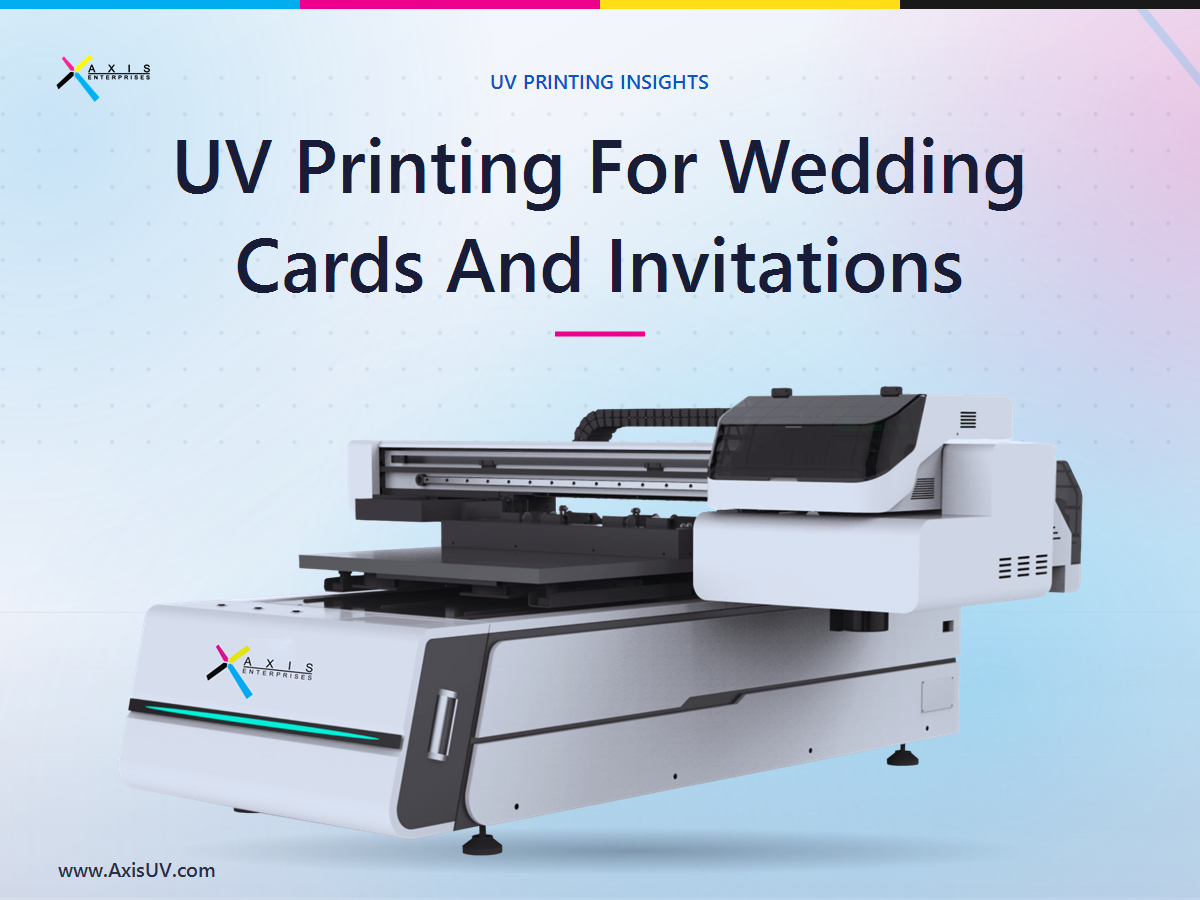
Given everything above, the logical next step for a print shop is a UV printing machine matched to short-run, multi-material stationery work, backed by real service. That is exactly what Axis Enterprises focuses on at uvprinterindia.com, supplying UV printing machines to Indian print, signage and personalization businesses.
If you are weighing your first machine or an upgrade, you can compare UV printer models for short-run stationery and get guidance on the substrate range, white-ink and varnish options, and after-sales support that wedding-season uptime demands.
The wedding calendar is not slowing down, and personalization is only becoming the default. If you want a clear, no-pressure assessment of which machine fits your product mix and volume, book a free UV printing machine buying consultation with the Axis Enterprises team, or simply reach out to talk through your options. It is a practical first step toward keeping the premium stationery margin inside your own shop.
Frequently asked questions
Can a UV printer print directly on thick wedding cardstock and envelopes?
Yes. UV flatbed printers cure ink instantly with ultraviolet light, so they print full color and raised textures directly on thick cardstock, envelopes, tags and boxes without smudging or long drying times. This makes them well suited to matched invitation suites.
Is UV printing cost-effective for small, personalized wedding runs?
Generally yes, because UV printing is digital and needs no plates or screens, so a run of 50 personalized cards costs roughly the same per card as a much larger run. That removes the high minimums that make short personalized jobs unprofitable on offset presses.
What materials beyond paper can I offer for premium invitations?
A single UV printer can print on acrylic, wood, MDF, metal and glass-look sheets in addition to cardstock. This lets a shop sell acrylic, wood and metal invitation cards as premium upsells from one machine.
How does GST affect buying a UV printer in India?
A GST-registered business can typically claim input tax credit on both the machine and its consumables, which lowers the effective cost. Price your wedding-card quotes on a GST-inclusive basis and account for this credit when calculating payback.
Do I need design or technical skills to start wedding-card printing?
Basic graphic-design ability and short operator training are enough to begin. Most demand is for personalizing set templates (names, monograms, dates and QR codes), so an operator can produce sellable invitation suites quickly with proper onboarding.
Sources
- India Brand Equity Foundation (IBEF): Examining the Economic Impact of India’s Wedding Industry
- IMARC Group: India Wedding Services Market (USD 32.98 billion in 2025)
- Grand View Research: India Wedding Services Market (14.3% CAGR, 2025 to 2030)
- IMARC Group: India Digital Printing Market (USD 1.4 billion in 2024 to USD 2.9 billion by 2033)
- Grand View Research: India Digital Printing Market Outlook (9.1% CAGR through 2030)
- Mordor Intelligence: UV Cured Printing Inks Market (USD 1.75 billion in 2025 to USD 2.49 billion by 2030)
- The Business Research Company: UV Inkjet Printing Global Market Report
- Marketing Charts (Deloitte data): Willingness to Pay a Premium for Personalized Products
- Medallia Research (February 2024): 61% of Consumers Willing to Spend More for Personalized Experiences
- Press Information Bureau, Government of India: MSME Sector Contribution to GDP, Manufacturing and Exports