

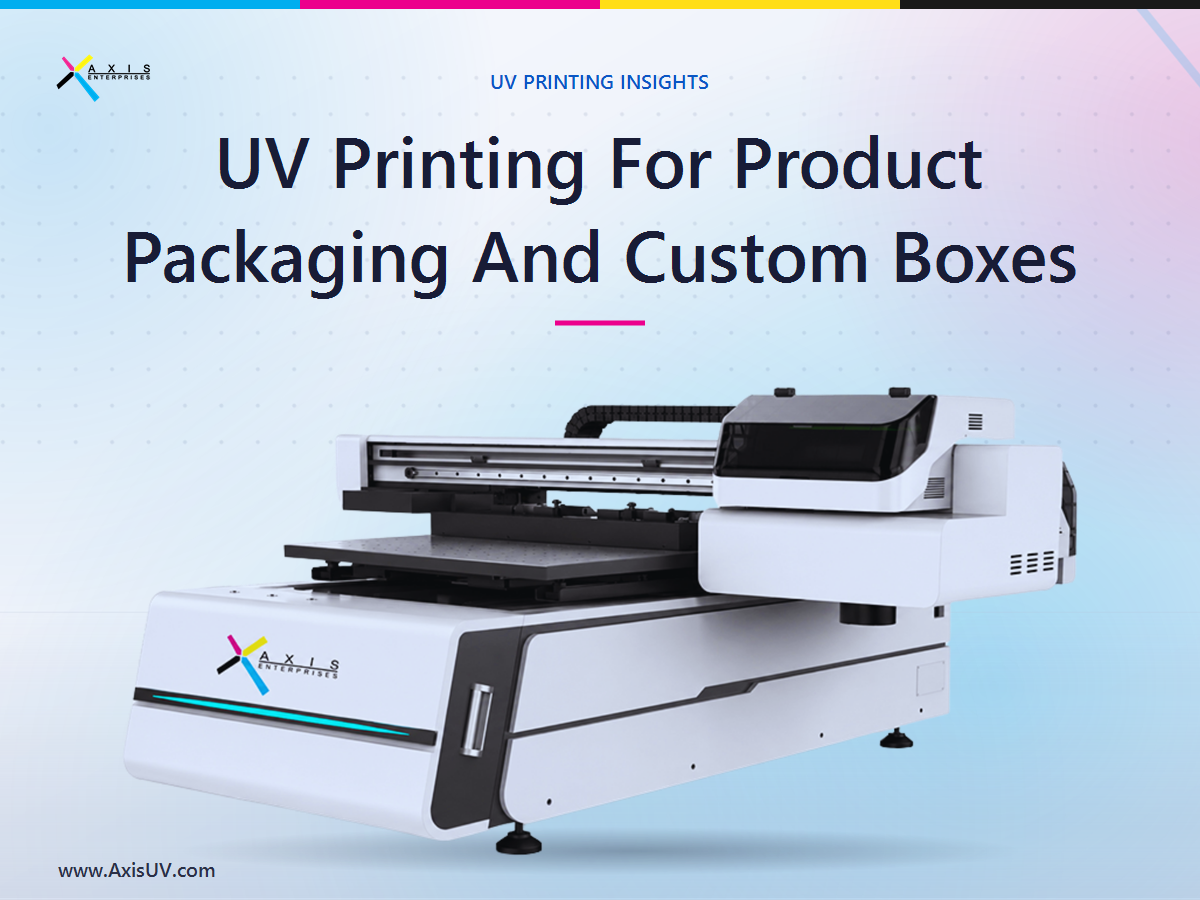
Published: August 8, 2026. Last updated: August 8, 2026.
Quick answer
UV printing lets a business print full color, durable graphics directly onto packaging surfaces (rigid boxes, folding cartons, labels, wood, acrylic, metal, and more) with no printing plates and no minimum order, which is what makes short runs and personalized boxes profitable. For Indian SMBs this matters because e-commerce, product variety, and seasonal launches are pushing demand toward small, fast, customized packaging runs that traditional offset and screen printing cannot serve economically. A UV flatbed or hybrid printer that relies on UV curing to cure ink instantly brings that capability in house, cutting outsourcing cost and turnaround time. The right machine depends on your substrate mix, monthly volume, and total running cost, not the sticker price alone.
Why is packaging suddenly a margin battleground?
Packaging is one of India’s fastest growing manufacturing categories, and demand is tilting toward smaller, more customized runs. According to IBEF (India Brand Equity Foundation), India’s packaging industry was worth about US$84 billion (roughly ₹7,36,092 crore) in 2024 and is projected to reach US$143 billion by 2029, a compound growth rate near 11% a year.
A large slice of that growth is being pulled by online retail. Grand View Research estimates India’s e-commerce packaging market at about US$4.87 billion in 2025, rising toward US$32.7 billion by 2033 at a 26.9% annual pace. Every parcel needs a box, and increasingly that box carries a brand story, not just an address.
The bad news for anyone standing still: the value is moving to short, branded, quick-turn work, and the old economics of long print runs do not fit it.
What is actually changing in how packaging gets printed?
The core shift is from long, uniform runs to short, variable, on-demand runs. Brands now launch more product variants, run more regional and seasonal editions, and expect faster restocks, so the average order size is shrinking while the number of designs is exploding.
Future Market Insights values the digital folding cartons segment at about US$13.3 billion in 2025 and projects US$24.3 billion by 2035, and reports that many packaging plants now see short-run work make up 25% to 40% of jobs by count. That is a structural move, not a fad.
This is where digital methods pull ahead. Traditional offset and screen printing carry heavy setup: plates, screens, make-ready, and minimum quantities. Inkjet-based UV printing has none of that, so a run of 50 boxes can be as viable as a run of 5,000. It also supports variable data printing, meaning each box, label, or carton can carry a different name, code, or design without stopping the machine.
What does this mean for small print shops and product makers?
For an Indian SMB, the packaging shift shows up as three specific pains: lost jobs, thin margins, and slow turnaround. When a customer wants 200 custom gift boxes by Friday, a shop tooled only for long offset runs either says no or outsources at a markup that eats the profit.
Outsourcing is the quiet leak. Every job sent out means paying someone else’s margin, waiting on their queue, and losing control over quality and revisions. For sign shops, promotional-product makers, gift and personalization businesses, packaging converters, and small manufacturers, that adds up across a year.
The other pain is versatility. Packaging today is not only paper. It is corrugated fiberboard, rigid board, plastic, acrylic, wood, and metal. A method that prints on all of them, directly, removes the need for separate processes and separate vendors.
What smart buyers should look for in a UV printer
The smartest buyers stop comparing machines on price and start comparing them on fit, running cost, and reliability. A cheaper machine that cannot handle your substrates or that sits idle for repairs is the expensive one. Judge a UV printer against clear, objective criteria.
- Substrate range: confirm it prints on the surfaces you actually sell, from cartons and labels to acrylic, wood, and metal, ideally with white ink and varnish for premium finishes.
- Print head quality and support: the print head is the heart of the machine; ask which head it uses, its expected life, and how quickly replacements and service arrive in India.
- Running cost per print: factor ink consumption, maintenance, and power, not just purchase price. This is where total cost of ownership decides real profitability.
- Curing system: UV LED curing runs cooler, lasts longer, and uses less power than older mercury lamps, which matters for both energy bills and heat-sensitive packaging.
- Software and workflow: good RIP and color management reduce waste and reprints; variable data support unlocks personalized runs.
- After-sales and warranty: uptime depends on service response, spare-part availability, and a clear annual maintenance plan.
How do the main options compare?
The right route depends on volume, substrate, and how much control you want over turnaround. The table below compares the common paths for packaging and custom-box work.
A better way forward for packaging work
Given everything above, the practical answer for most Indian SMBs is to bring short-run, high-mix packaging printing in house with a UV machine matched to their substrates and volume. That is exactly the decision Axis Enterprises helps owners make. You can explore the range of UV printing machines at uvprinterindia.com and see which configuration fits box, label, and product work.
Because packaging spans so many materials, machine fit is everything. If you are unsure whether a flatbed, a DTF, or a hybrid setup suits your product mix, it helps to compare UV flatbed and hybrid options with the Axis Enterprises team before committing capital. The goal is a machine that pays for itself through in-house jobs you currently send out.
Buyers in India should also plan for tax and landed cost. UV printing machines attract GST (Goods and Services Tax), and registered businesses can typically claim input tax credit, so the real cost is lower than the headline figure. A short conversation about your volumes and materials will size this correctly, and you can request a GST-aware price and specification breakdown for your case.
Why the timing favors owners who act now
The opportunity is large because the buyer base is large. According to the Ministry of MSME (Press Information Bureau), India’s micro, small, and medium enterprises account for about 30.1% of GDP, 35.4% of manufacturing output, and 45.73% of exports, with about 6.5 crore units registered on the Udyam portals. Every one of them ships or sells something that can be packaged and branded.
Material mix also favors in-house digital printing. Fortune Business Insights reports plastic packaging led with roughly a 52% share while paper-based packaging held about 26%, and both are printable on modern UV systems. A single machine can therefore serve a wide swath of local demand.
The window is simple to read: demand is rising, orders are getting smaller and more customized, and the businesses that can print them fast and in house will capture the margin. If you want to size the right machine for your products, you can book a free UV printing machine buying consultation with Axis Enterprises and get a clear, no-pressure recommendation based on your substrates, volumes, and budget.
Frequently asked questions
Can UV printing create short-run promotional packaging?
Yes. UV printing has no plates and no minimum order, so a run of a few dozen boxes is economical. This is its core advantage over offset and screen printing for promotional and seasonal packaging, where designs change often and quantities are small.
Which industries need custom packaging most?
Gifting, cosmetics, food and beverage, electronics, apparel, and any e-commerce seller need custom packaging most, because branded boxes drive perceived value and unboxing experience. Sign shops, promotional-product makers, and personalization businesses serve these buyers and benefit directly from in-house UV printing.
How do I price custom packaging and box jobs?
Price on material cost, ink and running cost per piece, machine time, and a margin for design and finishing, then compare against what outsourcing would cost. Because UV printing removes setup fees, short runs can carry healthy margins that offset shops often decline.
Which packaging products have the highest margins?
Premium and personalized items tend to carry the highest margins: rigid gift boxes, short-run cosmetic and food cartons, branded packaging for limited editions, and custom inserts. These are exactly the jobs that reward fast, flexible, in-house UV printing over long-run outsourcing.
How do I calculate ROI for a packaging printer?
Add up the jobs you currently outsource plus new work you could win, multiply by the margin you keep in house, and compare that monthly figure against the machine cost including ink, maintenance, and GST-adjusted price. Most owners size payback by how many outsourced jobs the machine replaces each month.
Sources
- IBEF (India Brand Equity Foundation): India’s Paper and Packaging Industry
- Grand View Research: India E-commerce Packaging Market Outlook
- Future Market Insights: Digital Printing for Packaging Market
- IMARC Group: India Corrugated Boxes Market
- Fortune Business Insights: India Packaging Market
- Ministry of MSME, Press Information Bureau: MSME Contribution to GDP, Manufacturing, and Exports
- Mordor Intelligence: India Packaging Industry Report