
Published: 29 September 2026 | Last updated: 29 September 2026
Quick answer
Buy a UV flatbed printer if most of your work is flat and rigid: signboards, panels, tiles, ID cards, awards, and product surfaces you can lay on a bed. Buy a UV DTF printer if most of your work is curved, irregular, or shipped as a ready-to-apply transfer: bottles, mugs, pens, phone cases, helmets, and small-batch personalization. A flatbed prints ink directly onto the object. A UV DTF machine prints a peel-and-stick transfer onto film that you apply later, including onto surfaces no flatbed can reach. The right choice is decided by the shape of what you print most often, your order size, and your total running cost, not by the sticker price alone.
What is the real difference between a UV flatbed printer and a UV DTF printer?
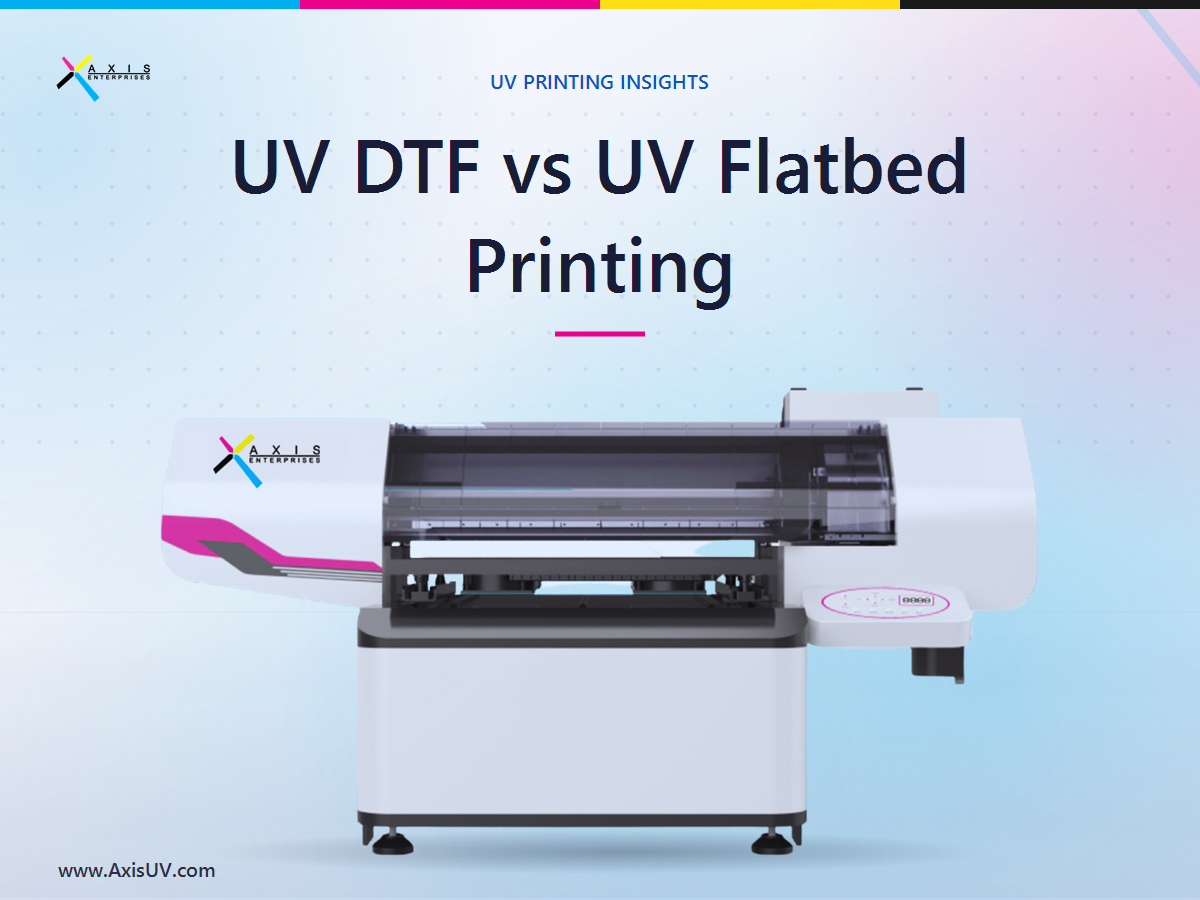
The difference is where the ink lands. A UV flatbed printer jets ink directly onto a rigid object held flat on its bed, then hardens it in place. A UV DTF printer jets the same kind of ink onto a film first, building a transfer you stick onto the product afterward.
Both use ultraviolet-cured ink, so both rely on UV curing, where ultraviolet light hardens the ink the instant it is laid down. Both are forms of inkjet printing, so both print full color plus white and varnish from a digital file with no plates and no screens.
The flatbed wins on flat, thick, and rigid substrates because the object sits still and the print is permanent and dead flat. The UV DTF machine wins on shape: because the design travels as a thin film, it wraps onto curves, edges, and textures a flatbed can never hold down.
Why the machine you pick now will define your margins for years
Print buyers are moving to short runs, personalization, and premium finishes, and the wrong machine locks you out of the fastest-growing work. Demand is real and it is compounding.
India’s digital printing market was valued at USD 1.50 billion in 2025 and is forecast to reach USD 2.94 billion by 2034, a compound annual growth rate of 7.64 percent, according to the IMARC Group India digital printing report. The custom end is growing faster still: Grand View Research values the India custom printing market at USD 2,451.8 million in 2024, rising to USD 4,790.4 million by 2030 at an 11.8 percent annual rate, in its India custom printing outlook.
That growth is buyer-led, and buyers now expect one supplier to decorate many surfaces. A shop that can only print flat sheets keeps turning away curved and personalized jobs. A shop that can only make transfers keeps sending rigid signage elsewhere. Either gap hands margin to a competitor.
What is quietly changing in India’s print market?
Three shifts are reshaping who wins: UV technology is taking share from solvent, flatbed and transfer demand are both rising, and small firms are the ones buying. Understanding these shifts is how you avoid buying yesterday’s machine.
Flatbed printers led the UV printers category with a 45.21 percent share in 2025, and Asia-Pacific was the single largest region at 38.43 percent, per Mordor Intelligence’s UV printers market report. The same report notes that Indian states including Maharashtra and Gujarat have tightened limits on solvent emissions, pushing solvent shops toward UV LED workflows that need no exhaust ducting.
Transfers are the fastest-moving segment. The UV DTF printer market was valued at USD 1.88 billion in 2025 and is projected to reach USD 5.59 billion by 2034, a 12.8 percent annual rate, according to Growth Market Reports. That is roughly double the pace of the wider printing market, and it exists because so many products cannot be printed any other way.
The buyers are small businesses, and there are a lot of them. India’s micro, small, and medium enterprises account for 30.1 percent of GDP, 35.4 percent of manufacturing, and 45.73 percent of exports, Union MSME Minister Jitan Ram Manjhi stated in July 2025, as reported by the Press Information Bureau. For most of these firms, one printer is a genuine capital decision, which is exactly why matching the machine to the work matters so much.
UV flatbed vs UV DTF: side-by-side comparison
Use this table to see, at a glance, which machine suits which kind of work. Neither is better in general. Each is better at a specific job.
How do you decide which UV machine fits your business?
Decide by the shape of your top ten jobs, not by the brochure. List the products you print or want to print most, then sort them into flat-and-rigid versus curved-or-irregular. Whichever pile is bigger points to your first machine.
Weigh your order pattern next. Large flat panels and signage in steady volume favor a flatbed. Many small personalized pieces across odd shapes favor UV DTF, because a transfer reaches surfaces a bed cannot hold.
Then weigh cost properly. Look past the purchase price to the total cost of ownership: ink, film and adhesive for transfers, printhead life, maintenance, power, and floor space over three to five years. Because a printer is capital equipment, factor in your input tax credit under the Goods and Services Tax (India) regime, which lets a registered business offset GST paid on the machine and its consumables.
What smart buyers check before signing a purchase order
Before you commit, verify a short list of things that separate a profitable machine from an expensive mistake. These apply whether you choose flatbed, UV DTF, or both.
- A test print on your own material. Ask the seller to print your actual substrate or product, not a demo sample, and check adhesion and color.
- Printhead type and availability. Confirm the printhead model and that replacements and spares are stocked in India, so a failure does not idle you for weeks.
- White ink and varnish capability. For dark and clear materials, a white underbase and a gloss or matte varnish are what make the print look premium.
- Real running cost per print. Get ink coverage and, for UV DTF, film and adhesive cost per unit, so you can price jobs for profit.
- Local service and response time. Ask how fast an engineer reaches you and whether training is included, because downtime is the hidden cost that kills margins.
- Room to grow. Choose a supplier who sells both flatbed and UV DTF, so you can add the second capability when demand appears instead of switching vendors.
A simpler way to make this decision
Once the checklist is in front of you, the honest answer for many Indian businesses is not one machine or the other, but the right one first and a clear path to the second. That is the conversation worth having before you spend. At Axis Enterprises (uvprinterindia.com), we supply both UV flatbed and UV DTF machines, and we start by looking at your actual product mix rather than pushing a model.
If you are weighing the two, the fastest way to get clarity is to book a free UV printing machine buying consultation and let us map your top jobs to the right technology. You can also send us your product samples for a test print so you see adhesion and finish on your own materials before deciding.
Frequently asked questions
Can one UV printer really print on acrylic, wood, glass, and metal?
Yes. A UV flatbed printer prints on acrylic, wood, glass, metal, tiles, and PVC because the ink is cured by UV light rather than absorbed like water-based ink. Most rigid, flat materials only need the correct profile and, on some surfaces, a primer for adhesion.
Which machine is easier for a beginner to start with?
A UV flatbed is usually simpler to learn because the print is finished the moment it leaves the bed, with no transfer step. UV DTF adds a manual application stage, which is easy but takes practice to do cleanly on curved items. Many owners start with the machine that matches their main product and add the other later.
Can I print on curved products like bottles and phone cases?
For curved and irregular products, UV DTF is the better fit because the design is printed on film and then wrapped onto the shape. A flatbed can decorate slightly contoured items with jigs, but true curves such as round bottles, tumblers, and helmets are where the transfer approach clearly wins.
Is UV printing durable enough for products that get handled?
UV-cured prints resist scratching, water, and fading well because the ink is a hardened polymer bonded to the surface, which is why the technology is used for signage and industrial parts. Durability depends on correct surface preparation, a white underbase where needed, and a protective varnish. Ask for a scratch and adhesion test on your own material.
Do I need both machines to run a profitable print business?
No. Most businesses start with one machine matched to their dominant work and stay profitable on it for a long time. Adding the second technology makes sense only when you are regularly turning away jobs the first machine cannot do, at which point it becomes a growth investment rather than a cost. If you want a second opinion on which one comes first, you can compare UV flatbed and UV DTF machines with our specialists.
Next step
Choosing between UV DTF and UV flatbed is really a question about your products, your order sizes, and your running costs, and it is worth getting right before you invest. If you would like a straight answer matched to your business rather than a sales pitch, request a free UV printing machine buying consultation, bring your top jobs and a few sample products, and we will help you decide which machine earns its keep first and when the second one is worth adding.
Sources
- IMARC Group, India Digital Printing Market Size and Growth 2025 to 2034
- Grand View Research, India Custom Printing Market Size and Outlook 2025 to 2030
- Growth Market Reports, UV DTF Printer Market Size, Share and Growth to 2034
- Mordor Intelligence, UV Printers Market Size, Share and Growth Trends
- Press Information Bureau, Government of India, MSME contribution to GDP, manufacturing and exports (July 2025)