
Published: September 30, 2026. Last updated: September 30, 2026.
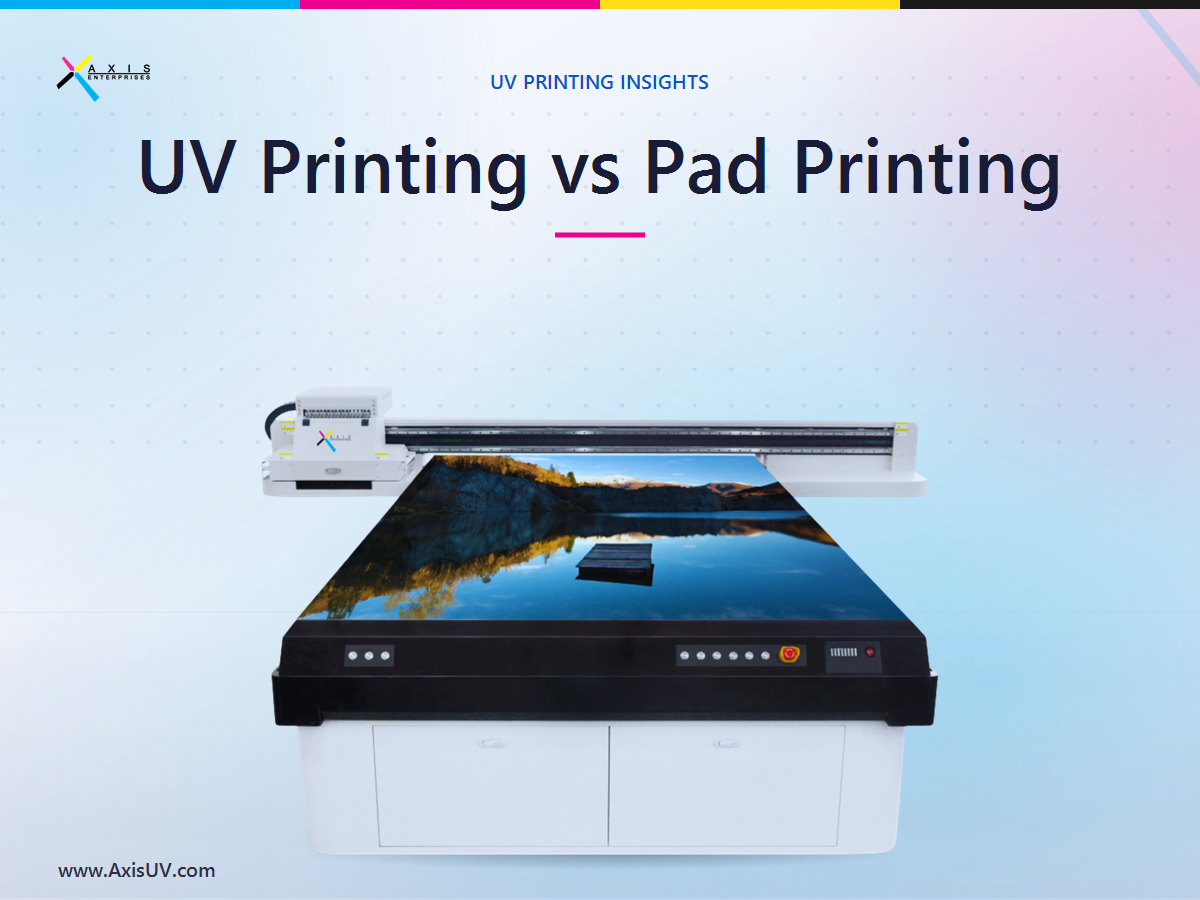
Quick answer: Pad printing and UV printing solve different problems, and choosing wrongly quietly caps your margins for years. Pad printing is an indirect process built for a single color on deeply curved or tiny objects, such as pens and golf balls. UV printing is a digital, non-contact process that lays full color, white ink, varnish and texture onto flat and gently contoured rigid materials in one pass, with no plates and no minimum order. For most Indian print and product businesses expanding into personalization, packaging, signage and premium branding, a UV flatbed printer covers far more paying work per machine, while pad printing stays useful only for a narrow set of deep three dimensional parts. Match the tool to the objects you actually sell, not to the machine you already own.
What is the real difference between UV printing and pad printing?
The core difference is contact and color. Pad printing is an indirect offset process: ink is picked up from an etched plate by a soft silicone pad and pressed onto the object, usually one color per pass. UV printing is a digital process where fine ink droplets are jetted onto the surface and cured instantly by ultraviolet light, building full color plus special layers in a single run.
Pad printing earns its place on shapes that nothing else can reach. As the reference on pad printing explains, the silicone pad wraps around complex geometry, so it prints on concave surfaces, spheres and awkward corners where a flat print head cannot go.
UV printing wins on versatility and finish. Because it is a form of inkjet printing, it deposits a photographic full color image, a white underbase for dark materials, a raised varnish or a tactile texture without changing plates, and it does this on acrylic, wood, glass, metal, leather and more.
Why are most small print shops quietly losing margin?
Most shops lose margin because they keep buying single purpose machines for a multi product world. The demand is moving toward short runs, personalization and premium finishes, and single color processes cannot capture that value.
The market data makes the shift concrete. According to IMARC Group, the India digital printing market is valued at USD 1.50 billion in 2025 and is projected to reach USD 2.94 billion by 2034, a compound annual growth rate of 7.64 percent. That is the direction customer orders are already flowing.
The incumbent technology is growing far more slowly. Future Market Insights reports the global pad printing machine market at roughly USD 1.3 billion, growing at a 4.8 percent CAGR through 2036 to about USD 2.1 billion. A tool that grows at 4.8 percent while its digital alternative grows at 7.64 percent is telling you where the new revenue is not.
Underneath that, ink chemistry is voting for UV. Mordor Intelligence values the UV cured printing inks market at USD 1.88 billion in 2026, rising to USD 2.65 billion by 2031 at a 7.17 percent CAGR. Faster ink growth signals rising installed capacity and falling consumable risk for buyers who commit now.
What does this mean for Indian print and product businesses?
For an Indian owner, the pressure is specific: more competitors, thinner single color jobs and customers who now expect full color personalization on demand. The formal small business base you compete inside is enormous, so differentiation matters more than price.
The scale is documented. The Ministry of Micro, Small and Medium Enterprises reported that over 7.83 crore enterprises had registered on the Udyam and Udyam Assist portals as of 28 February 2026. That is the crowded field an undifferentiated print shop is competing in, and a single color pad setup offers almost no visible differentiation to a buyer.
Hardware alone is not the full picture either. IMARC Group puts the broader India printer market at USD 1.78 billion in 2025, growing at a slower 4.32 percent CAGR to 2034, which means commodity printing is maturing while the value is migrating to specialized, full color and finished output. The margin sits in what you can print that others cannot.
Tax treatment reinforces the case for a capital machine. A UV flatbed printer bought for business use is a capital asset, and under the Goods and Services Tax (India) framework, input tax credit on eligible business purchases can be set against output liability, which changes the true landed cost of the equipment. Owners should confirm eligibility with their accountant before buying.
How do the two technologies actually work?
Understanding the mechanics explains the cost and the limits of each. It also stops buyers from paying for capability they will never use.
Pad printing: indirect, plate based, one color at a time
Pad printing transfers ink from an etched plate (cliché) to the product through a silicone pad. Each color needs its own plate and pass, so setup time and cost rise steeply with color count, and photographic images are impractical. Its strength is geometry: deep curves, small parts and uneven surfaces.
UV printing: digital, plateless, full color in one pass
UV printing jets cyan, magenta, yellow, black, white and varnish and then cures each layer with ultraviolet light almost instantly. The UV curing reaction is a low temperature, solventless process, so prints are handle ready at once and there is no drying rack. No plates means no per color setup, which is why short runs and one off personalization become profitable rather than painful.
UV printing vs pad printing at a glance
What should a smart buyer look for before choosing?
Choose by the objects and orders you actually take, not by the lowest sticker price. The right questions reframe the decision away from machine cost and toward revenue per machine.
- Job profile first: list your top twenty products and note how many are flat or gently curved versus deeply three dimensional. If most are flat or rigid, a UV flatbed captures more of them.
- Color and finish demand: if customers ask for full color, photos, logos with gradients, white ink on dark items or premium varnish, a single color process cannot quote that work at all.
- Run length: if you handle short runs, samples and personalization, plateless printing removes the setup cost that makes small jobs unprofitable.
- Total cost of ownership: weigh ink, maintenance, consumables and the input tax credit position, not just purchase price, and think in Indian Rupees of landed cost.
- Service and support: confirm local spare parts, response time and operator training, because uptime decides real output.
- Room to grow: favor a machine that opens new applications every quarter, so one purchase keeps paying back as you add markets.
A better way forward
Given everything above, the honest recommendation is to match the tool to the work. Pad printing remains the right answer for a narrow set of deeply curved or miniature parts, and it is worth keeping for those specific jobs. For the full color, multi material, personalized and premium finished work that is actually growing, a UV flatbed printer is the machine that earns its keep across the widest range of orders. This is the decision Axis Enterprises helps owners get right, so you buy for the next five years of orders rather than the last five.
If you are weighing the two, start by mapping your product mix and your margins, then talk it through with someone who sells the machine every day. You can book a free UV printing machine buying consultation and get a straight answer on whether a flatbed fits your work. Our team can also walk you through the right UV flatbed configuration for your materials and help you compare running costs and ROI against your current outsourcing or pad printing spend. Before you commit, it is worth requesting a sample print on your own product so you can judge quality on the exact surfaces you sell.
You do not need to replace anything today. The next step is small and low risk: bring your real product samples, see them printed in full color, and decide with evidence in front of you. Reach out through uvprinterindia.com to arrange a no pressure consultation and a live sample, and let the print quality make the case for you.
Frequently asked questions
Can UV printing do everything pad printing does?
No, and any honest supplier will say so. UV flatbed printing covers flat and gently contoured rigid surfaces with full color, white ink and varnish, while pad printing still handles deeply concave shapes, spheres and very small objects better. For most product ranges the flatbed covers the majority of jobs, with pad printing kept for the few deep three dimensional parts.
Is UV printing more expensive to run than pad printing?
It depends on the job, not the machine. Pad printing looks cheap per single color pass but adds plate and setup cost for every color and every design change, which makes short and personalized runs costly. UV printing removes plate and setup cost, so full color and short run work is usually cheaper per finished piece, and buyers should compare total cost of ownership in Indian Rupees rather than headline price.
Can one UV flatbed printer print on curved or three dimensional objects?
Partly. A UV flatbed handles flat items and gently curved or raised surfaces within its head clearance, and cylindrical attachments extend it to some round products. For deep curves, concave interiors and tiny parts, pad printing remains the more suitable process, so the two technologies often complement rather than replace each other.
Which process is better for printing on pens, bottles and industrial parts?
It splits by shape. Thin cylindrical items like pens are classic pad printing territory, while bottles and flat or lightly curved industrial panels are well suited to UV printing, especially when full color, logos or variable data are needed. The deciding factor is the geometry of the specific object and whether the customer wants full color.
Do I need to scrap my pad printing setup to move to UV printing?
No. Many shops run both, using UV flatbed printing to win the growing full color and personalization work and keeping pad printing for the deep three dimensional jobs it does best. The practical path is to add UV capability where your order book is expanding and retire single purpose equipment only when its jobs dry up.
Sources
- IMARC Group, India Digital Printing Market Report (size, forecast and CAGR)
- IMARC Group, India Printer Market Report (size, forecast and CAGR)
- Future Market Insights, Pad Printing Machine Market (size, forecast and CAGR)
- Mordor Intelligence, UV Cured Printing Inks Market (size, forecast and CAGR)
- Press Information Bureau, Ministry of Micro, Small and Medium Enterprises (Udyam registration figure)
- Wikipedia, Pad printing
- Wikipedia, UV curing
- Wikipedia, Inkjet printing
- Wikipedia, Goods and Services Tax (India)