
Published: July 25, 2026
Quick answer
Safety signage is one of the most dependable, repeat-order categories in print, because factories, warehouses, hospitals, construction sites, and public buildings are legally required to display and periodically replace hazard, fire, and evacuation signs. A UV printing machine lets you produce these signs in-house on rigid, weather-resistant substrates (acrylic, aluminium composite, PVC, polycarbonate, and metal) with scratch and fade resistance that ordinary vinyl stickers rarely match. That means faster turnaround, higher margins, and recurring compliance contracts instead of one-time jobs. For an Indian print or signage business, bringing safety-sign production in-house is often the difference between chasing orders and owning a steady revenue line.
How big is the signage opportunity, and why does it keep growing?
The printed signage market is large and steady, and the outdoor segment is growing fast. According to Mordor Intelligence, the global printed signage market is worth about USD 43.63 billion in 2026 and is projected to reach USD 49.58 billion by 2031. The outdoor printed signage segment, tracked separately by Mordor Intelligence, is estimated at USD 34.65 billion in 2025 and is forecast to grow at 10.5% a year to USD 57.09 billion by 2030.
Indian demand is climbing in parallel. Grand View Research values the India signage market at USD 889.4 million in 2024, heading toward USD 1.6 billion by 2030 at a 10.4% compound annual growth rate. Safety signage sits inside this expanding demand, and it is one of the least discretionary parts of it.
Why is safety signage a reliable order rather than a one-time job?
Because it is driven by law and by risk, not by fashion or budgets. The International Labour Organization estimates that nearly 3 million workers die from work-related accidents and diseases every year, including about 330,000 deaths from workplace accidents, while 395 million workers sustain non-fatal injuries. The ILO also reports that the Asia and Pacific region accounts for about 63% of global work-related mortality, which keeps regulatory pressure high across Indian factories and worksites.
Every hazard, electrical, fire-exit, and evacuation sign has to stay legible and correct, so faded or damaged signs are replaced on a schedule. International standards such as ISO 7010, maintained by the International Organization for Standardization, define more than 200 registered safety symbols. That means signs must be reprinted accurately, in consistent colours and shapes, again and again. Recurring replacement is exactly what makes this category valuable.
Where do small print and signage businesses lose this margin?
Most lose it to outsourcing and to the wrong production method. When a factory, hospital, or builder asks for a batch of durable hazard signs, a shop without in-house rigid-substrate printing sends the job to a vendor. That adds days, shaves the margin, and slowly hands the client relationship to whoever actually prints the work.
The other leak is method. Vinyl-sticker approaches peel, curl, and fade outdoors, which triggers complaints, free replacements, and lost trust. A recurring, compliance-driven order then turns into a low-margin, one-time headache. The businesses that keep the margin are the ones that can print durable signs themselves, on demand, in single pieces or in bulk.
What makes UV printing the right tool for compliance signage?
UV printing cures ink instantly using ultraviolet light, so the ink bonds to hard, non-porous surfaces that ordinary printing struggles with. In simple terms, UV curing flashes liquid ink into a solid film the moment it lands, rather than letting it soak or air-dry. Because it uses drop-on-demand inkjet printing heads, a single machine can print full colour, white, and varnish in one pass.
For safety and compliance work, that translates into practical advantages:
- Substrate range: prints directly on acrylic, aluminium composite panel, PVC, polycarbonate, and metal, the materials real safety signs are made from.
- Durability: cured UV ink resists scratching, chemicals, and fading, so signs survive indoor and outdoor use.
- High-contrast colour: white ink and layered builds hold the bold, standardised colours that hazard and mandatory signs require.
- No minimum order: a single custom sign is economical, so odd sizes and site-specific warnings are profitable.
- Speed: instant curing means same-day production and dispatch for urgent compliance requests.
What should a smart buyer look for in a UV printer for signage?
Look past the headline price to the features that decide daily output and running cost. A machine that is cheap to buy but slow, unsupported, or limited in materials will cost far more over its life. Use this checklist:
- Substrate range and bed size: confirm it prints on rigid boards at the thicknesses your clients use.
- Print head quality and white ink: essential for opaque, high-contrast safety colours.
- Curing system: LED UV curing runs cooler, uses less power, and lasts longer than older lamp systems.
- Adhesion and primer support: important for metal, glass, and coated panels used in industrial signage.
- Colour management and RIP software: needed to reproduce standardised safety colours consistently.
- Local after-sales support and spare parts: the single biggest driver of uptime.
- Total cost of ownership: weigh ink, maintenance, and uptime, not just the purchase price. See the concept of total cost of ownership.
UV printing compared with common signage methods
A better way to own the safety-signage market
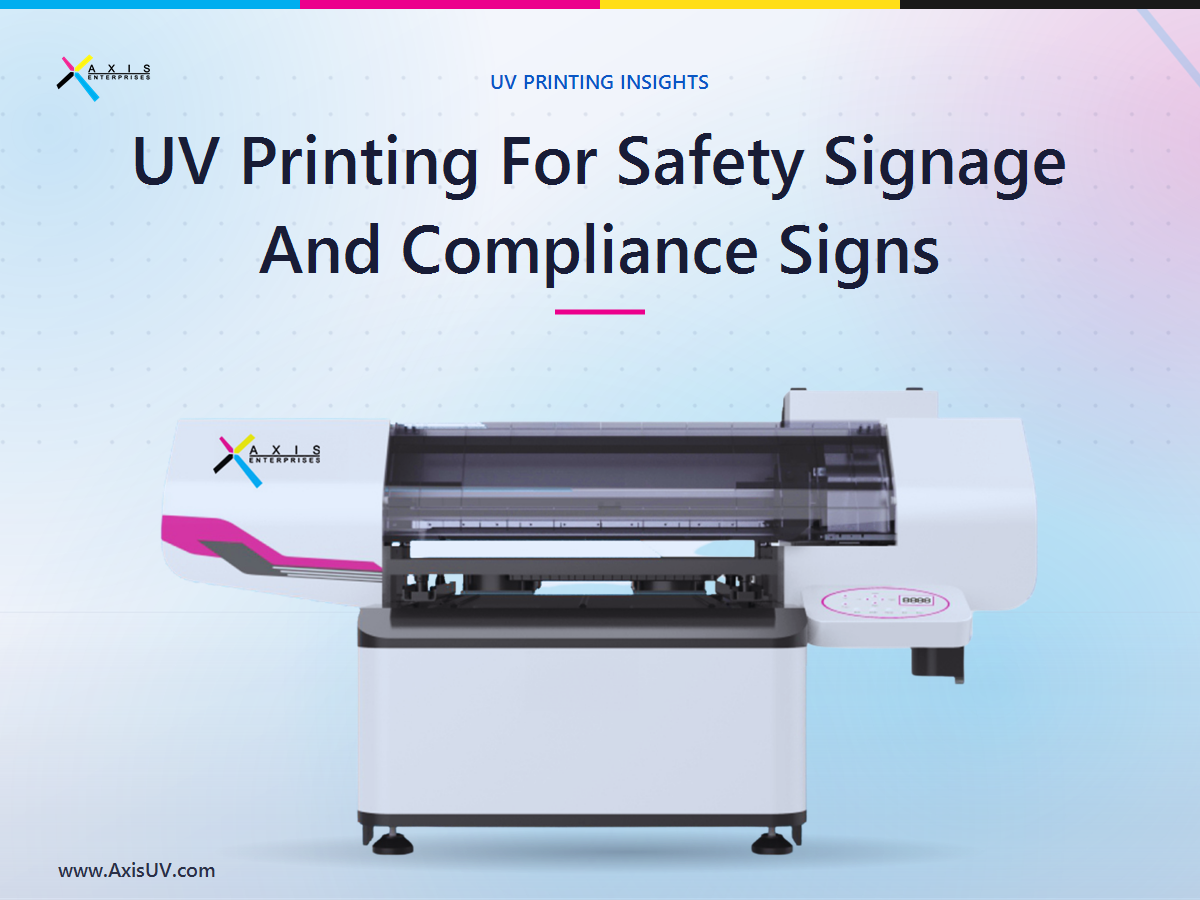
Given everything above, the businesses that win compliance work are the ones that print it themselves, quickly, durably, and in any quantity. That is the exact job a flatbed UV printing machine is built for. At Axis Enterprises, we build UV printing machines for signage, industrial, and product-customisation work, and you can explore UV printing machines built for signage production on our site.
If you are weighing your first machine, it helps to see the models side by side and match one to the substrates your clients actually order. You can compare UV flatbed and hybrid options and talk to the Axis Enterprises team about bed size, white ink, and after-sales support in your city. For GST-registered buyers, an in-house machine is usually eligible for input tax credit under the Goods and Services Tax (India) framework, which lowers the effective cost of bringing production in-house.
Next step
If safety and compliance signage is a demand you keep sending to vendors, that is recurring revenue leaving your business every month. The simplest way to test whether a UV printer fits your order mix is a short, no-pressure conversation about your materials, volumes, and budget. You can book a free UV Printing Machine Buying Consultation and get a straight answer on the right machine for your work.
Frequently asked questions
Which industries buy safety signage every year?
Manufacturing plants, warehouses, construction and infrastructure sites, hospitals, schools, hotels, malls, and public buildings all need safety signage on an ongoing basis. Because signs must stay legible and compliant, these buyers replace worn signs regularly, which makes safety signage a recurring order rather than a one-time sale.
How durable are UV-printed safety signs?
UV-printed signs are highly durable because the ink is cured into a solid, bonded film that resists scratching, cleaning chemicals, and sunlight. On rigid substrates such as aluminium composite panel and polycarbonate, they hold up well outdoors and in industrial environments, which is why they often outlast vinyl stickers.
Which materials work best for safety signage?
Acrylic, aluminium composite panel, PVC, polycarbonate, and metal are the most common. UV printing bonds directly to all of these, so you can match the substrate to the location, for example rigid metal or composite panels for factory floors and outdoor gates, and acrylic for indoor and reception areas.
Can a UV printer replace stickers and reflective labels for signs?
For most rigid safety signs, yes. UV printing lets you print directly onto the sign board itself instead of printing a sticker and applying it, which removes a peeling failure point and speeds up production. Highly specialised retroreflective road signs remain a separate category, but the bulk of workplace and building safety signage can be produced directly on the substrate.
Which certifications and standards matter for safety signage?
The key reference is ISO 7010, maintained by the International Organization for Standardization, which defines standardised safety symbols, colours, and shapes so signs mean the same thing everywhere. Producing signs that follow these standardised symbols and colours accurately is what makes your output usable for compliance, and good colour management on a UV printer supports that consistency.
Sources
- Mordor Intelligence, Printed Signage Market
- Mordor Intelligence, Outdoor Printed Signage Market
- Grand View Research, India Digital Signage Market Outlook
- International Labour Organization, Work-related accidents and diseases estimates
- Market.us, Ultraviolet Curable Inks Market
- International Organization for Standardization, ISO 7010 Safety Signs
- Ministry of MSME (Press Information Bureau), Year End Review 2024